Disclaimer: Information found on CryptoreNews is those of writers quoted. It does not represent the opinions of CryptoreNews on whether to sell, buy or hold any investments. You are advised to conduct your own research before making any investment decisions. Use provided information at your own risk.
CryptoreNews covers fintech, blockchain and Bitcoin bringing you the latest crypto news and analyses on the future of money.

A cautious Bitcoin market transitions from trading activities to a focus on holding assets.

Grasping the complexities of Bitcoin balances on cryptocurrency exchanges is essential for market analysis. These balances, characterized by inflows and outflows, serve as indicators of the market’s vitality, sentiment, and possible future trends. As these balances fluctuate, they illustrate investor behavior, confidence, and strategies. Likewise, changes in volume provide valuable insights into the market’s liquidity and trading dynamics.
Examining the deposit and withdrawal volumes for September reveals a persistent trend of Bitcoin withdrawals exceeding deposits. This is not a temporary phenomenon; since the start of 2023, withdrawals have consistently outstripped deposits, indicating a broader market narrative.
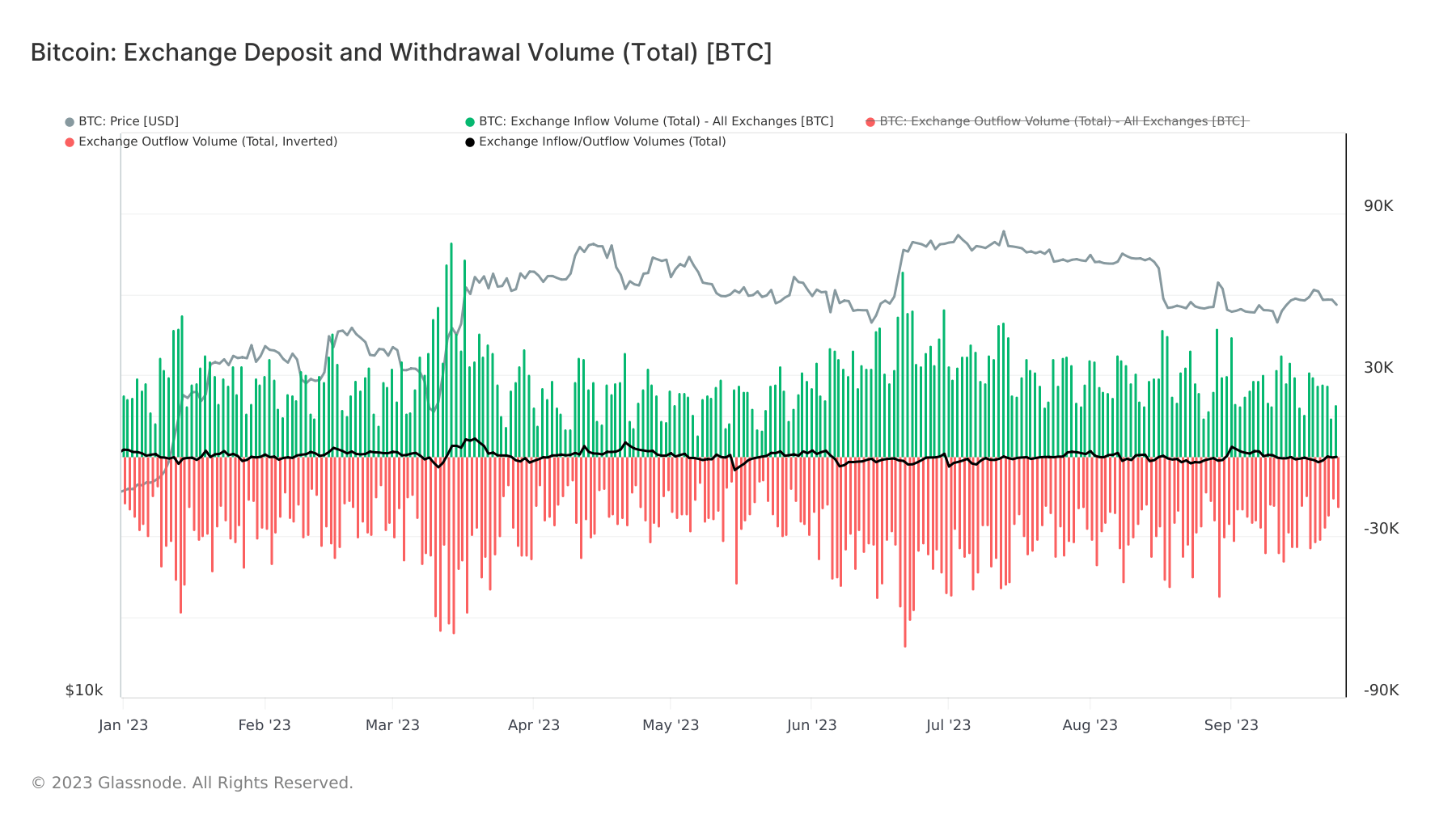 Graph depicting Bitcoin’s exchange deposit and withdrawal volume in 2023 (Source: Glassnode)
The ongoing decline in Bitcoin balances on exchanges further substantiates this trend. Exchange balances reached a high of 3.21 million BTC in March 2020. However, in the following months and years, this figure has significantly decreased, now standing at 2.29 million BTC as of Sept. 25, 2023. Despite occasional periods of positive inflows, the prevailing trend has been downward.
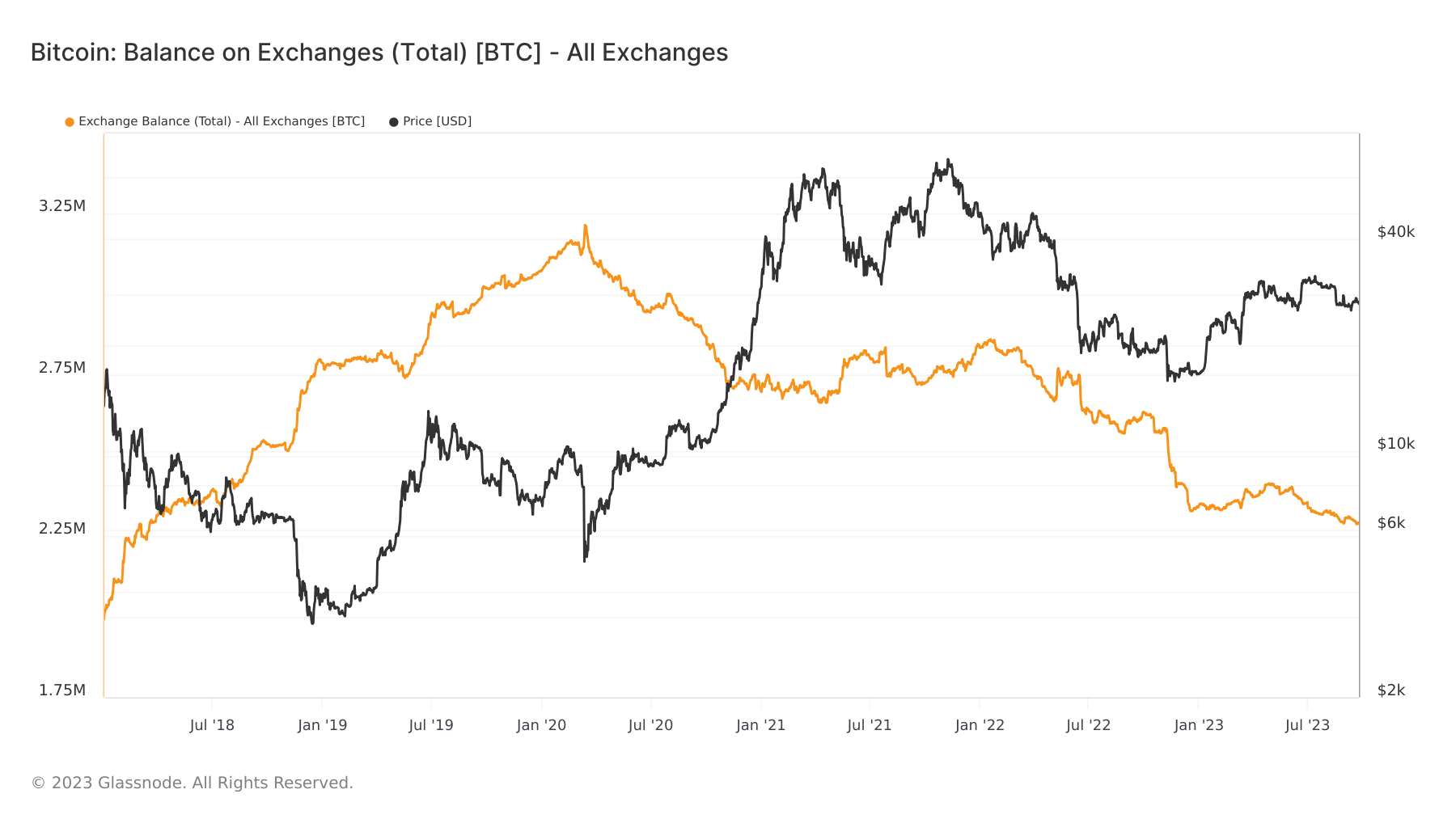 Graph illustrating the balance of Bitcoin on all exchanges from January 2018 to September 2023 (Source: Glassnode)
Since the beginning of September, exchanges have experienced a decline of over 17,000 BTC in their Bitcoin balances.
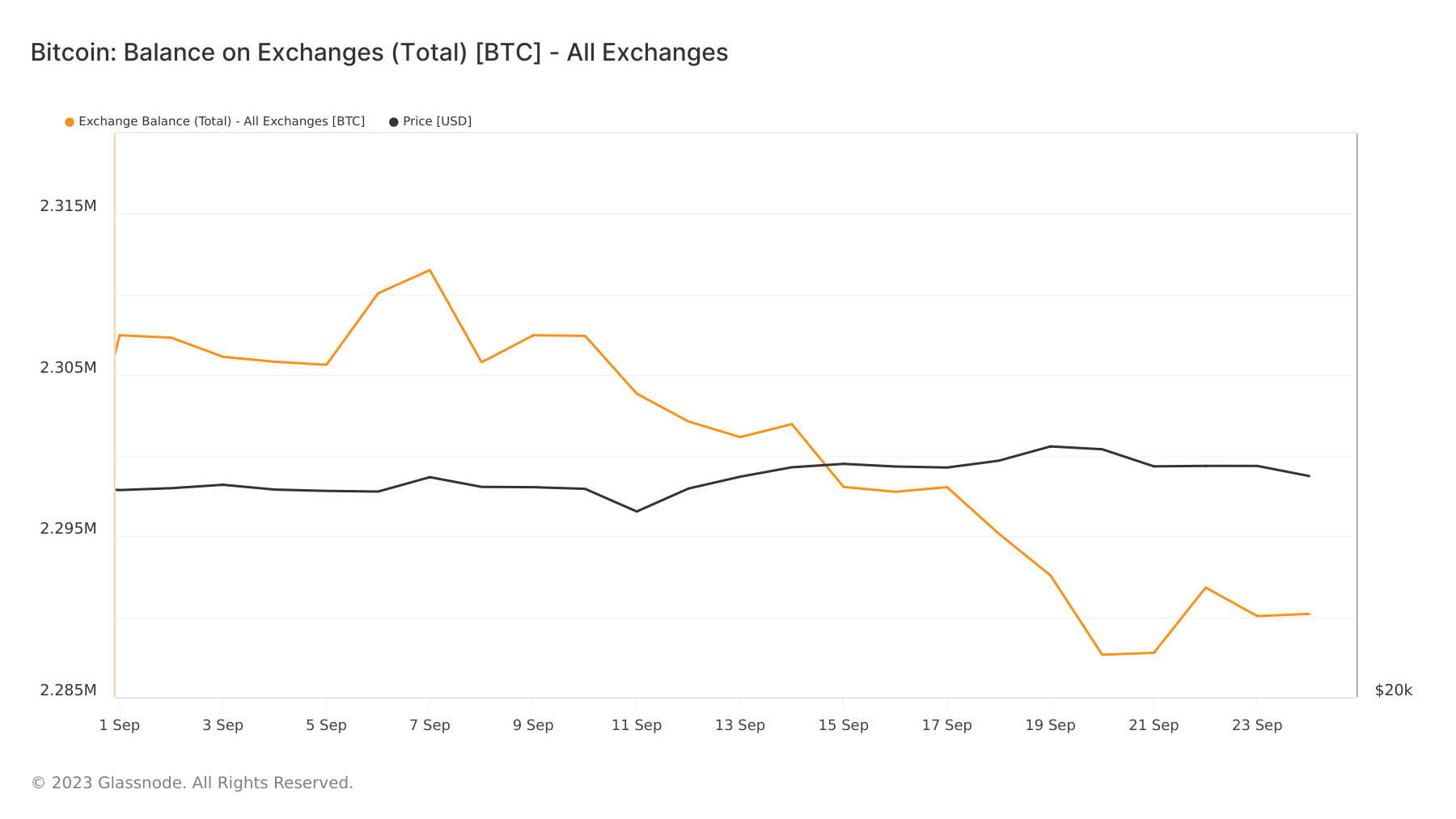 Graph showing the balance of Bitcoin on all exchanges in September 2023 (Source: Glassnode)
Related Posts
The prevalence of withdrawals over deposits may indicate a market shift towards a long-term holding approach, driven either by a strategic anticipation of future gains or as a safeguard against market fluctuations.
The momentum of exchange volume further reinforces this trend. This metric, which compares the monthly average of total inflows and outflows against the yearly average, serves as a reliable gauge of investor interest in Bitcoin. A monthly average that exceeds the annual average typically indicates an increase in exchange-related on-chain activity, often coinciding with price rises.
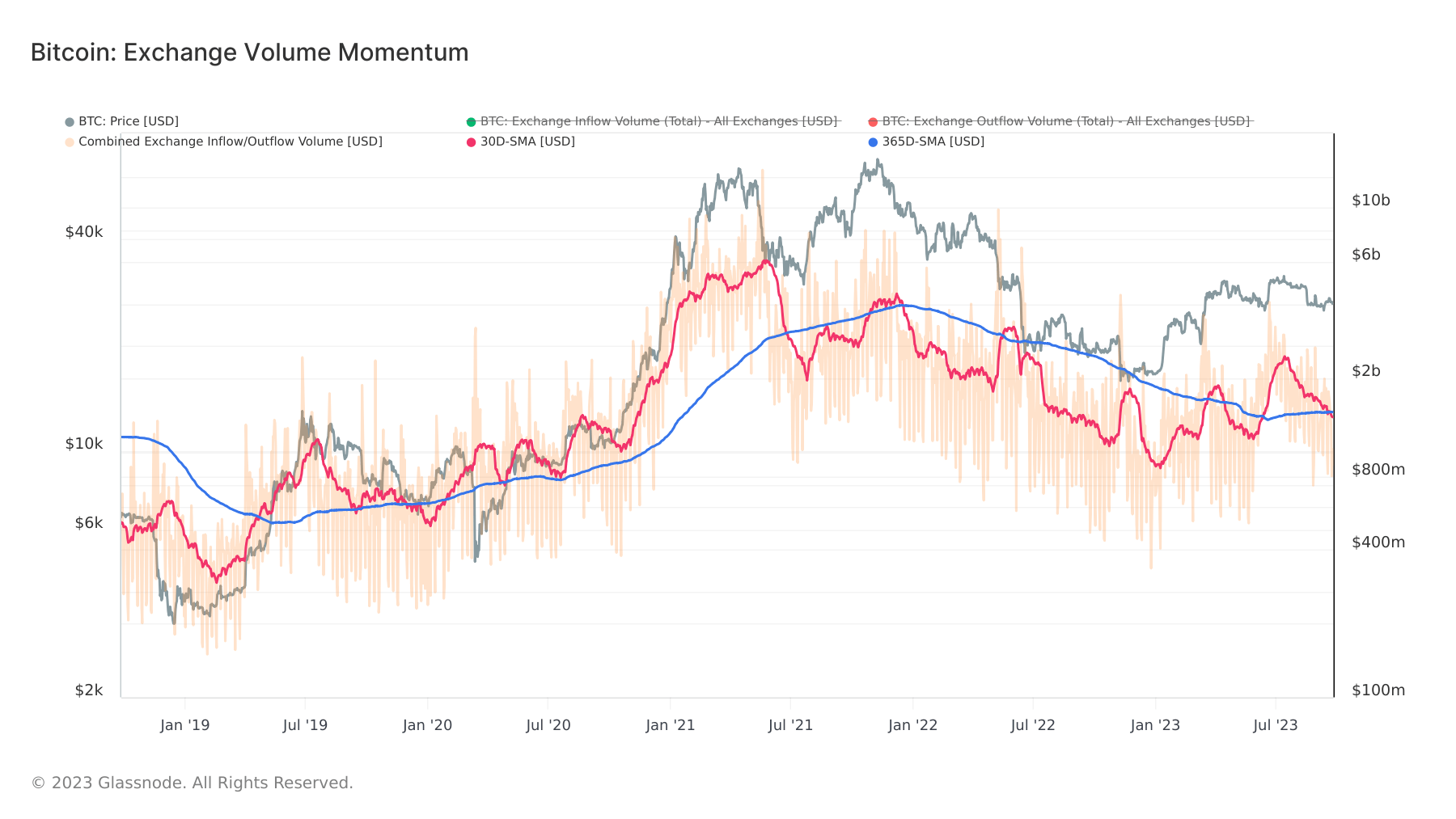 Graph showing the exchange volume momentum from September 2018 to September 2023 (Source: Glassnode)
On the other hand, when the monthly average falls short of the yearly average, it suggests a reduction in exchange-related on-chain activity. This decline is indicative of diminishing interest in the asset and a decrease in trading volumes. According to Glassnode, the monthly average has been on a downward trajectory since July, ultimately dropping below the yearly average on Sep. 21. This decline coincided with Bitcoin’s price decrease from $27,225 to $26,220.
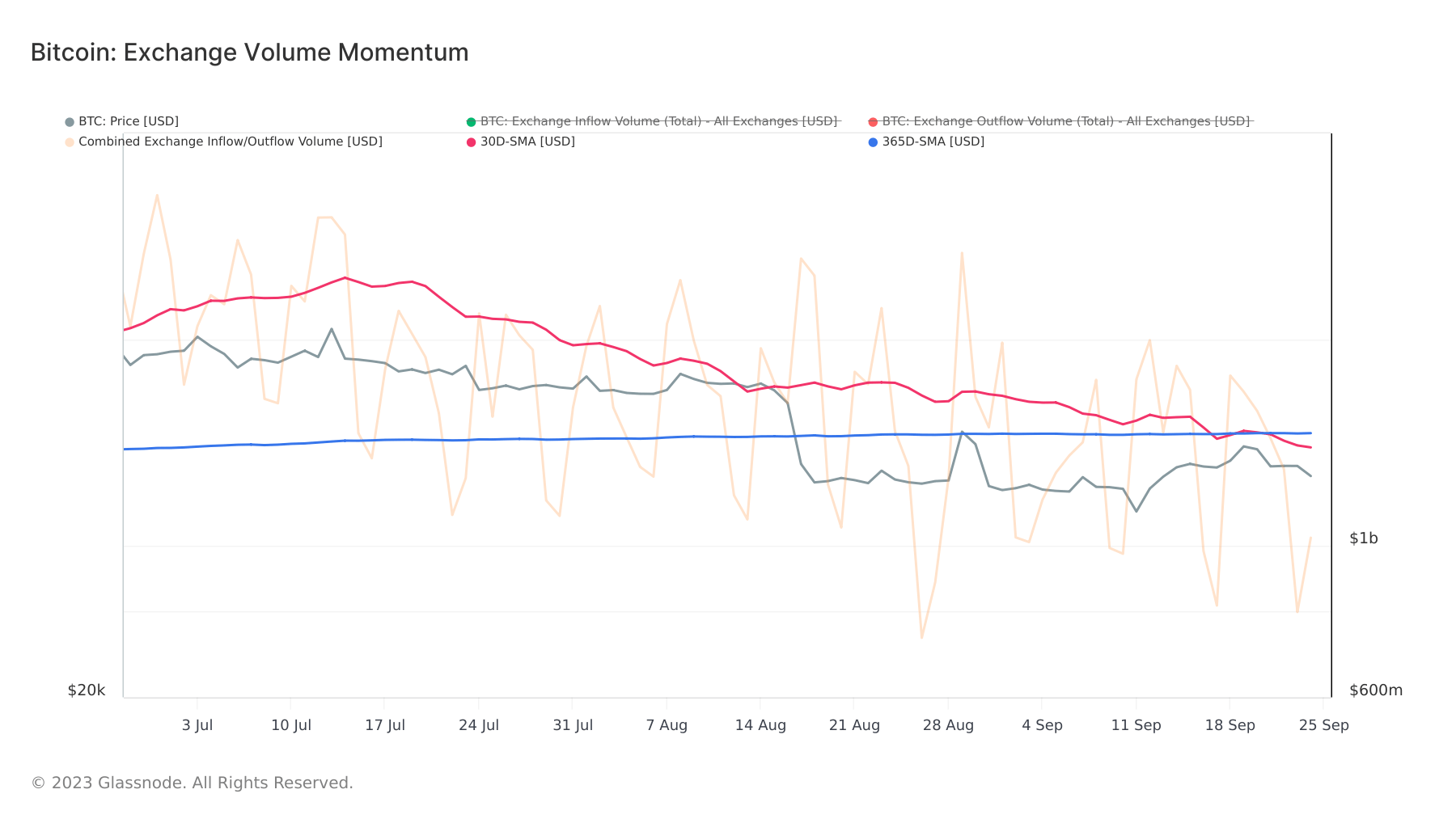 Graph illustrating the exchange volume momentum from June 28 to Sep. 25, 2023. The red line represents the monthly average, while the blue line represents the yearly average. (Source: Glassnode)
The predominance of withdrawals and the falling exchange volume momentum suggest a market that is becoming increasingly cautious. Investors appear to be transitioning from a trading approach to a holding strategy, possibly in anticipation of future gains or simply as a hedge against uncertainty. The recent decline in Bitcoin’s price, along with the drop in the monthly average, underscores the potential influence these metrics can exert on market dynamics.
The post A cautious Bitcoin market is shifting from trading to holding appeared first on CryptoSlate.
