Disclaimer: Information found on CryptoreNews is those of writers quoted. It does not represent the opinions of CryptoreNews on whether to sell, buy or hold any investments. You are advised to conduct your own research before making any investment decisions. Use provided information at your own risk.
CryptoreNews covers fintech, blockchain and Bitcoin bringing you the latest crypto news and analyses on the future of money.

Bitcoin’s recovery to $80,000 appears to be a temporary trend influenced by Asia’s AI market activity.

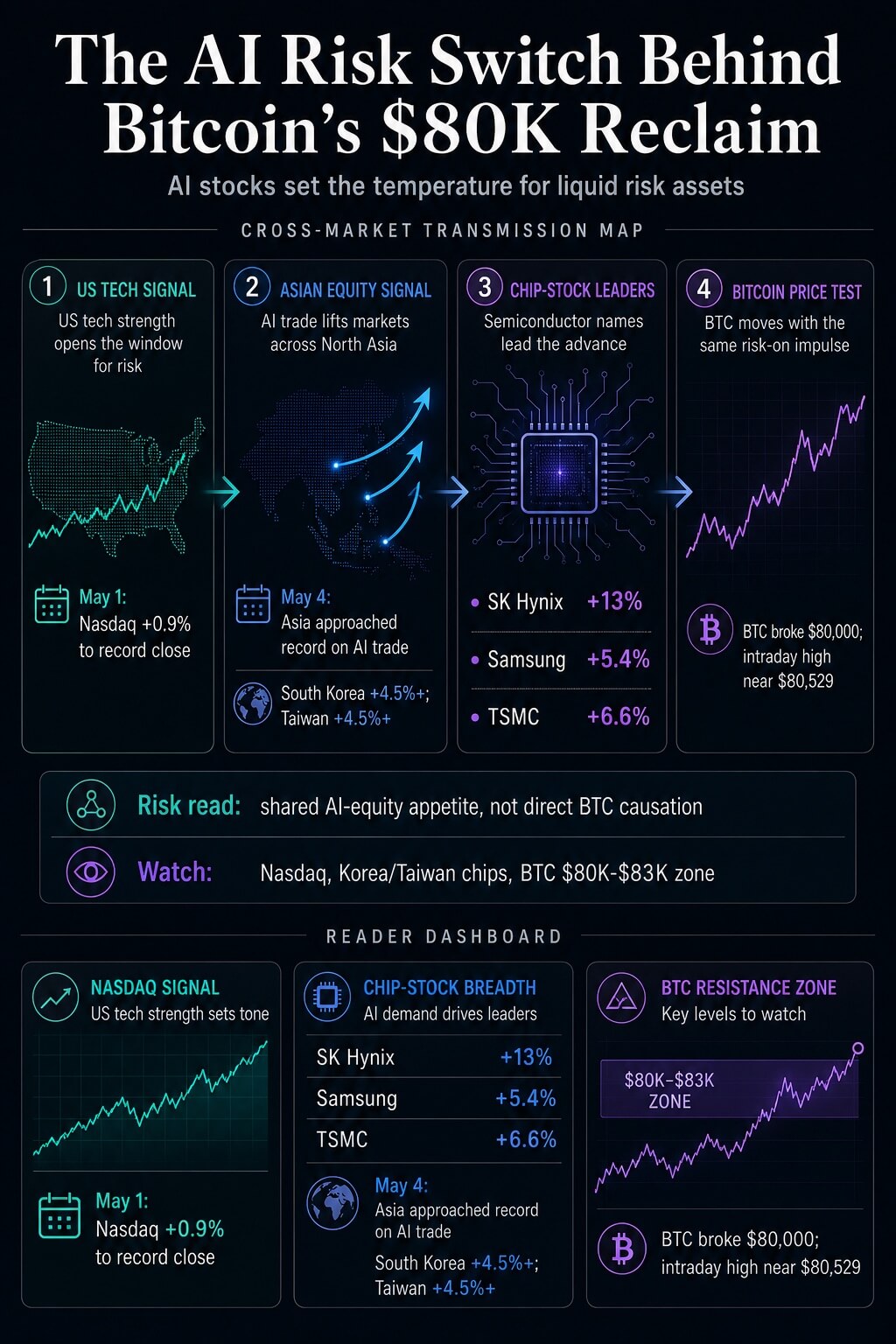
On May 4, Bitcoin regained the $80,000 mark, coinciding with Asian equities nearing record highs driven by the AI sector, particularly with Korea and Taiwan leading the surge, while Nasdaq 100 futures also indicated upward movement.
This timing presents a challenge for typical investors. Bitcoin’s reactions vary at different times to similar market shifts, influencing chip stocks, technology indices, spot ETF movements, and Strategy stock.
At the beginning of the week, we characterized the $80,000 range as a test between relief and recovery, while MEXC identified the next market-color levels in the low-$80,000s, including the 200-day moving average near $82,000 and ETF cost-basis references around $83,000.
The most significant indication came from outside the cryptocurrency sector. Stocks not only rose alongside Bitcoin but were also led by the same companies and markets that have become synonymous with AI risk appetite.
 Related Reading
Bitcoin is surging when oil goes up but only when the US stock market is closed
Bitcoin increased alongside crude oil while US markets were closed, then reversed as the S&P 500 declined, creating a conflict between flows, oil, and Federal Reserve risks. Apr 29, 2026 · Liam 'Akiba' Wright
The rally started outside crypto
The Asian trading session provided Bitcoin with context beyond Bitcoin ETFs, regulatory changes, geopolitical risks, and on-chain dynamics. Stocks approached record levels due to the AI trade, with South Korean and Taiwanese indices rising over 4.5%.
During the rally, the Kospi reached an all-time high above 6,900, with SK Hynix surging 13%, Samsung increasing by 5.4%, TSMC rising 6.6%, and the Taiex advancing 4.6%.
This equity momentum was already underway before Bitcoin surpassed the significant level.
Last week, enthusiasm for chips and AI propelled South Korea and Taiwan to record highs, while energy and geopolitical concerns impacted other areas of the region.
Today’s movement extended that disparity.
The US transition also supports a risk-on interpretation. The Nasdaq composite increased by 0.9% to a record close on May 1, while the S&P 500 also added to its record.
Asian technology stocks then rallied following these US tech gains to commence the new week. Bitcoin’s ascent to $80,000 was part of that same sequence: US tech strength, Asian chip strength, followed by renewed interest in liquid risk assets.
The earnings backdrop clarifies why this was an AI trade rather than a general equity rebound.
TSMC announced first-quarter revenue of NT$1.134 trillion and a net income increase of 58.3% year over year. SK Hynix reported record quarterly performance driven by AI demand.
Samsung indicated that memory sales were bolstered by high-value AI demand and anticipated that demand would remain robust as AI infrastructure expands.
 Related Reading
Bitcoin is now trading like an AI stock — and Nvidia just proved it
Nvidia reported $68.1 billion in revenue and $62.3 billion from Data Center, yet Bitcoin now behaves like a risk appetite amplifier. Feb 27, 2026 · Gino Matos
The emphasis is on correlation through portfolio risk appetite, not an equity-style identity. The market’s inclination for AI-related risk is now influencing assets that appear on the same portfolio screens.
BTC has become one of those assets as investors can now acquire it through wrappers that resemble and trade like conventional securities.
CryptoSlate’s risk-on rotation analysis positioned BTC within equity-fund inflows and money-market outflows.
 Related Reading
Wall Street’s $292 billion risk-on rotation just created a new bullish setup for Bitcoin
Equity funds have absorbed approximately $118 billion over four consecutive weeks of inflows, while money-market funds experienced a $173 billion weekly outflow. May 3, 2026 · Gino Matos
Our passive-money ETF analysis regarded Bitcoin as a portfolio-allocation trade. A previous piece on Nvidia and Bitcoin beta also clarifies how BTC can behave like a high-beta technology exposure.
Today’s setup incorporates a North Asia AI component and a brokerage-wrapper connection.
ETFs turn the signal into brokerage exposure
Related Posts
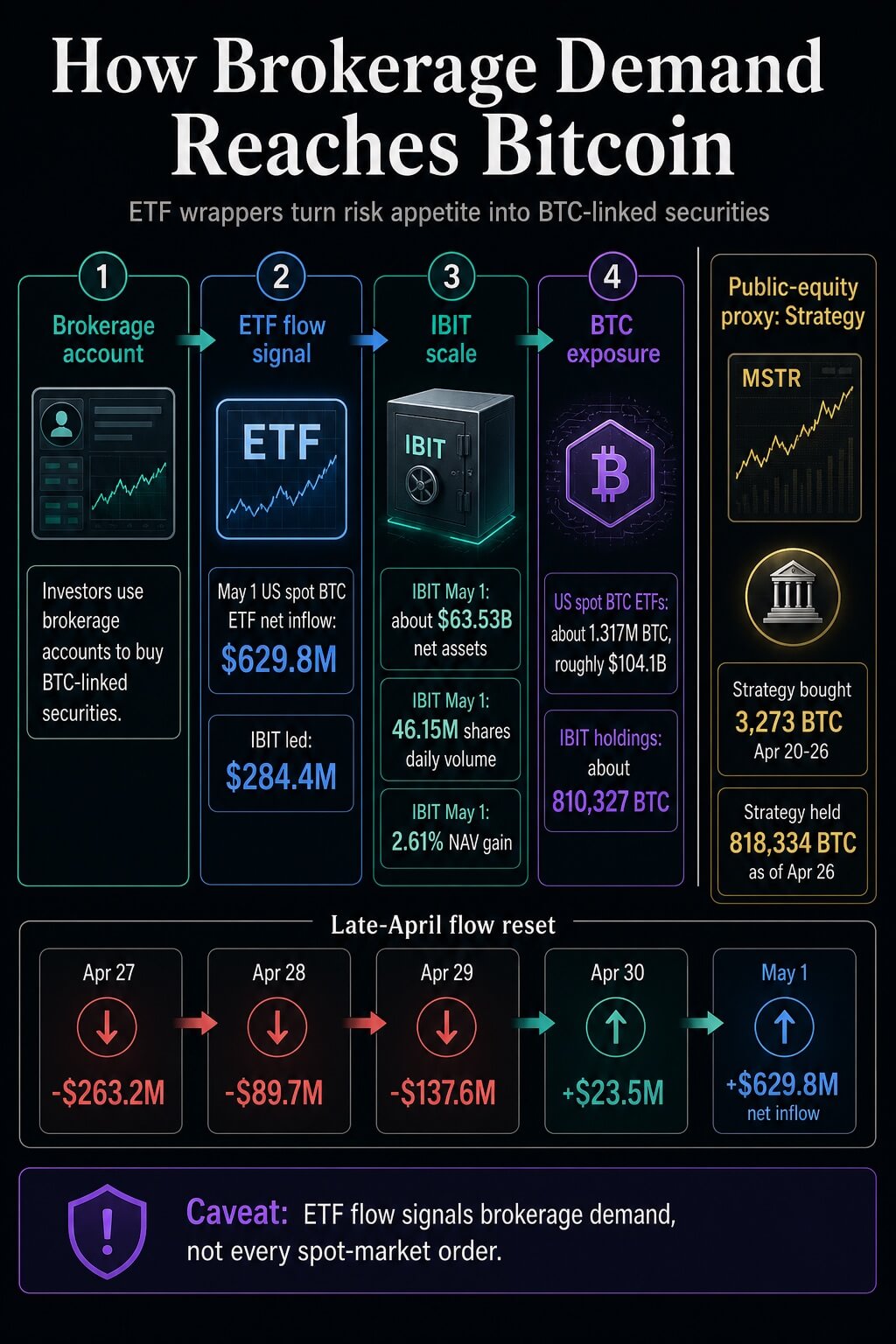
US spot Bitcoin ETFs attracted $629.8 million on May 1, led by BlackRock’s IBIT at $284.4 million and Fidelity’s FBTC at $213.4 million.
This marked a significant rebound following late-April outflows of $263 million on Apr. 27, $89 million on Apr. 28, and $137 million on Apr. 29, followed by only $23 million of inflows on Apr. 30.
The sequence conveys two messages. ETF demand returned prior to today’s Asian risk-on session, and the inconsistency suggests the movement was a rebound in risk appetite rather than a straightforward institutional purchasing program.
However, ETF flow does not equate to immediate spot buying on public exchanges. Authorized participants, NAV mechanics, in-kind transfers, custody arrangements, and OTC routes can all exist between reported flow and spot-market execution.
In simple terms, while ETF inflows signify active brokerage-account demand, they provide an incomplete representation of every dollar that reaches a BTC order book.
IBIT is substantial enough for its signal to influence portfolio behavior. BlackRock’s May 1 data indicated approximately $63.53 billion in net assets, 46.15 million shares traded daily, and a 2.61% NAV increase.
Across all funds, US spot Bitcoin ETFs held around 1.317 million BTC valued at approximately $104.1 billion as of May 1, with IBIT alone holding about 810,327 BTC.
At that scale, the ETF complex has become one of the primary methods public-market investors convert risk appetite into Bitcoin exposure.
 Related Reading
Bitcoin’s ETF machine is turning passive money into the next major price risk
ETF flows have transformed Bitcoin into a portfolio allocation trade, with macro data now determining whether the bid compounds or reverses. Apr 29, 2026 · Gino Matos
This alters the experience for the typical holder. An individual who possesses BTC through an ETF may consider halving cycles, exchange liquidity, or crypto-native narratives. However, that position may also respond to Nasdaq strength, chip-stock earnings, ETF flow breadth, and the same allocation models that influence equity funds.
| Market channel | Verified signal | Interpretive limit |
|---|---|---|
| Bitcoin price | BTC reclaimed $80,000 during the May 4 session. | The level remained a live technical test, with no confirmed hold in the available market data. |
| AI equities | Korea, Taiwan, SK Hynix, Samsung, and TSMC rallied during the May 4 session. | Equity strength supports shared risk appetite without proving direct BTC causation. |
| ETF flows | US spot Bitcoin ETFs took in $629.8 million on May 1, led by IBIT. | ETF flow signals brokerage demand but cannot map all spot buying. |
| Public BTC proxies | Strategy reported 818,334 BTC held as of Apr. 26. | The latest confirmed purchase predates May 4. |
Bitcoin’s movement on May 4 can be interpreted as a crypto rally, yet that perspective overlooks the portfolio mechanism.
AI earnings enhance the appetite for technology risk. Nasdaq strength validates the interest in US equities. Asian chip stocks continue their gains in the subsequent trading session.
Bitcoin ETFs provide ordinary brokerage accounts a means to express the same risk preference through BTC-linked instruments.
This mechanism is easy to overlook since each component has its own terminology. Crypto traders discuss resistance, ETF flows, and cost basis. Equity investors focus on AI demand, memory chips, and Nasdaq momentum. Brokerage-account holders observe tickers, without necessarily recognizing the underlying risk factor.
The outcome is a portfolio that may appear diversified, even though several positions respond to the same trigger.
The next test is alignment
Bitcoin’s rise above $80,000 demonstrated buyers’ willingness to re-engage as AI-linked risk appetite improved across public markets. It left BTC’s resistance test and the sustainability of ETF demand unresolved.
BTC must demonstrate whether it can maintain trading above the $80,000 level and challenge the low-$83,000 range without losing ETF flow support.
ETF flow needs to clarify whether May 1 was merely a one-day rebound or the onset of broader issuer participation. IBIT must sustain volume and asset scale without becoming the sole demand channel.
Strategy can indicate whether equity-market BTC proxies continue to trade with the same risk-on impulse, while its balance sheet remains a distinct source of leverage and volatility.
The AI aspect also requires monitoring.
If South Korea and Taiwan persist in leading chip demand, and if Nasdaq futures continue to affirm the same appetite, Bitcoin’s brokerage-wrapper trade will have a stronger foundation.
If the AI trade diminishes or ETF flows decline, the same wrapper channel could transmit risk-off pressure back into BTC.
This is the consequence for holders. A Bitcoin position can still revolve around supply, custody, ETF adoption, and crypto market structure.
It can also function as a liquid representation of the AI trade when the market’s most significant risk switch is influenced by semiconductors. The May 4 recovery of $80,000 made that overlap apparent.
Maintaining the low-$80,000 range would make it increasingly difficult to overlook.
The post Bitcoin’s $80k reclaim is starting to look like a momentary Asia-led AI trade in disguise appeared first on CryptoSlate.
