Disclaimer: Information found on CryptoreNews is those of writers quoted. It does not represent the opinions of CryptoreNews on whether to sell, buy or hold any investments. You are advised to conduct your own research before making any investment decisions. Use provided information at your own risk.
CryptoreNews covers fintech, blockchain and Bitcoin bringing you the latest crypto news and analyses on the future of money.

Wall Street’s $292 billion shift towards risk assets has established a new positive outlook for Bitcoin.

Global equity funds experienced inflows exceeding $15 billion in the week ending April 1, followed by $23.47 billion, $31.26 billion, and ultimately $48.72 billion in the week concluding April 22.
During the same period, global money-market funds faced a significant outflow of $173.24 billion in the week ending April 15, marking the largest single-week withdrawal from cash since at least September 2018.
These figures collectively indicate a risk-on sentiment of approximately $292 billion, combining $118 billion in global equity fund inflows over four weeks with a distinct $173 billion weekly cash exit.
According to Coinbase and Glassnode’s Q2 Institutional Outlook, Bitcoin’s daily return correlation with the S&P 500 is projected to be 0.58 in the fourth quarter of 2025, while its correlation with gold remains minimal.
As capital shifts towards risk, it gravitates towards the asset class that Bitcoin currently resembles.
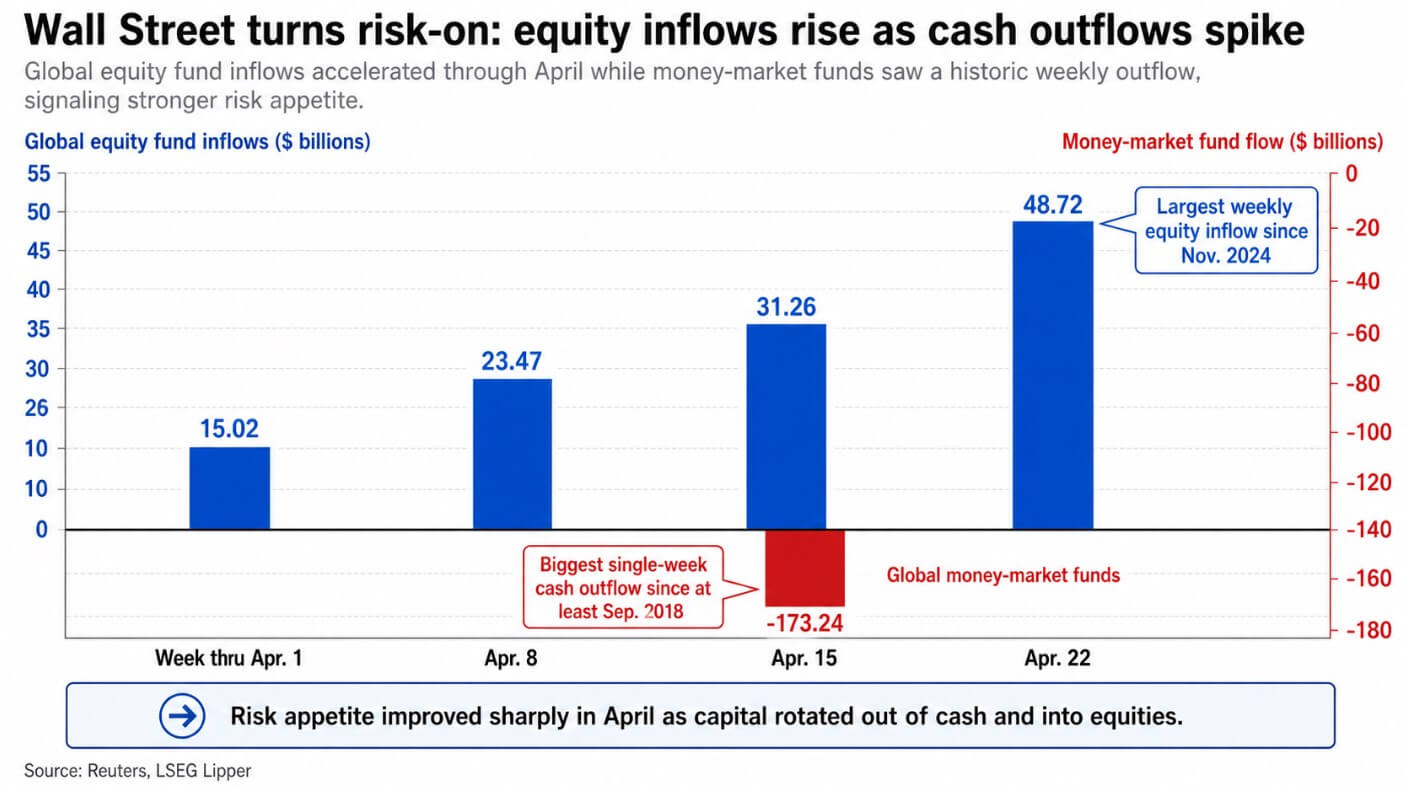 Global equity funds garnered $48.72 billion in the week ending April 22, while money-market funds recorded a historic outflow of $173.24 billion the previous week.
More specific insights arise from Coinbase’s survey of 91 global investors, which included 29 institutions and 62 non-institutions, conducted between March 16 and April 7.
Among institutional participants, 75% consider Bitcoin to be undervalued, while 61% of non-institutional crypto investors share the same perspective. Only 7% of institutions and 11% of non-institutions perceive BTC as overvalued.
These statistics illustrate a market where significant buyers still identify potential for growth. Capital moving into risk aligns with an asset that its most knowledgeable holders still regard as inexpensive, within a market that has yet to adjust for exuberance.
The on-chain picture
BTC supply that changed hands in the last three months decreased by 37% during the first quarter, while the supply that remained unchanged for over a year increased by 1%.
Speculative holders who purchased at higher prices exited during the downturn, while long-term holders accumulated more.
The Puell Multiple dropped to 0.7 in the first quarter, indicating that miner revenue was approximately 30% below its one-year average, a range that has historically coincided with accumulation phases.
Balances of long-term holders increased while exchange balances decreased, and stablecoin supply rose from $308 billion to $320 billion, suggesting that liquidity remained within the crypto market during the selloff.
Options open interest increased by 2.4%, and perpetual futures open interest rebounded by about 8.6%, reflecting a market that absorbed its deleveraging and rebuilt at a cautious pace.
| Metric | Reading | Why it matters for the BTC setup |
|---|---|---|
| Institutional respondents viewing BTC as undervalued | 75% | Large investors still see upside from current levels |
| Non-institutional respondents viewing BTC as undervalued | 61% | Constructive view extends beyond institutions |
| Institutional respondents viewing BTC as overvalued | 7% | Little sign of institutional euphoria |
| Non-institutional respondents viewing BTC as overvalued | 11% | Froth still looks limited |
| Survey sample | 91 global investors | Gives context for how broad the sentiment snapshot is |
| Institutional share of sample | 29 respondents | Shows the institutional result is based on a defined subgroup |
| Non-institutional share of sample | 62 respondents | Balances the institutional view with broader crypto investor sentiment |
| Survey field dates | Mar. 16 to Apr. 7, 2026 | Positions the survey in the run-up to Q2 |
| BTC correlation with S&P 500 (4Q25) | 0.58 | Supports the idea that BTC still trades like a risk asset |
| BTC correlation with gold | Negligible | Suggests BTC is not behaving like a defensive hedge in this regime |
| Read-through for Q2 | Undervalued + risk-sensitive | Macro risk-on flows could support BTC without requiring euphoria |
Related Posts
The bull case
If the equity rotation in April continues to expand into high-yield credit, private credit, and emerging-market risk, Bitcoin is positioned to benefit from that capital.
EPFR noted a “marked increase in risk appetite,” with high-yield bond funds recording their first inflow since mid-February and private credit flows reaching an eight-week peak.
In this context, institutional confidence in undervaluation and improved on-chain positioning create a pathway for repricing with substantial potential for growth. Coinbase’s survey participants are positioned cautiously, suggesting that an improving macro environment may catch them under-invested.
A gain of 12% to 20% from current levels over the remainder of the second quarter could place BTC in the range of $87,500 to $94,000, potentially driven solely by sustained institutional rotation.
The recent weakening of the dollar, evident in last week’s intervention-driven decline of 0.8% in the dollar index, provides an additional supportive factor.
Bitcoin has historically tracked global dollar liquidity closely, and softer financial conditions tend to favor risk assets marginally.
The bear case
Coinbase’s official position for the second quarter remains neutral, and the conditions required for a more positive outlook, such as a definitive resolution to the Middle East conflict, a decline in oil prices, and easing inflation, have yet to materialize.
Persistently high oil prices and the Fed’s constraints due to ongoing inflation could shift Bitcoin’s equity correlation from a supportive factor to a hindrance. Should macro desks revert to cash, as seen in early March, BTC would trade as a liquidity beta during downturns.
In such a scenario, macro factors could overshadow the conviction of institutional undervaluation. Survey respondents may believe BTC is undervalued yet remain on the sidelines due to geopolitical uncertainties influencing their positioning.
The on-chain accumulation data would still indicate a longer-term constructive outlook, but a renewed macro shock could overshadow those indicators in the short term.
A decline of 8% to 15% from current levels, bringing BTC to approximately $66,500 to $72,000, aligns with the magnitude of previous macro-driven BTC corrections and would necessitate only a return to the defensive flow patterns observed in March.
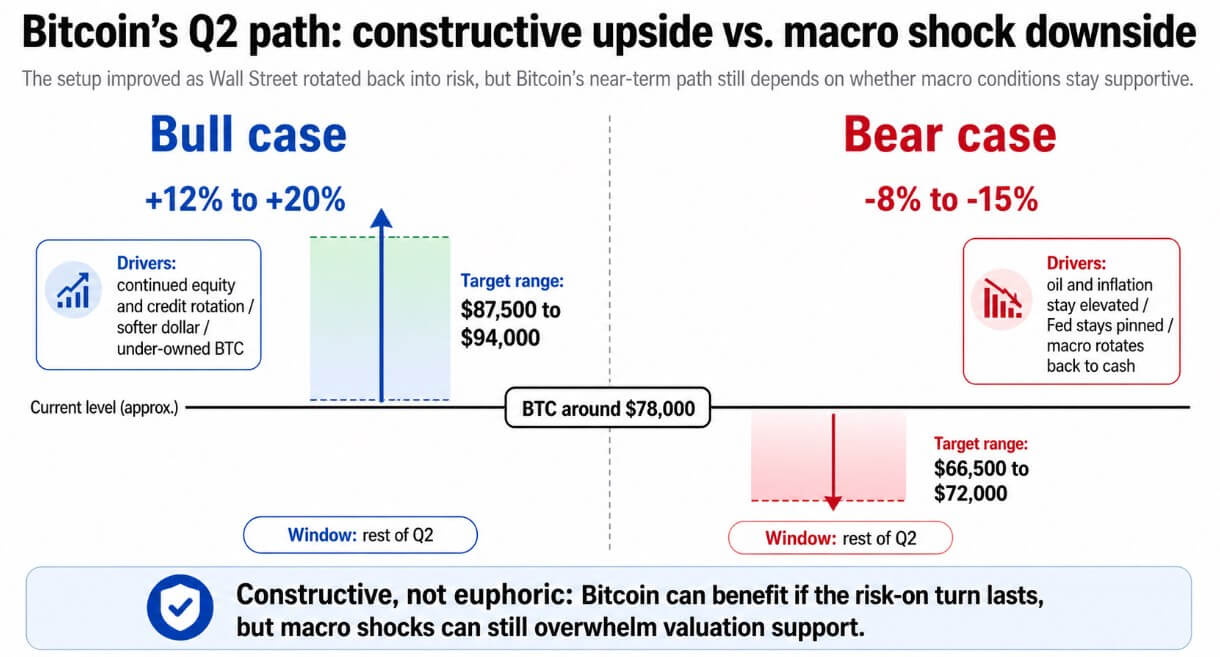 Bitcoin is currently trading around $78,000, with a bullish scenario targeting $87,500–$94,000 based on equity rotation and a bearish scenario of $66,500–$72,000 if macro conditions worsen.
The remainder of the quarter hinges on whether the equity and credit rotation from April proves sustainable or reverts in response to the next geopolitical event, and whether Bitcoin’s correlation with equities remains high or shifts towards a more independent trajectory as crypto-specific flows start to dominate price movements.
The constructive outlook relies on broader markets embracing more risk again, while Bitcoin’s most knowledgeable holders remain under-invested for a clean recovery.
The post Wall Street’s $292 billion risk-on rotation just created a new bullish setup for Bitcoin appeared first on CryptoSlate.
