Disclaimer: Information found on CryptoreNews is those of writers quoted. It does not represent the opinions of CryptoreNews on whether to sell, buy or hold any investments. You are advised to conduct your own research before making any investment decisions. Use provided information at your own risk.
CryptoreNews covers fintech, blockchain and Bitcoin bringing you the latest crypto news and analyses on the future of money.


Bitcoin momentarily regained the $80,000 psychological threshold during the early Asian trading hours on May 4, marking the first occurrence since February, as it has been steadily rising in recent weeks.
Data from CryptoSlate indicated that the leading cryptocurrency reached an intraday peak of $80,529 before retreating to $79,621 at the time of reporting.
However, what may seem like a significant achievement on a price chart conceals a market structure that is quite conflicted beneath the surface.
This is due to the fact that the leading cryptocurrency’s return to this level is more of a high-stakes examination than a straightforward bullish breakout.
Nevertheless, market analysts observed that BTC traders are currently assessing whether recovering institutional spot demand can surpass a still-challenging macroeconomic environment characterized by tensions in the Middle East, a hawkish Federal Reserve transition, and a derivatives market that remains heavily skeptical.
 Related Reading
Bitcoin’s next breakout will depend on whether investors treat $80K as relief, resistance, or the start of a new recovery
BTC is probing the precise area where short-term holders typically either capitulate or maintain their positions. May 2, 2026 · Andjela Radmilac
An aggressive, yet vulnerable breakout attempt
Bitcoin’s initial surge past $80,000 was marked by sheer force rather than organic accumulation.
Data from CryptoQuant reveals that the movement was concentrated on major offshore exchanges, particularly Binance, where taker-buy volume, a metric indicating traders crossing the spread to execute immediately at market prices, surged.
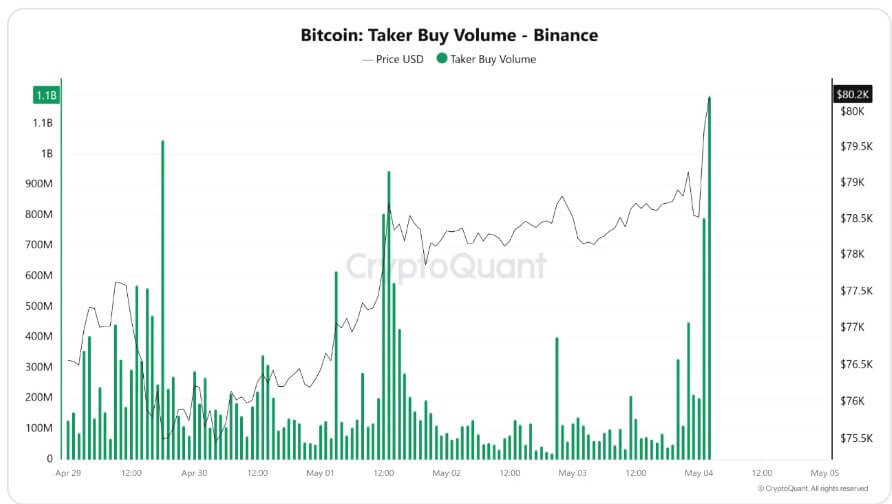 Bitcoin Taker Volume on Binance (Source: CryptoQuant)
According to CryptoQuant, BTC experienced two consecutive spikes of approximately $1.19 billion and $792 million on the exchange, resulting in a total of $1.98 billion in taker-buy volume within a two-hour timeframe.
When such aggressive buying occurs at a significant resistance level, it generally suggests that momentum traders are not waiting for a cautious pullback. Instead, they are actively pursuing confirmation of a breakout.
However, market structure analysts caution that this type of volume introduces immediate fragility.
CryptoQuant analyst JA Maartunn highlighted that the asset is now facing its true test, stressing that the price should not remain in this area for an extended period if the rally is legitimate.
According to Maartunn, Bitcoin must maintain a closing price above $79,000 to preserve structural integrity. If it falls below that level, he contends, the weekend surge was likely just a liquidity grab to eliminate late short sellers.
Derivatives push the move, but expose a structural divergence
The derivatives landscape adds complexity to the narrative, revealing a market grappling with a significant divergence between spot psychology and leveraged positioning.
While call options targeting higher strikes are heavily populated—with data from Deribit showing $1.7 billion in notional value locked into the $80,000 call option, along with substantial clusters at $90,000 and $100,000—the underlying sentiment metrics depict a growing sense of unease.
Instead of a wave of bearish short-selling, the market is witnessing a sharp decline in spot conviction while leverage remains stubbornly long.
Data from analytics firm Alphractal indicates that Bitcoin’s sentiment shifted dramatically in less than a week, with the Fear & Greed index dropping 10 points to a “Fear” level of 43.
Related Posts
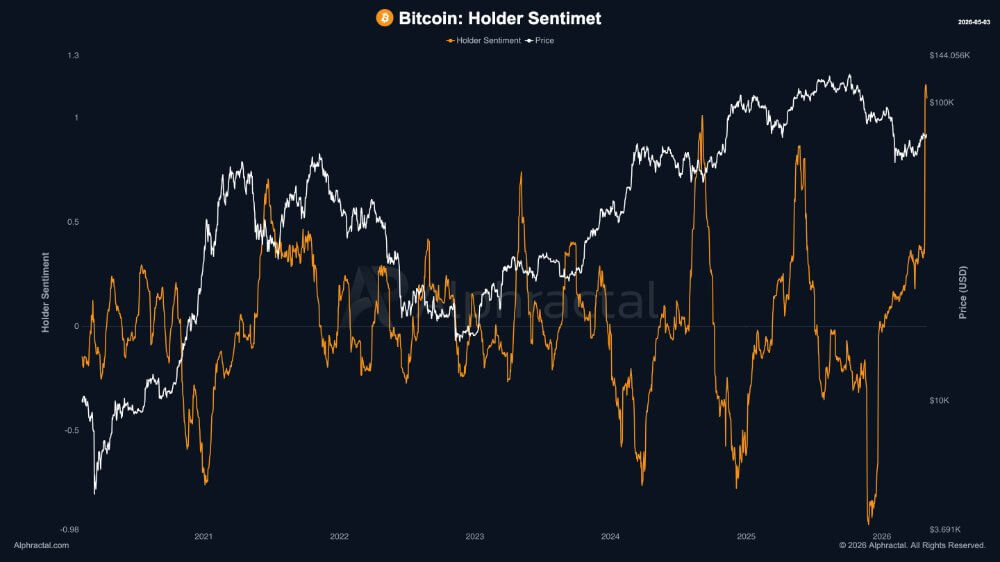 Bitcoin Holder Sentiment (Source: Alphractal)
Yet, despite this fear in the spot market, futures traders are unwilling to retreat. Alphractal data reveal that perpetual futures funding rates have remained distinctly positive, currently at +0.51%. This suggests that while holder sentiment has cooled, speculative traders are still paying a premium to sustain their bullish positions.
This combination of fear in the spot market, along with long-biased leverage, is essential for understanding the current price fluctuations. Historically, this specific divergence signifies a volatile “stress phase” for the asset.
As a result, the brief surge past $80,000 appears to have been driven primarily by leverage-sensitive traders rather than a clear, fundamental macro reset.
While the market continues to ascend, this heavy dependence on derivatives renders the structure top-heavy and highly susceptible to abrupt long liquidations if the macroeconomic environment suddenly deteriorates.
ETF demand points to durable spot bids
If derivatives are contributing to the unstable volatility, US spot ETFs are establishing a structural foundation for the leading cryptocurrency.
Data from SoSoValue indicates that US-listed spot Bitcoin ETFs have now recorded two consecutive months of net inflows, totaling $3.29 billion in investor funds. This follows a period of outflows that had dominated the previous four months.
Significantly, this marks the first back-to-back month of inflows since last September and October, when the funds attracted nearly $7 billion in new capital.
Ecoinometrics, a Bitcoin economics platform, noted that the current figures demonstrate that “demand [for BTC] is beginning to solidify.” It further stated:
“Over the past few weeks, Bitcoin ETFs experienced a nine-day streak of net inflows. That’s the longest period of consistent demand we’ve observed throughout this entire bear market. The last time flows resembled this was in October 2025, right as Bitcoin was approaching its all-time high. After that, demand vanished and the market declined. What’s different now is not the magnitude of the inflows, but their consistency.”
In light of this, this consistency is subtly reshaping the market’s underlying framework, as genuine spot demand gradually absorbs the volatility produced by the futures market.
Moreover, CryptoQuant data highlighted that the average cost basis of early institutional ETF buyers is now serving as a significant technical support level for the leading cryptocurrency.
Macro risks shadow the rebound
Despite the improving micro-structure of the crypto market, the broader macroeconomic landscape argues against unrestrained confidence.
The geopolitical situation in the Middle East remains volatile. While a ceasefire has temporarily halted outright hostilities, the underlying tensions are actively influencing global risk appetite.
Iran recently issued stern warnings to US forces to steer clear of the Strait of Hormuz, a vital global shipping route, even after President Donald Trump stated the US would intervene to assist stranded commercial vessels.
This geopolitical tension has kept oil prices elevated well above the $100-per-barrel threshold, which in turn poses a significant challenge to global disinflationary efforts.
Meanwhile, the persistence of energy-driven inflation is necessitating a swift reassessment of US monetary policy.
Rather than a dovish pivot, the Federal Reserve is facing pressure to completely abandon its easing bias. Consequently, major financial institutions are adjusting their forecasts accordingly; Barclays recently revised its outlook to predict no rate cuts for the entirety of 2026.
Compounding this uncertainty is an impending change in central bank leadership. Chairman Jerome Powell’s term concludes on May 15, and his designated successor, Kevin Warsh, has cleared the committee with a full Senate vote anticipated during the week of May 11.
Warsh’s ascent introduces a new variable into risk asset pricing, as institutional managers remain cautious about deploying substantial capital without clarity on how the new chair will navigate the tension between persistent inflation and an increasingly burdened economy.
The post Bitcoin bulls set sights on $90,000 this week after briefly reclaiming $80,000 appeared first on CryptoSlate.
