Disclaimer: Information found on CryptoreNews is those of writers quoted. It does not represent the opinions of CryptoreNews on whether to sell, buy or hold any investments. You are advised to conduct your own research before making any investment decisions. Use provided information at your own risk.
CryptoreNews covers fintech, blockchain and Bitcoin bringing you the latest crypto news and analyses on the future of money.

Solana Price Forecast: Potential Loss of $3 Billion in Token Rewards – Could This Propel SOL to $500?

A developer from Solana has recently suggested a significant modification: reducing the duration for Solana to achieve its 1.5% terminal inflation from over six years to just three. If this proposal is approved, it would prevent nearly 3 billion dollars’ worth of new SOL from being generated at current market prices.
The proposal, designated SIMD-0411, was uploaded to GitHub on November 21. It recommends increasing the rate at which staking rewards decrease, from 15% annually to 30%. No new elements are introduced to the system, and no structural alterations are made; it merely accelerates the current disinflation timeline.
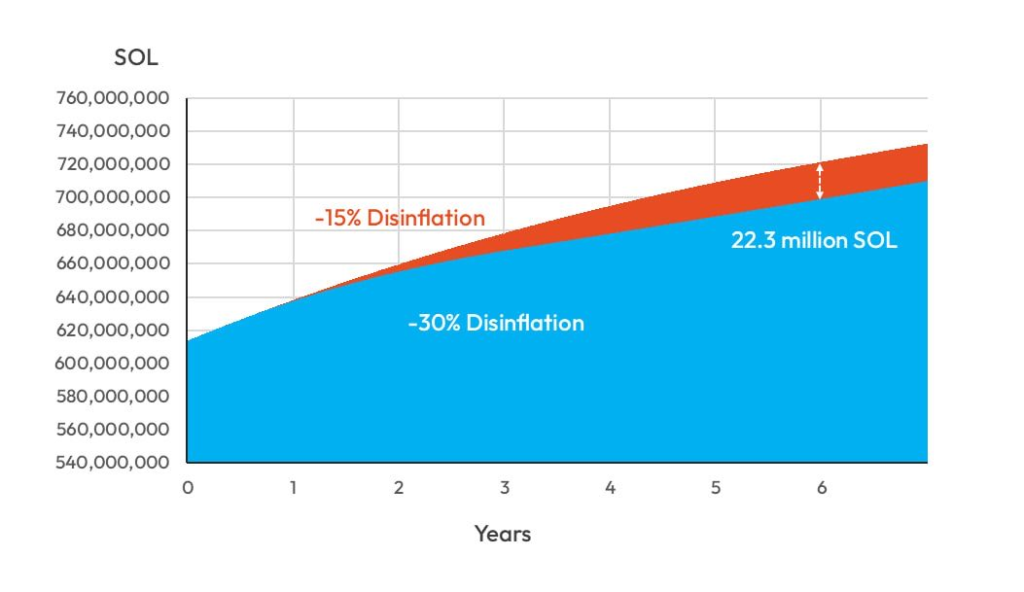 Source: SIMD-0411 Proposal / Github
By hastening the reduction, Solana would achieve its long-term inflation goal of 1.5 percent significantly sooner. The initial projection was around 2032, but the revised schedule would advance that target to early 2029.
Solana would produce approximately 22.3 million fewer SOL over the next six years. A decrease in new SOL entering the market implies reduced selling pressure from staking rewards, which has contributed to the downward pressure on the token’s price.
What Are the Reasons This Proposal Might Be Rejected?
On the surface, it appears ideal. Just approve it and watch the price rise, right? Not necessarily. There is a considerable trade-off involved. Reduced inflation also implies that staking rewards will diminish at a much quicker pace.
 Source: Solana Validators / Solanabeach
According to this proposal, the current yields of around 5% would decrease to approximately 2.4 percent within the next three years. This directly impacts validator economics, as many validators depend on staking rewards to manage their operational expenses.
If rewards decline too swiftly, smaller validators may be compelled to shut down or increase fees, leading to a concentration of power among larger operators. A reduction in the number of validators raises the risk of censorship, coordinated failures, or outages, thereby undermining trust in Solana’s decentralization, which is crucial for the network’s security and credibility.
Nonetheless, not all validators depend exclusively on staking rewards. Some support their operations for branding or ecosystem presence, while others generate income through delegation fees, so the effects will not be uniformly felt across the network.
JUST IN: @defidevcorp (NSDQ: $DFDV) BECOMES THE 1ST SOLANA DAT TO SIGNAL SUPPORT FOR REDUCING $SOL INFLATION RATE VIA SIMD-0411!#SOLANA
pic.twitter.com/fMQRv3GcOc
— curb.sol (@CryptoCurb) November 24, 2025
 pic.twitter.com/fMQRv3GcOc
The proposal has a genuine possibility of being approved, but it ultimately hinges on the backing of major validators and liquid staking providers. They are likely to experience the most significant revenue loss, so if they oppose it, the proposal is likely to fail. Conversely, if they accept the trade-off for a healthier long-term validator ecosystem, it will likely progress.
Related Posts
Solana Price Outlook: Could This Proposal Propel SOL to $500?
Bitwise recently attracted a substantial $39.5 million into its SOL ETF, marking the largest inflow since its inception. This influx has resulted in Solana ETFs experiencing 20 consecutive days of inflows, which is noteworthy given the market’s volatility. Overall, ETFs accumulated approximately $58 million on November 24 alone.
 Source: SOLUSD / TradingView
Solana appears to be establishing a robust support zone between 124 and 127 dollars. This range now serves as the primary safety net, so if SOL falls below 130, it is likely to stabilize and accumulate in that area once more.
SOL bulls are primarily looking for a clear breakout above 140 with substantial volume backing it. If this occurs, and the ETF momentum continues, a return toward 160 becomes feasible.
While it is still early, the RSI is beginning to rise, and trading volume surged by 20% to 5.19 billion in the past day, indicating positive momentum.
Bitcoin Hyper: The First Layer 2 Built On Bitcoin That May Outperform Solana

As Solana engages in discussions regarding inflation reductions, validator rewards, and the potential long-term effects of the proposal, Bitcoin Hyper is one of the few projects gaining traction without significant controversy.
Bitcoin Hyper is developing a rapid Bitcoin Layer 2 utilizing the Solana Virtual Machine, providing the speed and low fees that traders desire while still settling back to Bitcoin for security. This combination is precisely what users seek during cautious market conditions, offering performance without reliance on a single chain upgrade or validator vote.

Investors seem to concur. Bitcoin Hyper has already secured 28.4 million dollars in its presale, which is notable in a market where many projects struggle to attract attention. The staking rewards are currently at a robust 73% APY, offering holders a genuine incentive to remain engaged early on.
Visit the Official Website Here
The post Solana Price Prediction: $3 Billion in Token Rewards Could Vanish – Is This What Sends SOL to $500 appeared first on Cryptonews.
