Disclaimer: Information found on CryptoreNews is those of writers quoted. It does not represent the opinions of CryptoreNews on whether to sell, buy or hold any investments. You are advised to conduct your own research before making any investment decisions. Use provided information at your own risk.
CryptoreNews covers fintech, blockchain and Bitcoin bringing you the latest crypto news and analyses on the future of money.

Simplified Multi-Chain Experience: Understanding Chain Abstraction and Its Functionality, 2026/05/03 23:59:59

Navigating between blockchains is not particularly straightforward and can be challenging for novice users. It necessitates a certain level of knowledge, experience, and caution. Blockchain abstraction helps to conceal technical complexities and provides a more accessible pathway.
The Issue of Blockchain Ecosystem Fragmentation
The current cryptocurrency industry is evolving into a multichain environment, featuring numerous independent solutions. On one hand, this enhances performance and fosters innovation within each individual network. It is evident that every project possesses its own strengths and weaknesses, maintaining a healthy level of competition among them. On the other hand, this leads to fragmentation of user assets and complicates the transfer of funds across networks.
To execute even a simple operation between blockchains, the end user may need to accurately perform a variety of specific actions. This includes identifying the appropriate network, transferring assets via a bridge, paying fees in the relevant tokens, and completing a series of checks and confirmations. Such a process not only complicates user interaction with the cryptocurrency world but also increases the likelihood of errors, which can sometimes result in actual financial losses.
Fragmentation also poses challenges for developers. Supporting multiple networks requires deploying infrastructure for each and considering the unique characteristics of each. The compromises that arise during the development of such complex systems ultimately impact the user experience as well.
Thus, despite the technological advantages of the multichain approach, it remains insufficiently user-friendly for widespread adoption, raising the entry barrier to the Web3 environment (the next generation of the internet based on blockchain). Essentially, this can be framed as a UX (User Experience) issue. This is precisely what the so-called “chain abstraction” aims to address.
What Is Chain Abstraction?
Related Posts
Blockchain abstraction is an approach designed to simplify the complexities of a multichain environment. The primary goal is not to create a singular technology but to enhance the user experience (UX): users should interact with applications without needing to contemplate how or in which specific network operations are conducted, and importantly, without reflecting on how “difficult and confusing” it all is.
It is crucial to emphasize that blockchain abstraction is not a single standard. Rather, it is a collection of various approaches and solutions.
Outside of these solutions, individuals must manage assets across different blockchains and consider the specifics of each network. In the blockchain abstraction model, these tasks are shifted to the infrastructure level. Instead of navigating the entire process from start to finish, the user articulates their intent, and the system determines how that intent will be realized.
In other words, chain abstraction can be viewed as a potential branch of the evolution of the UX paradigm in Web3, where users only need to clearly express the outcome they wish to achieve to receive it from the system.
The Essence of Blockchain Abstraction
At the core of most chain abstraction solutions or approaches lies the idea of separating the user’s intent from the technical execution of that intent.
Users do not create transactions in the conventional sense (selecting a network, executing operations, and paying fees). Instead, they express an intent—such as exchanging 100,000 USDT on the Tron blockchain for an equivalent amount of Bitcoin. This intent is relayed to a separate level, where specific participants compete to actualize the intent. These participants are commonly referred to as solvers (from the English words solver and solve).
Solvers can be viewed as simple “executors of intent.” They analyze the request and then propose and implement the optimal method for completing the task.
Let’s examine the logic of blockchain abstraction more closely using the theoretical model CAKE framework (Chain Abstraction Key Element) from Frontier Research. CAKE presents chain abstraction as a multi-layered system, where each layer is responsible for a distinct function.
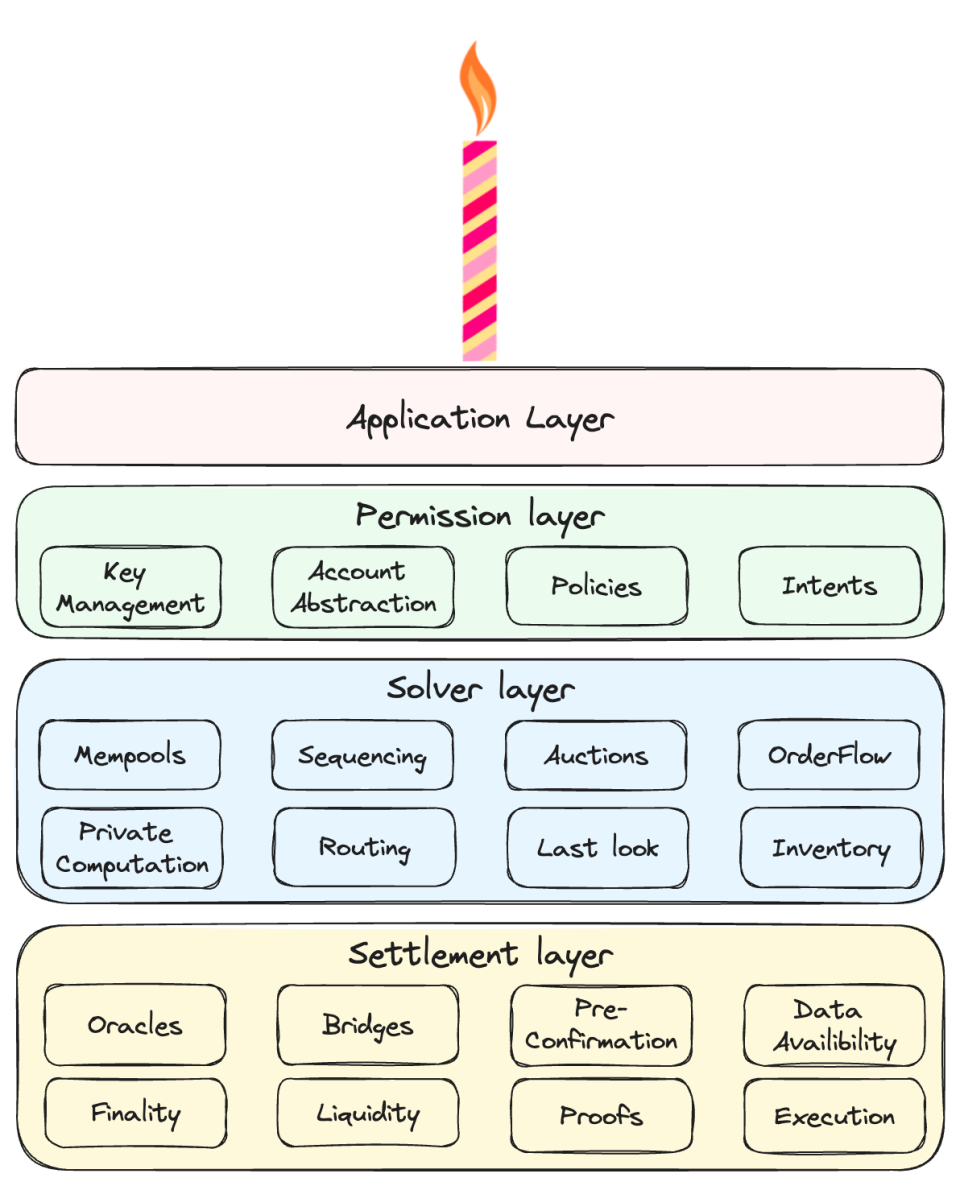
Source: frontier.tech/the-cake-framework
The first layer is the Application layer. This is the level that users interact with directly. It includes decentralized applications, interfaces, and crypto wallets. The objective is to provide a simple and unified interface that conceals the barriers between blockchains and allows users to work with them as a single system.
The second layer is the Permission layer. At this level, user actions are authorized. Once a wallet is connected, the system can read the status of assets across different networks and initiate transactions on behalf of the user. The intent is formalized here as a description of the desired outcome without concern for how it will be achieved.
The third layer is the Solver layer. This is where the intent is processed. Solvers evaluate possible execution options, taking into account fees, speed, and available liquidity. In a multichain environment, there may be numerous ways to realize the intent. The solvers’ task is to select the optimal one; their profit can arise from the difference between the actual cost of executing the operation and the quoted price. Competition among solvers revolves around who can offer the most efficient execution.
The fourth layer is the Settlement layer. Here, after the user confirms the operation, the actual execution begins. This level is responsible for the final realization of the intent. Depending on the architecture of the solution, execution can occur through traditional mechanisms (such as bridges) or by utilizing the liquidity of the solvers themselves, who carry out the operation on behalf of the user and then settle accounts.
Examples from the Crypto Industry
CAKE serves as a clear analytical model that describes chain abstraction as a phenomenon. However, in practice, various projects implement blockchain abstraction in their own ways, combining different elements of the aforementioned architecture.
For instance, NEAR Protocol embodies an intent-based approach for users and execution through solvers. A smart contract verifier (Verifier) is responsible for finalization.
Projects like Particle Network focus on consolidating a wide array of functions within a single universal account. Users are offered a straightforward interface, convenient authorization (including login via social media accounts), and a “seamless experience.”
Infrastructure solutions such as Socket emphasize the creation of applications that are inherently designed for a multichain environment. The protocol is positioned as a solution for blockchain abstraction, enabling developers to create applications that interact with different networks as if they were a single environment. At the core of Socket is a set of smart contracts deployed across various networks that establish the rules for executing operations prior to actual execution in the application. This allows developers to shield the technical aspects from the end user.
Advantages and Limitations of Blockchain Abstraction
The advantages include:
-
simplification of interaction with Web3, allowing users to focus on outcomes rather than technical details;
-
reduction of ecosystem fragmentation by simplifying operations across different blockchains;
-
attraction of new users due to a lower entry barrier.
Conversely, it is important to note the drawbacks and limitations:
-
it is challenging to formalize user intents in a way that they can be executed correctly and unambiguously across all scenarios;
-
chain abstraction introduces additional layers of complexity and opacity into the infrastructure, potentially increasing the number of vulnerabilities;
-
blockchain abstraction can lure users into a kind of “convenience trap”: individuals may sacrifice control over processes for simplicity, compromising their ability to ensure the security of their assets in favor of centralized platforms.
Conclusion
Blockchain abstraction represents an effort to rethink user interaction with the Web3 ecosystem, shifting the focus from the technical complexity of the process to the outcome. Instead of navigating multiple networks, bridges, and intricate sequences of actions, users only need to articulate their intent, with the infrastructure handling the execution. In the long run, this approach may lay the groundwork for a more widespread and user-friendly Web3. However, the development of this approach is inevitably linked to compromises between convenience, transparency, and the level of user control.
