Disclaimer: Information found on CryptoreNews is those of writers quoted. It does not represent the opinions of CryptoreNews on whether to sell, buy or hold any investments. You are advised to conduct your own research before making any investment decisions. Use provided information at your own risk.
CryptoreNews covers fintech, blockchain and Bitcoin bringing you the latest crypto news and analyses on the future of money.


Ethereum faces headwinds in its quest for upward momentum following a failed breakout earlier this week, which drove prices back toward the $2.2K mark. Trading near $2.25K, the asset is currently testing a short-term support zone that will likely dictate whether the market finds stability or extends its current correction. Concurrently, user wallet activity has plummeted from its mid-2026 peaks, offering minimal evidence of renewed buying pressure.
Ethereum Price Analysis: The Daily Chart
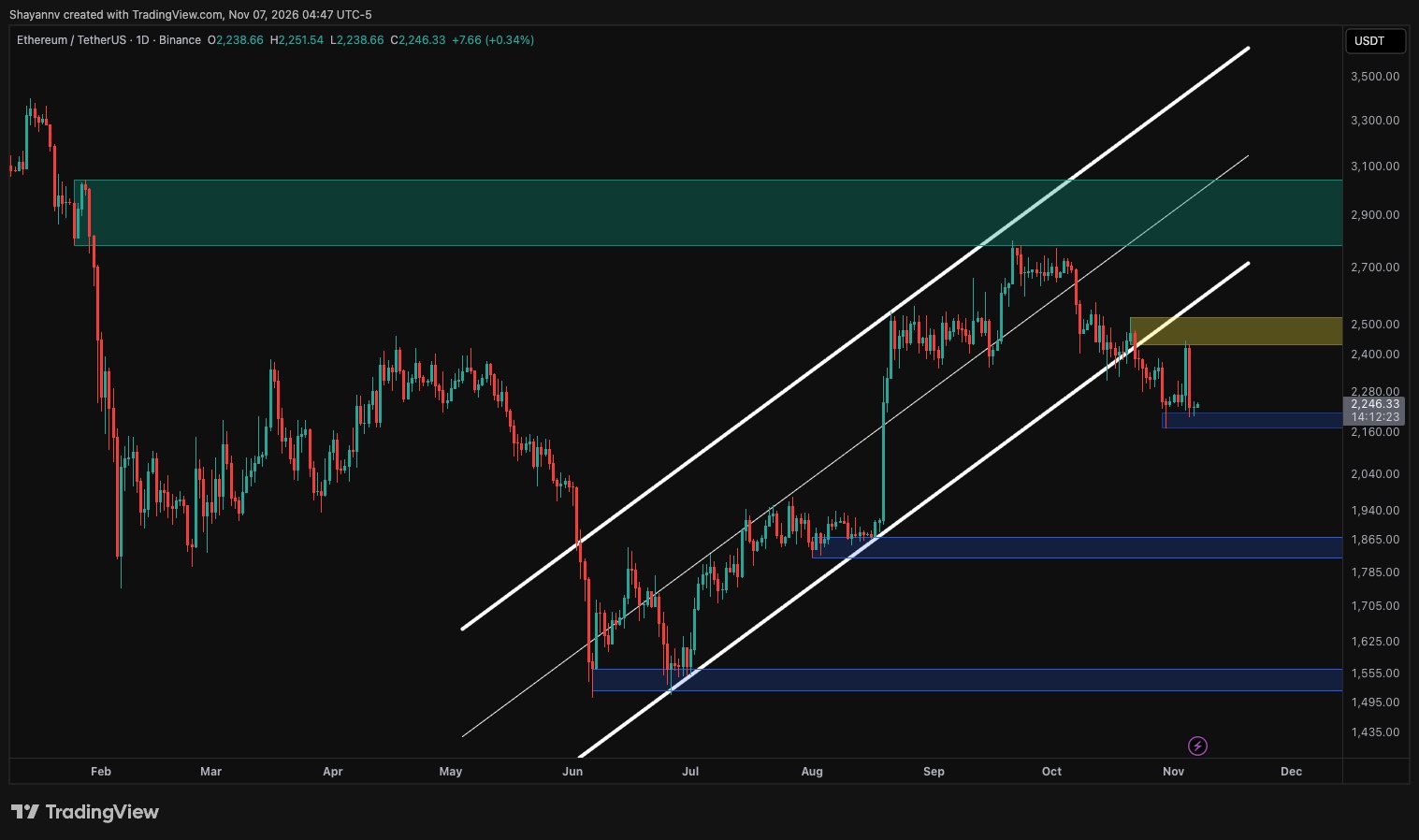
A breach of the ascending channel that had propelled prices from the June lows near $1.5K is evident on Ethereum’s daily chart. After peaking near $2.8K in late September, the asset slid through the channel’s midpoint and broke its lower boundary in late October, signaling a clear weakening of the medium-term trend.
A recent rebound tested the $2.5K supply zone, which now aligns with the broken lower trendline, but sellers stepped in to reject the move. This behavior confirms that previous support has flipped into resistance. While ETH holds the $2.2K level established during the late-October low, buyers must reclaim $2.5K to revive the bullish thesis and make the $2.8K-$3K supply zone relevant again.
If Ethereum closes decisively below $2.2K on a daily basis, the channel breakdown will be confirmed, exposing the $1.85K demand zone that preceded the strong August rally. Further down, the $1.5K area acts as the primary floor, having served as the foundation for the recovery that started in June.
ETH/USDT 4-Hour Chart
Related Posts
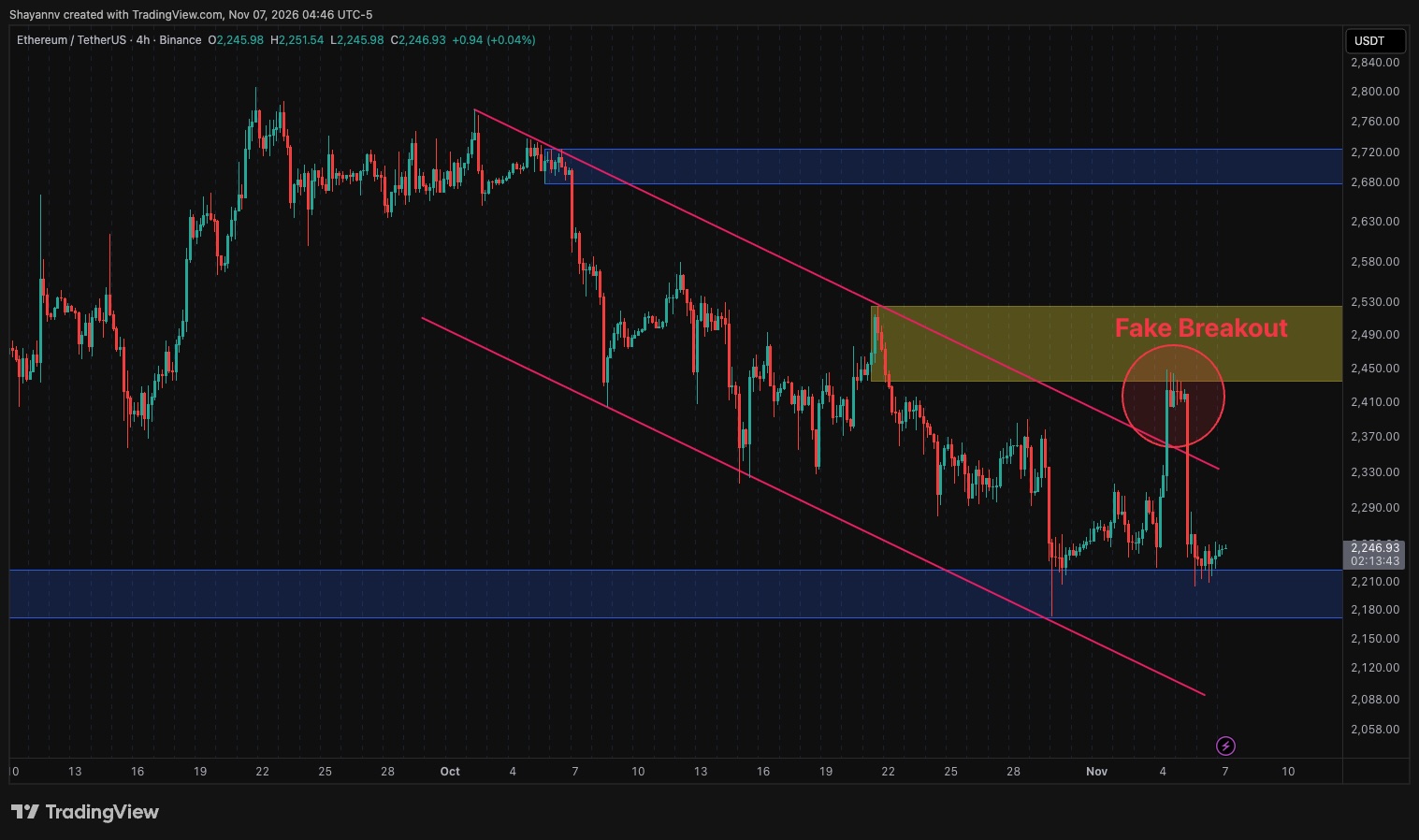
On the 4-hour timeframe, ETH has been confined within a descending channel since early October, marked by a pattern of lower highs and lower lows. Although the asset briefly surged above the upper boundary to reach $2.5K earlier this week, a rapid sell-off pulled it back inside the structure. This false breakout trapped late entrants and strengthened the bearish short-term outlook.
Price action is currently consolidating just above the $2.2K demand zone, which has successfully absorbed two previous sell-offs. Continued defense of this level could trigger a relief rally toward the upper channel boundary near $2.3K. To negate the failed breakout, buyers need to reclaim that trendline and then break through $2.5K to aim for the $2.7K order block.
Alternatively, a break below $2.2K would likely drive the price toward the channel’s lower boundary at $2K. Frequent tests of this support heighten the risk of a failure, and the short-term structure remains bearish unless the upper trendline is broken decisively to the upside.
On-Chain Analysis
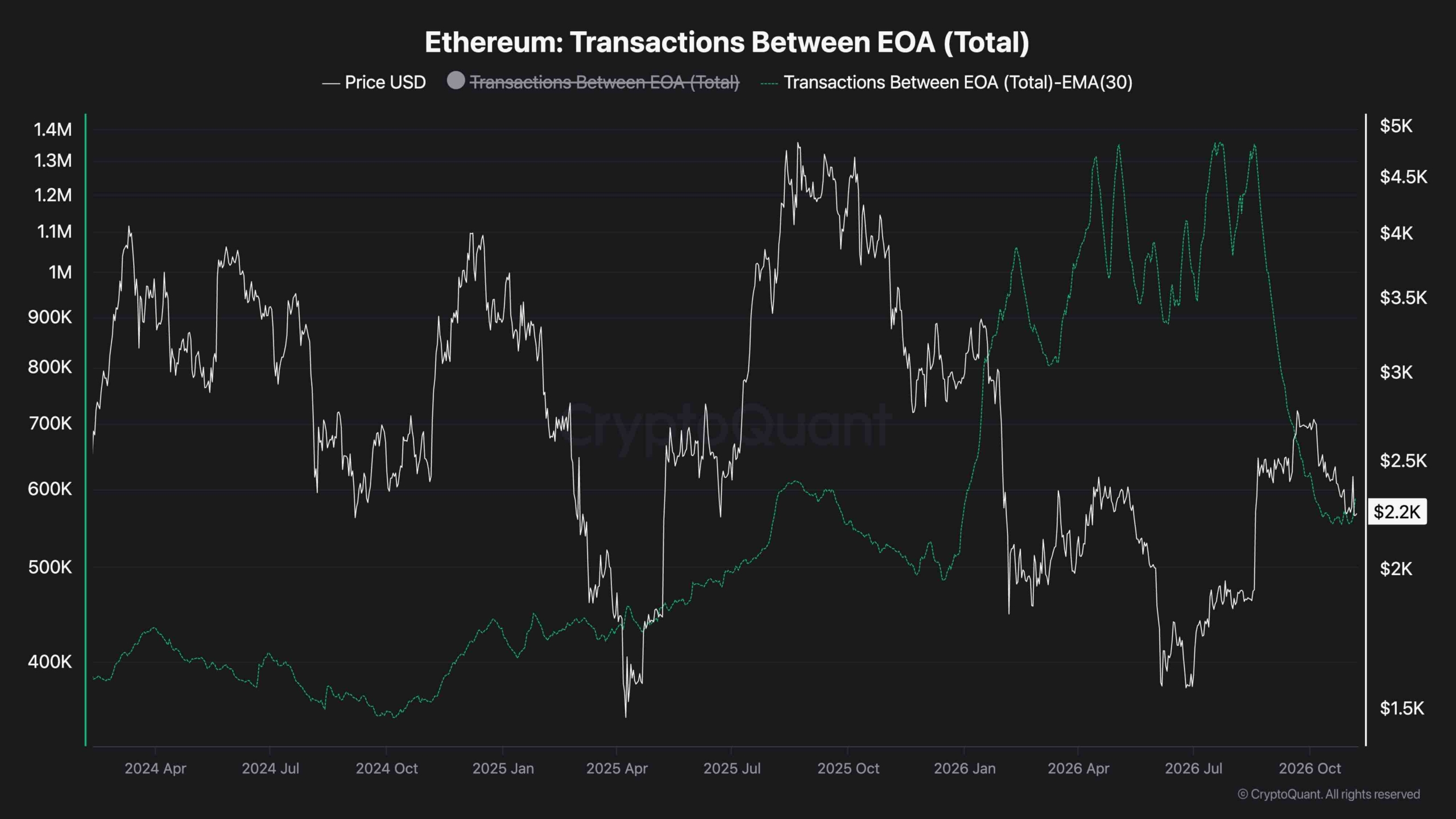
CryptoQuant’s Transactions Between EOA metric monitors transfers between externally owned accounts, defined as wallets managed via private keys rather than smart contracts or exchanges. The 30-day exponential moving average of this metric acts as a proxy for direct peer-to-peer network usage, where higher values typically indicate stronger user engagement.
This indicator climbed from approximately 400K in 2024 to 600K by late 2025, before spiking to 1.3M in the first half of 2026. This growth happened while ETH dropped toward $1.5K, demonstrating that activity and price can diverge. It also highlighted a significant shift in ownership as price lows formed. Since August, the metric has fallen to roughly 560K, nearing its lowest point in a year, and is only now beginning to stabilize.
These figures require careful interpretation because transaction volumes can be skewed by low-value automated transfers and fee structures, meaning they do not directly reflect buying demand. Nevertheless, the sharp drop in wallet activity, coupled with the loss of the daily channel, implies the market lacks a powerful catalyst. Consequently, defending the $2.2K support level remains the critical task for buyers.
