Disclaimer: Information found on CryptoreNews is those of writers quoted. It does not represent the opinions of CryptoreNews on whether to sell, buy or hold any investments. You are advised to conduct your own research before making any investment decisions. Use provided information at your own risk.
CryptoreNews covers fintech, blockchain and Bitcoin bringing you the latest crypto news and analyses on the future of money.


Key Takeaways:
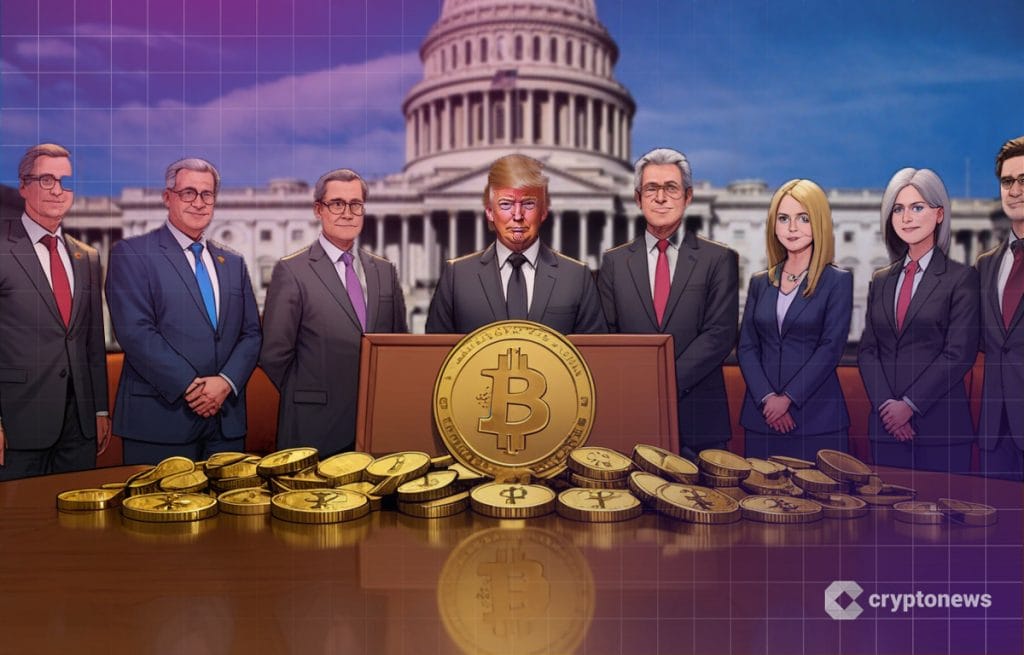
- U.S. President Donald Trump is under pressure to fulfill his commitment regarding a strategic Bitcoin reserve.
- While some states have introduced legislation for a strategic Bitcoin reserve, experts are split on whether this can be achieved at the federal level.
- If implemented, however, the reserve could significantly elevate the BTC price, they suggest.
America’s new President, Donald Trump, is a newcomer to the crypto landscape, yet his frustration with bureaucratic processes has consistently positioned him favorably for the industry’s decentralization agenda.
As he assumes control of the slow-moving government machinery, Trump is a man eager to deliver on promises made to his cryptocurrency supporters. The President has already accomplished a significant milestone by appointing a pro-crypto chair for the Securities and Exchange Commission (SEC).
Trump has also aligned himself with crypto billionaires to assist in dismantling governmental bureaucracy. Now, all attention is focused on his pledge to establish a strategic Bitcoin reserve for the United States.
There exists a notable divergence of views on the path forward, with federal agencies and the judiciary historically slow to embrace financial innovation in this area.
The U.S. Supreme Court recently authorized the Justice Department to liquidate a $6.5 billion cache of Bitcoin seized as criminal proceeds from the now-defunct Silk Road marketplace. This poses a challenge for Trump, who had intended to use these funds as a foundation for his proposed BTC reserve.
You may also like Who’s Ross Ulbricht? The Silk Road Founder Pardoned By Trump
Nevertheless, a predominantly pro-crypto Congress, alongside the “Crypto President” himself, is working towards a bold new reality where the establishment must adapt.
At least 11 states, including Texas, Oklahoma, Ohio, Pennsylvania, and others, have taken steps to adopt Bitcoin as a reserve asset.
“It’s time for Texas to lead the way in establishing a Strategic Bitcoin Reserve,” Texas Senator Charles Schwetner stated on X after submitting the bill last week.
“That’s why I filed SB 778, which, if passed and signed into law, would make Texas the first state in the nation to establish a Strategic Bitcoin Reserve,” he added.
It’s time for Texas to lead the way in establishing a Strategic Bitcoin Reserve. That’s why I filed SB 778, which, if passed and signed into law, would make Texas the first state in the nation to establish a Strategic Bitcoin Reserve. This would position our state on the… pic.twitter.com/dRdCt86Otr
— Charles Schwertner (@DrSchwertner) January 15, 2025
The question circulating on social media, however, is whether the strategic Bitcoin reserve will actually materialize at the federal level. Will other nations follow the U.S. example? How will this influence the Bitcoin price?
Silk Road Setback
In 2024, Senator Cynthia Lummis introduced the BITCOIN Act, legislation that mandates the U.S. government to acquire up to one million Bitcoins in increments of 250,000 BTC over four years.
The aim is for the U.S. to possess one million Bitcoins, or approximately 5% of the total fixed supply, funded from three sources, including Bitcoin seized by the government from criminals. The U.S. currently holds over 200,000 confiscated BTC.
The other funding avenues include utilizing the profits of the U.S. central banking system returned to the Treasury by the Federal Reserve. The Senator also suggested purchasing Bitcoin using gains from the gold certificates held by the Treasury, which have reportedly increased in value to $10 billion since 1973.
However, the Silk Road ruling may set a precedent that could hinder plans for a strategic Bitcoin reserve.
The U.S. government seized 69,370 BTC from a hacker associated with the dark market Silk Road in 2020. Earlier, in 2013, authorities recovered approximately 50,000 BTC from Silk Road founder Ross Ulbricht.
Tim Popplewell, founder and CEO of digital asset advisory firm Scintilla, is uncertain about whether a BTC reserve will come to fruition under Trump’s administration.
“While his proposal may align with the growing recognition of Bitcoin as a strategic asset, the recent court ruling permitting the U.S. government to sell $6.5 billion worth of Silk Road BTC indicates a conflicting approach,” Popplewell stated in an interview with Cryptonews.
He added:
“Historically, the U.S. government has chosen to liquidate seized Bitcoin rather than retain it as a reserve, favoring fiat returns over digital asset accumulation. For Trump’s promise to materialize, a significant policy shift would be necessary to prioritize Bitcoin as a long-term national asset over immediate fiscal benefits, and such a move would likely encounter political, economic, and regulatory hurdles.”
The United States already maintains strategic reserves of commodities such as gold, grain, fuel, and oil. As outlined in the BITCOIN Act, which Trump supports, his primary objective for a BTC reserve is to promote economic stability, provide an innovative hedge against inflation, and integrate crypto assets into the U.S. financial system.
Regardless, other nations have begun to strategically accumulate Bitcoin. In 2021, El Salvador became the first country to adopt Bitcoin as legal tender and continues to purchase BTC to hold in reserve. Bhutan has established state-owned mining operations, retaining the mined Bitcoin in reserve.
For President Trump, the outlook appears favorable for crypto in Congress on a bipartisan basis. However, political challenges may lie ahead.
Related Posts
Trump has expressed his intentions to reform certain commissions. His Department of Government Efficiency (DOGE) is targeting some agencies for complete elimination.
Radical proposals are likely to face opposition from Democrats, whom outgoing President Joe Biden has cautioned to remain vigilant against an oligarchic takeover of government.
In the House of Representatives, it may only be a matter of time before class narratives overshadow points of convergence, including Bitcoin.
Speaking to Cryptonews, Sid Powell, CEO and co-founder of crypto lender Maple Finance, noted that inertia could impede a formal Bitcoin reserve proposal, stating:
“Whether the rest of the party chooses to support him in this endeavor remains uncertain and will likely be influenced by market sentiment at the time of the proposal.”
He also referenced the Silk Road ruling as establishing a precedent for liquidating seized Bitcoin rather than retaining it.
The Urgent Case for a Bitcoin Reserve
Other commentators, however, adopted a more optimistic tone. For Alex Buelau, chief technology and product officer at digital asset custody firm Parfin and Rayls, Bitcoin’s distinctive characteristics as a deflationary and globally recognized asset enhance its value over time.
Bitcoin’s remarkable increase over the past decade, soaring over 33,000%, illustrates how the U.S. Treasury could leverage the leading cryptocurrency for the benefit of America, he asserts.
Consider Trump’s proposition of using BTC to pay off America’s debt, and you have a compelling argument for a national reserve asset.
“The longer a country postpones establishing such a reserve, the greater the cost will be, especially if another nation takes the lead. This dynamic encourages prompt action to avoid being priced out later,” Buelau told Cryptonews.
Buelau downplayed concerns that the Silk Road ruling would hinder the establishment of a reserve, arguing that it’s a separate issue.
“These assets have been in government custody for years and have been gradually liquidated over time.”
Forest Bai, co-founder of Web3 investment firm Foresight Ventures, remarked that Donald Trump’s vision for a Bitcoin reserve is an exciting prospect, reflecting the new administration’s progressive approach to crypto.
More broadly, the proposal highlights the potential for Bitcoin in national strategy. Bai indicated that the Silk Road Bitcoin setback might pave the way for a more structured approach to holding digital assets, telling Cryptonews:
“Overcoming the economic and logistical challenges could lead to innovative financial policies, showcasing the U.S.’s leadership in the crypto space. With the right framework, this initiative could become a reality, enhancing the nation’s standing in global finance.”
Domino Effect and Price Rally
The U.S. is the world’s largest economy and a geopolitical player with unmatched soft power. Its adoption of the benchmark cryptocurrency, supported by Bitcoin’s inherent market advantages, is likely to create a domino effect, prompting other countries to follow Washington’s example.
Experts assert that the demand generated by this activity will positively influence the price of BTC.
24h7d30d1yAll time
Scintilla CEO Popplewell stated that America’s adoption of a BTC reserve would signify institutional validation at the highest level. It could enhance investor confidence and stimulate stronger retail and institutional demand.
“The announcement alone could trigger a sharp price rally as markets respond to the perceived scarcity and increased legitimacy of Bitcoin,” Popplewell explained, adding:
“In the long run, the establishment of the reserve could solidify Bitcoin’s reputation as ‘digital gold’, encouraging global adoption, and potentially motivating other nations to follow suit, further driving up demand and price.”
Bitcoin’s price is influenced by supply and demand dynamics. Buelau, the Parfin and Rayls co-founder, agreed that a U.S. initiative to establish a Bitcoin reserve would have a domino effect, increasing the BTC price.
“It’s important to note that Bitcoin’s supply is strictly capped at 21 million, meaning there can never be more than this amount in circulation,” Buelau stated.
“As a result, countries, institutions, and individuals will be competing for the same finite supply, amplifying scarcity and further driving up Bitcoin’s price,” he added.
The post Trump’s Strategic Bitcoin Reserve: Bold Promise or Uncertain Reality? appeared first on Cryptonews.
