Disclaimer: Information found on CryptoreNews is those of writers quoted. It does not represent the opinions of CryptoreNews on whether to sell, buy or hold any investments. You are advised to conduct your own research before making any investment decisions. Use provided information at your own risk.
CryptoreNews covers fintech, blockchain and Bitcoin bringing you the latest crypto news and analyses on the future of money.


The cryptocurrency sector has embraced a new ethos. Following years dominated by a “number go up” mentality, projects are eager to demonstrate that they offer “real utility.” Each presentation now begins with sincere discussions about daily active users, transaction volumes, and authentic adoption. We are told that the era of speculation has concluded.
However, the uncomfortable reality is that the industry has not completely discarded its previous strategies. It has merely devised more advanced methods to manipulate the figures.
Table of Contents
- In This Article
The Great Metric Migration Airdrop Economics and the Mirage of Engagement The Red Flags No One Wants to See What Real Utility Actually Looks Like The Reckoning No One’s Prepared For
- In This Article
- The Great Metric Migration
- Airdrop Economics and the Mirage of Engagement
- The Red Flags No One Wants to See
- What Real Utility Actually Looks Like
- The Reckoning No One’s Prepared For
Show Full Guide
The Great Metric Migration
Enter any Web3 funding discussion today, and you will hear founders listing impressive statistics. “We’re achieving 4 million daily transactions.” “Our DAU has just reached 1.2 million.” The terminology has transitioned from speculative assurances to data-supported evidence. It appears to signify maturity. It seems to convey legitimacy.
The issue? Many of these figures are as insubstantial as the market cap metrics they were intended to replace.
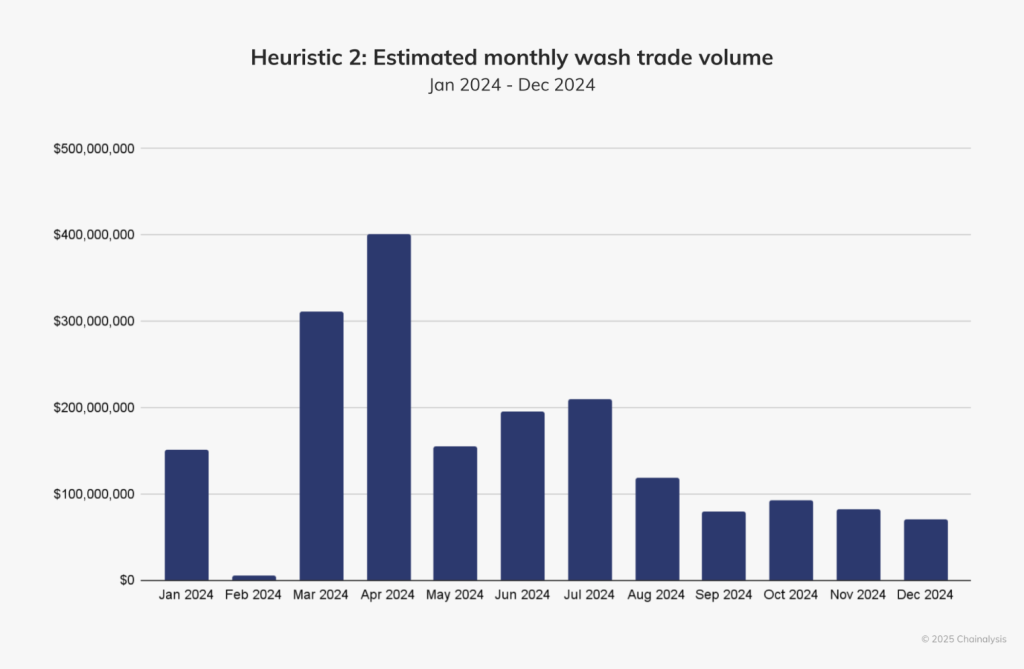
Recent findings from Chainalysis highlight the extent of this deception. In 2024 alone, researchers uncovered around $2.57 billion in suspected wash trading activities across prominent decentralized exchanges. One address executed over 54,000 buy-and-sell transactions of nearly identical amounts—not for profit, but to create the illusion of activity.
Moreover, researchers discovered that, on average, a single master wallet controlled approximately 183 other wallets, with some operators managing tens of thousands. These interconnected wallet networks can make one individual appear as an entire user community. When a small number of people can fabricate the illusion of widespread adoption, it prompts an unsettling question: what does “adoption” truly signify?
Airdrop Economics and the Mirage of Engagement
The phenomenon of airdrop farming has exacerbated this issue. Projects boast substantial user figures without recognizing that a significant portion of their “community” consists of individuals seeking free tokens across multiple protocols simultaneously.
Consider the statistics: according to industry data, over 52.7% of all cryptocurrencies ever listed on major tracking platforms have already failed, with most of these failures occurring in 2024 and early 2025. In fact, more than 1.8 million tokens disappeared in the first quarter of 2025 alone, highlighting how many projects vanish shortly after launch once initial excitement and airdrops fade.
This does not constitute adoption. It resembles a digital ghost town, animated by bots.
Projects celebrate millions of transactions without addressing the uncomfortable question: how many of these interactions would occur if we eliminated the token incentive? The answer, in most instances, is nearly zero. Yet these superficial metrics are packaged into pitch decks and used to justify nine-figure valuations.
Related Posts
The Red Flags No One Wants to See
The indicators of utility theater are consistent:
- Suspicious transaction patterns. When 90% of your volume originates from accounts that engage with your protocol solely to meet the minimum requirements for rewards, you do not have users—you have a gamified points system.
- Bot-driven metrics. Services openly sell fabricated trading volume, with bots generating tens of thousands of dollars in artificial activity within a single day. In one documented instance, purchased bots created $39,723 in fake volume for a token, representing 43% of its total Uniswap trading activity over several days.
- Token-gated everything. If your “utility” necessitates users to hold, stake, or spend your token for basic functionality, you are not addressing a problem—you are creating artificial demand.
- Metrics that vanish post-airdrop. The Chainalysis study found that suspected pump-and-dump schemes typically abandon tokens within an average of six days, with 94% of these schemes executed by the same addresses that deployed the liquidity pools.
What Real Utility Actually Looks Like
Authentic utility in crypto does not require a complex token mechanism to operate. It addresses a specific problem that users are willing to pay to resolve, regardless of the token. The value proposition exists independently of speculative appreciation.
True utility generates revenue from actual service delivery, not from selling tokens to the next buyer. It attracts users who remain engaged after the incentives diminish. It creates measurable value that can be verified without relying on easily manipulated on-chain metrics.
The infrastructure layer has not resolved this issue; it has become part of it. Tools designed to measure “real-world value” often merely create new opportunities for manipulation. When the measurement itself becomes tokenized and incentivized, we have merely added another layer to the shell game.
The Reckoning No One’s Prepared For
Let’s be candid: the industry’s rush to rebrand as “utility-driven” is less about developing useful products and more about attracting a new wave of investors, who have grown weary of empty promises.
After numerous boom-and-bust cycles and increased regulatory scrutiny, founders recognized the need for better narratives. Thus, they adopted the language of traditional technology, such as Daily Active Users (DAU), retention, and engagement, and applied it to an ecosystem still fundamentally rooted in speculation.
The unfortunate reality is that this shift could have signified genuine progress. Blockchain technology does enable truly innovative applications. However, by disguising the same speculative dynamics as utility metrics, the industry has squandered an opportunity to create something legitimate.
When the music stops—and it always does—projects will be evaluated not by their transaction counts or DAU figures, but by a straightforward question: Would anyone utilize this if the token were to drop to zero?
For the vast majority of today’s “utility-driven” projects, the answer is no. And everyone involved in this space is aware of it.
The emperor’s new clothes are composed of smart contracts this time. Yet he remains somewhat exposed.
Disclaimer: The views expressed in this article are those of the author and do not necessarily reflect the opinions of Cryptonews.com. This article aims to provide a broad perspective on its subject and should not be interpreted as professional advice.
The post The Utility Mirage: How Crypto’s New Metrics Are Just Old Tricks in Disguise appeared first on Cryptonews.
