Disclaimer: Information found on CryptoreNews is those of writers quoted. It does not represent the opinions of CryptoreNews on whether to sell, buy or hold any investments. You are advised to conduct your own research before making any investment decisions. Use provided information at your own risk.
CryptoreNews covers fintech, blockchain and Bitcoin bringing you the latest crypto news and analyses on the future of money.

South Korea’s Major Political Parties Introduce Stablecoin Legislation, Disagree on Interest Payment Proposals

Legislators from South Korea’s two largest political parties have introduced stablecoin legislation. The authors of the bills agree on several aspects, but the issue of interest payment structures seems to be a point of contention.
The South Korean news outlet Newsprime reported that both the ruling Democratic Party (DP) and the primary opposition People Power Party (PPP) presented their respective bills, drafted by individual lawmakers, on July 28.
The bill from DP MP An Do-geol is titled the Act on the Issuance and Distribution of Value-Stable Digital Assets.
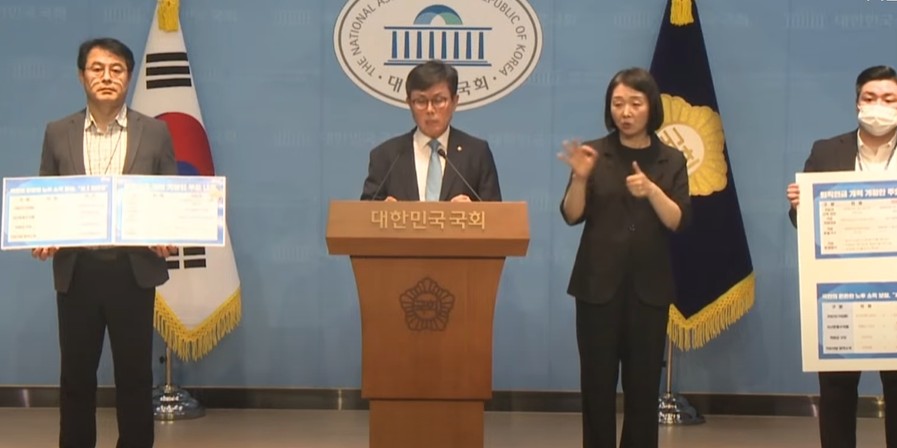 The DP lawmaker An Do-geol (second from left) addressing the National Assembly earlier this month. (Source: National Assembly/Screenshot)
On the other hand, the PPP’s Kim Eun-hye has named her legislation the Act on Payment Innovation with Fixed-Price Digital Assets.
Stablecoin Bills: Areas of Consensus
Both pieces of legislation advocate for KRW-pegged stablecoins to be integrated into the domestic financial institutional framework.
Additionally, the two proposed laws show considerable agreement between the parties. Both bills suggest that the Financial Services Commission (FSC) should oversee the regulation of won stablecoins.
If enacted, the FSC would have the authority to establish regulations regarding the issuance, distribution, and redemption of stablecoins.
It would also possess the capability to issue emergency directives to operators if there are concerns regarding market disruption or user harm.
Former first lady’s home and office searched as investigations accelerate ahead of August summonshttps://t.co/mmFqfL9CPk
— The Korea Herald 코리아헤럴드 (@TheKoreaHerald) July 25, 2025
Both Kim and Ahn’s bills specify that the FSC will be the exclusive licensing authority for KRW-pegged coins.
All potential issuers must be regulated financial institutions or joint stock companies. Foreign entities will only be permitted to apply for licenses if they maintain branches or sales offices in South Korea.
Moreover, all issuers must demonstrate that they possess equity capital of at least 5 billion won ($3.6 million). They are also required to have dedicated IT teams and employ personnel focused on stablecoin operations.
Related Posts
 The PPP lawmaker Kim Eun-hye. (Source: National Assembly TV/Screenshot)
Inflation: A Point of Disagreement
The topic of interest payments, however, is creating division. The DP seeks to prohibit interest-paying stablecoins to avert market disruption.
Conversely, the opposition PPP argues that interest-paying tokens would enhance the competitiveness of won-pegged stablecoins.
Kim articulated that interest payments would facilitate the expansion of won stablecoins in international markets.
However, Ahn’s bill entirely forbids such payments, cautioning that they could disrupt monetary policy and financial markets.
Views on this issue are split “even within the industry,” according to the media outlet. An unnamed source from the domestic crypto sector informed Newsprime:
“In the case of dollar stablecoins, interest payments would classify them as securities under US law. […] I believe that other countries can formulate regulations for stablecoins in accordance with their own legal frameworks.”
South Korean companies, including numerous commercial banks and technology firms, are hurrying to develop stablecoin issuance strategies as Seoul prepares to implement regulations in the near future.
This initiative is partly a response to the swift advancement of the GENIUS Act in the United States. Last month, US media reported that companies like Amazon and Walmart are considering launching stablecoins to reduce transaction fees.
The “GENIUS Act” signifies one of the most substantial revisions to US bankruptcy law since 2005, allowing stablecoin holders to be compensated before other creditors when reserves are insufficient. https://t.co/OrWDYKSUmc
— Bloomberg Law (@BLaw) July 21, 2025
This has prompted regulators in East Asia to expedite their own stablecoin regulations, seemingly determined to keep pace in the fiat-pegged token landscape.
In South Korea, major internet companies like Kakao and Naver are preparing to respond, with credit card issuers such as Lotte Card also taking action.
The post South Korea’s Biggest Parties Roll Out Stablecoin Bills, Clash on Interest Payment Plans appeared first on Cryptonews.
