Disclaimer: Information found on CryptoreNews is those of writers quoted. It does not represent the opinions of CryptoreNews on whether to sell, buy or hold any investments. You are advised to conduct your own research before making any investment decisions. Use provided information at your own risk.
CryptoreNews covers fintech, blockchain and Bitcoin bringing you the latest crypto news and analyses on the future of money.

Rakuten Enhances Ripple XRP Functionality for 44 Million Users: Significant Adoption or Minor Improvement?

Japan’s largest e-commerce platform is set to incorporate Ripple XRP into its payment system on April 15, 2026, making it available for spot trading on Rakuten Wallet and integrating it into Rakuten Pay, the application utilized by 44 million users for purchasing coffee, groceries, and bullet train tickets.
The overall figure is substantial enough to be significant.
The analytical inquiry is more complex: does the utility of XRP within a closed loyalty ecosystem represent retail adoption, or is this merely a product feature enhancement that utilizes crypto infrastructure that most users will not encounter?
Key Takeaways:
- Integration date: XRP will be available on Rakuten Wallet for spot trading starting April 15, 2026, alongside XLM, DOGE, SHIB, and TON.
- User scale: Rakuten Pay boasts 44 million users, while Rakuten’s broader ecosystem in Japan encompasses over 100 million member IDs.
- Mechanism: Users can convert Rakuten Points directly into XRP, which can then be used to fund Rakuten Cash – accepted at over 5 million merchant locations – indicating that XRP serves as a bridge asset rather than a directly held consumer token in most transactions.
- Points pool: Over 3 trillion Rakuten Points, valued at approximately $23 billion USD, are available for conversion, creating a significant but loyalty-locked potential demand for XRP.
- Regulatory footing: Rakuten Wallet operates under FSA licensing and JVCEA membership, providing compliance assurance in one of the most regulated crypto environments globally.
- What it does not do: This is not an open XRP wallet; users do not have direct custody of XRP outside the Rakuten ecosystem, and merchants receive fiat currency – not XRP – at the point of sale.
- Watch: Monitor whether Rakuten Bank’s planned FinTech integration (mentioned at its March 27, 2026 AGM) facilitates seamless fiat-to-XRP conversion across its 17 million banking accounts by Q3 2026.
Understanding the Rakuten-Ripple XRP Integration – and Its Limitations
Rakuten Points are not classified as a crypto asset. They are a proprietary loyalty currency issued by Rakuten at a rate of approximately one point per yen spent within its ecosystem – including shopping, travel, streaming, and banking.
The company issued around 620 billion points in 2022 alone. The total outstanding balance exceeds 3 trillion points, valued at roughly $23 billion USD based on current exchange rates. This represents a considerable pool of locked consumer value.
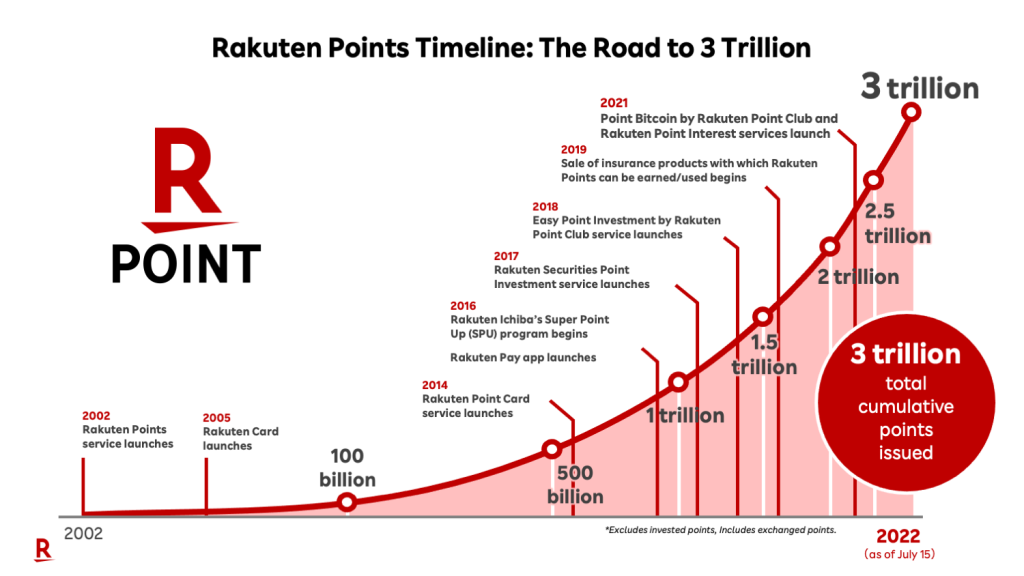 Source: Rakuten
The integration on April 15 creates a conversion pathway: users can convert their points into XRP via Rakuten Wallet and subsequently load the resulting balance into Rakuten Cash, the platform’s e-money layer, for use at over 5 million merchant locations.
The Rakuten Pay app manages the front end, while Rakuten Wallet, which is FSA-licensed and JVCEA-registered, manages the crypto backend.
Related Posts
It is important to note that merchants receive fiat currency. When a user pays with XRP-funded Rakuten Cash, the conversion to yen occurs in the background.
The retailer does not have any exposure to Ripple XRP. In most instances, the user is engaging with a points-to-payment flow that utilizes XRP infrastructure. This does not equate to 44 million individuals purchasing and holding XRP.
 Source: Tats on X
Japan’s regulatory framework enables this structure. The FSA has established a clear legal classification for XRP as a cryptocurrency, separate from a security, a framework that Japan’s evolving crypto regulatory landscape has been developing through successive amendments to the Payment Services Act.
Rakuten is not charting a new regulatory course; it is following a path that has already been navigated by SBI Holdings and others.
Liquidchain Aims for Early-Mover Advantage as XRP Approaches Key Levels
Liquidchain (LQC) is one project gaining attention in this context, a Layer-3 execution environment designed to aggregate liquidity across Ethereum and its rollup ecosystem, with a technical architecture specifically addressing the throughput challenges that Glamsterdam tackles at the base layer.
The presale has raised over $660K at a current token price of $0.0147, with staking rewards available for early participants.
The project’s primary differentiator is its unified liquidity routing across fragmented L2 environments, a structural issue that becomes increasingly relevant as Ethereum’s rollup ecosystem expands following Glamsterdam. Presale investments carry inherent risks, and this is an early-stage L3 infrastructure project with significant execution uncertainty. DYOR applies unconditionally.
Explore the Liquidchain presale here
The post Rakuten Expands Ripple XRP Utility for 44M Users: Mass Adoption or Incremental Update? appeared first on Cryptonews.
