Disclaimer: Information found on CryptoreNews is those of writers quoted. It does not represent the opinions of CryptoreNews on whether to sell, buy or hold any investments. You are advised to conduct your own research before making any investment decisions. Use provided information at your own risk.
CryptoreNews covers fintech, blockchain and Bitcoin bringing you the latest crypto news and analyses on the future of money.


Despite the ongoing downturn in the majority of the cryptocurrency market, privacy coins have exhibited an unexpectedly strong increase.
The October 2025 report from Grayscale Research highlights: “While cryptocurrency valuations generally declined in October, a notable exception was the Zcash network’s ZEC token, which surged by 248% during the month, achieving a market capitalization of approximately $6.5 billion.”
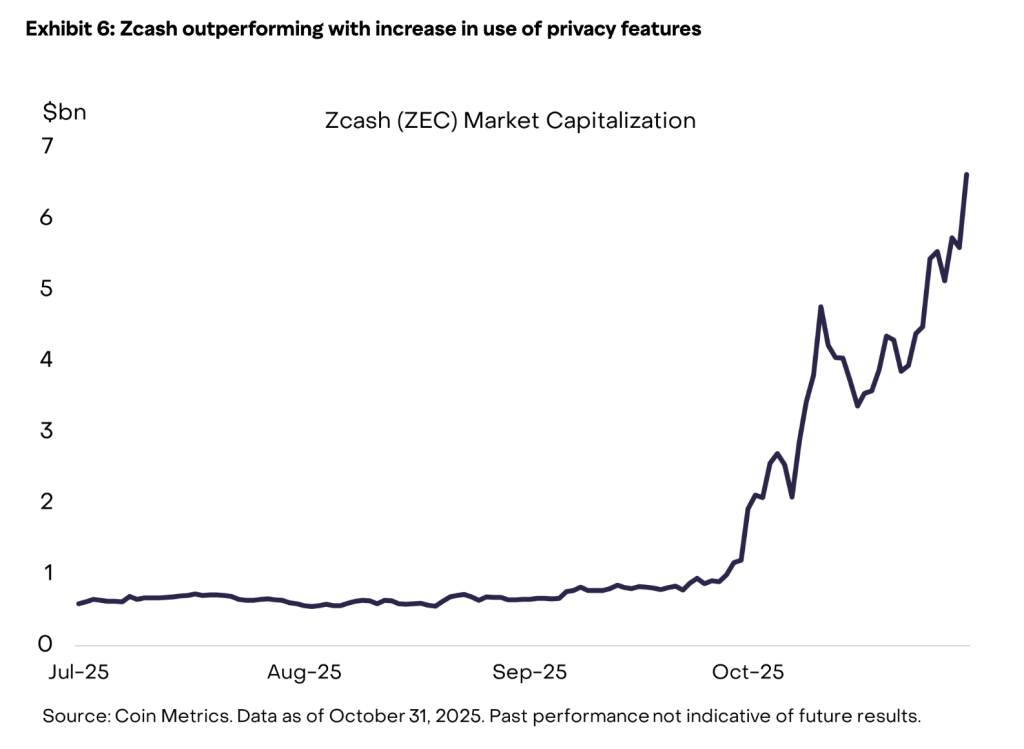 Source: Grayscale Research
Litecoin (LTC), Monero (XMR), and Dash (DASH) have also experienced heightened adoption, as evidenced by CoinMarketCap’s ranking of top-performing privacy tokens.
Only 17 of the Top 100 Coins Have Increased in Value Over the Last 90 Days
> Privacy: $ZEC, $XMR, $DASH, $DCR
> CEX: $BNB, $LEO, $MNT, $OKB, $KCS
> Meme: $M, $PUMP
> L1: $TAO, $ICP
> Others: $ASTER, $AERO, $TWT pic.twitter.com/lXgtG2A4SR— CoinMarketCap (@CoinMarketCap) November 6, 2025
A Closer Examination of Privacy Coins
While it may be surprising that privacy coins are gaining traction, industry analysts suggest that this trend was inevitable.
Privacy coins are the only narrative showing positive growth this quarter.
+39% in the last 3 months, while all other sectors are experiencing significant declines.
Who anticipated this? @0xMert_pic.twitter.com/cwuGRqwO2J
— Sharpe AI (@SharpeLabs) November 6, 2025
 pic.twitter.com/cwuGRqwO2J
Howard Wu, CEO of Provable and Creator of Aleo—an ecosystem of specialists utilizing privacy solutions for blockchain—shared with Cryptonews that privacy is becoming an increasingly important focus. Wu emphasized that this shift is a result of the market’s emphasis on financial infrastructure for practical applications.
“The requirements of businesses and institutions differ from those of early crypto users,” Wu stated.
With the enterprise blockchain market projected to reach $287 billion by 2032, organizations are turning to privacy coins to find solutions that provide some level of confidentiality. For instance, Grayscale’s report clarifies that Zcash is a decentralized digital currency akin to Bitcoin (BTC), but it includes optional privacy features through “shielded” accounts and transactions.
Shielded transactions on Zcash conceal the sender, recipient, and transaction amount using zero-knowledge proofs. The Zcash network employs cryptography to allow users to decide whether a transaction is public or shielded.
Grayscale’s findings indicate a rising demand for these features. “The proportion of ZEC supply held in shielded addresses has grown to around 30% from an average of about 10% in 2024,” the report notes.
How Institutions Utilize Privacy Coins
While traders are recognized for utilizing Zcash, institutions are beginning to adopt privacy coins for various applications.
Carter Feldman, Founder and CEO of Psy Protocol—a Layer-1 blockchain centered on privacy—told Cryptonews that institutional usage of Zcash mainly focuses on two areas.
“First, for selective privacy in transactions, where institutions can utilize Zcash’s shielded pools to perform confidential transfers while maintaining the ability to reveal details for audits or compliance through view keys.”
Furthermore, Feldman noted that investment products like the Grayscale Zcash Trust—which provides investors with indirect exposure to ZEC—have experienced consistent growth in assets under management (AUM).
“Such offerings indicate that institutions are actively diversifying their portfolios to incorporate privacy-enhancing assets,” he remarked.
The Significance of Privacy
Charlie Lee, the creator of Litecoin, explained that privacy is crucial for many businesses engaging in transactions with LTC. “I don’t view LTC as a privacy coin since we are not specifically focused on privacy. However, having privacy features available for users is an essential aspect of payments, which is the purpose for which LTC was designed,” he stated.
Will Wendt, head of ecosystem at Oasis Protocol, further informed Cryptonews that enterprises interested in privacy coins are not solely focused on the tokens themselves, but rather on the outcomes.
“Projects developing privacy-preserving technology that can operate across chains and integrate with existing systems are what truly capture institutional and enterprise interest, rather than merely holding privacy-focused tokens,” Wendt explained.
Related Posts
Institutions have also started to experiment more with ZKP architecture to investigate private settlement layers and confidential reporting mechanisms.
Gracy Chen, CEO of crypto exchange Bitget, informed Cryptonews that similar privacy principles are being incorporated into newer Web3 networks that emphasize compliance-friendly privacy, where data can be selectively disclosed when necessary.
“It’s not about concealing transactions anymore, but about safeguarding sensitive business information in a manner that remains auditable and compliant with regulations,” Chen stated.
Privacy Versus Anonymity
While the concept of privacy is appealing to both institutions and businesses, it is crucial to differentiate between privacy and anonymity.
Tom D’Eletto, Head of Product at Arculus—a cold storage wallet provider—shared with Cryptonews that the cryptocurrency sector often conflates “privacy” and “anonymity,” but there are distinctions.
“Tokens like ZCash, Monero, and sentz (formerly Mobilecoin) are anonymous,” D’Eletto noted. “Solutions such as Aleo, Midnight, and private transactions in Solana (and other similar options) are ‘private,’ meaning that not everyone can see all transactions (to some extent).”
This distinction is significant, as D’Eletto pointed out that institutions and businesses utilizing privacy coins still need to comply with regulations. “A regulator must still be able to access certain data when necessary,” he stated.
Regulatory and Technical Challenges
In light of this, Lee mentioned that several regulatory hurdles will pose challenges for institutions and enterprises using privacy coins.
“For instance, there have been numerous crackdowns on exchanges listing privacy coins in regions like Korea. When Litecoin introduced its privacy layer, LTC was removed from exchanges in Korea. This created difficulties for users in acquiring LTC and utilizing the token.”
The United States has also recently expressed concerns regarding privacy coins. If enacted, FinCEN’s proposed regulation would mandate exchanges and institutions to maintain records and report any transactions exceeding $500 involving an unhosted wallet if the transaction is private or encrypted. The U.S. has also imposed sanctions on specific privacy tools like Tornado Cash, associating them with money laundering and terrorism.
Eric Jardine, head of research at blockchain analysis firm Chainalysis, informed Cryptonews that one of the primary challenges for institutions exploring privacy tokens is achieving the right balance between safeguarding user privacy and enabling lawful oversight.
“Privacy features may complicate transaction tracing, but institutions still need to ensure they can meet compliance obligations and investigate suspicious activities when they arise. Ultimately, establishing trust will depend on demonstrating that privacy and accountability can coexist,” Jardine stated.
Technical challenges are also linked to privacy coins. Lee explained that a transparent, fixed supply of tokens—as seen with Bitcoin—becomes complex with privacy coins.
“Advanced cryptography is required to prove that no additional coins have been created out of nothing,” he noted. “There may also be quantum attacks against privacy coins that could lead to hidden inflation.”
Lee further added that transactions often take longer to process when utilizing privacy coins due to potential hidden inflation.
On-chain Privacy Will Expand, But What About Privacy Coins?
Despite these challenges, it is evident that the demand for on-chain privacy is increasing and will likely continue to grow.
“We’re observing this not only at the base layer but also with the rise of next-generation blockchains designed for privacy-preserving smart contracts, such as Psy, Miden, and Aztec,” Feldman stated.
While this may be the case, privacy coins like Zcash that are gaining momentum during the current bear market could represent a trend.
“People are always pursuing the next significant development, and privacy becomes a focal point when more individuals learn about privacy coins,” Lee remarked.
The post Institutions Are Buying Into The Privacy Coin Hype – But Will It Last? appeared first on Cryptonews.
