Disclaimer: Information found on CryptoreNews is those of writers quoted. It does not represent the opinions of CryptoreNews on whether to sell, buy or hold any investments. You are advised to conduct your own research before making any investment decisions. Use provided information at your own risk.
CryptoreNews covers fintech, blockchain and Bitcoin bringing you the latest crypto news and analyses on the future of money.



Blockchain developers are often behind not only major projects in the cryptocurrency sector but also create their own messaging applications. What distinguishes these messengers from popular options, and should users pay attention to such applications?
Keet
Related Posts
Keet is a messaging application developed by the team behind the Holepunch platform and the world’s largest stablecoin issuer, Tether. The project is supported by Bitfinex and Hypercore. A key feature of this communication app is its use of a peer-to-peer (P2P) network with end-to-end encryption (E2EE). According to the developers, this eliminates any interaction with central servers.
This means that all conversations between users are stored on their devices. To implement such a network, Keet employs certain solutions from the cryptocurrency realm. For instance, instead of conventional phone numbers and email addresses, a seed phrase is required to access the application, similar to what is used for recovering non-custodial crypto wallets. When creating a new account, Keet presents a set of 24 words that the user must securely store, ensuring that unauthorized individuals cannot access it.
Visually, Keet resembles traditional messengers like Telegram. It supports chats between users, group chats, and audio/video calls. Media files (such as photos and voice messages) can be shared through the messenger. Given that exchanges occur directly between individuals, there are no potential additional restrictions imposed by a server.
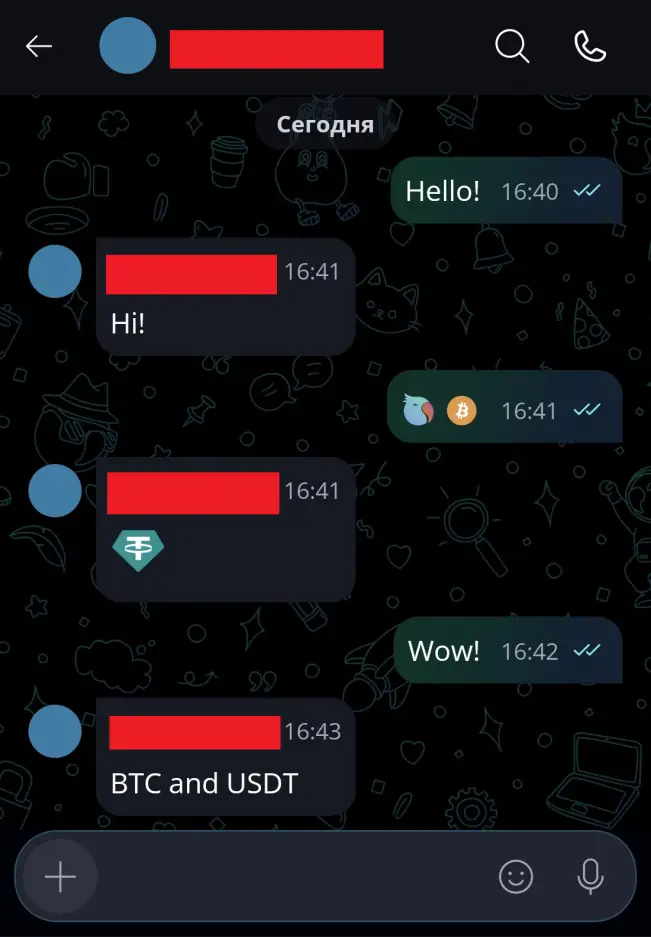
The application is free and available on the App Store and Google Play, as well as in desktop versions.
Interestingly, a built-in emoji pack hints at its connection to the cryptocurrency industry and Tether in particular, featuring logos for BTC, USDT (Tether’s main product), and Keet itself—a blue-green bird.
BitChat
Another P2P messenger with end-to-end encryption and no centralized servers is BitChat. This application is developed by American entrepreneur Jack Dorsey, one of the co-founders of Twitter. Dorsey is also the founder of the fintech company Block, which is involved in hardware Bitcoin wallets, mining solutions, and other blockchain products.
Unlike Keet, BitChat does not require an internet connection for message transmission. It operates as a decentralized mesh network that connects users via Bluetooth. Thus, internet access is only necessary during the app download, after which it can be disregarded.
This method of data exchange is drastically different from that of traditional messengers like WhatsApp. When sending messages, users simultaneously act as nodes for relaying others’ messages. This means that the distance between the sender and receiver can exceed the Bluetooth range of smartphones/tablets. Nevertheless, the message will still be delivered through other users’ devices while remaining encrypted.
On the downside, this technology presents a significant limitation for the messenger—it is suitable for local use, such as for a household chat. It does not cover vast distances where necessary nodes are understandably absent. The program’s interface and functionality are quite minimalistic. Essentially, the messenger is designed for text message transmission, with no real-time audio or video calling features.
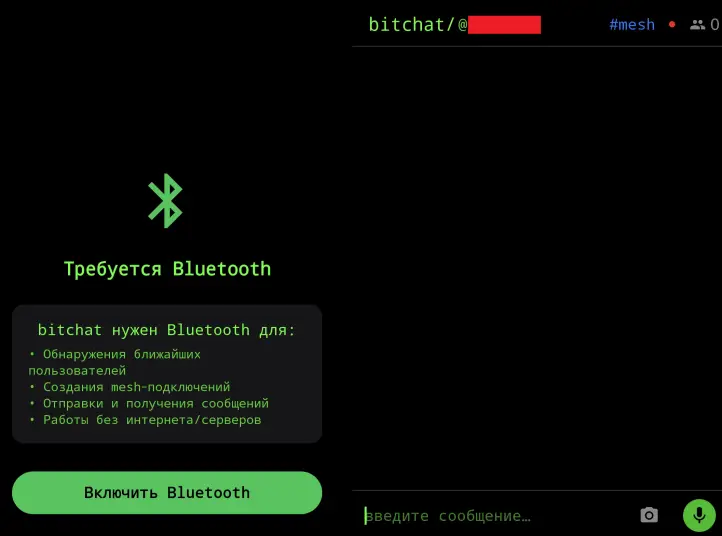
The blockchain developments from Block are not the only connection between BitChat and the cryptocurrency industry.
- The name BitChat is likely inspired by Bitcoin, the first cryptocurrency;
-
The description style on the official project website closely resembles the Bitcoin White Paper’s abstract. It highlights the existing issue of “the centralized infrastructure that traditional messengers rely on, which can be censored, controlled, or shut down.” According to the developers, BitChat aims to create “self-organizing communication networks” as an alternative.
The application operates freely in Russia as of spring 2026, but is subject to censorship in some countries. In April, Apple removed the app from the Chinese App Store at the request of local authorities.
An unverified hypothesis suggests that Jack Dorsey may be the person behind the pseudonym Satoshi Nakamoto. The entrepreneur actively supports BTC, referring to it as a tool for financial freedom.
The BitChat application is completely free and available on the App Store and Google Play.
Status
Status is more of a modern Web3 application with messaging capabilities than a convenient text communication tool like Keet or BitChat. The program is linked to the Ethereum ecosystem and is primarily designed for cryptocurrency storage. The developers describe their product as a “decentralized wallet and open-source messenger.”
When creating an account, there is no need for an email address or phone number, and recovery is done using a seed phrase and password. For users unfamiliar with the functionalities of modern Web3 wallets, the Status interface may appear somewhat confusing and counterintuitive.
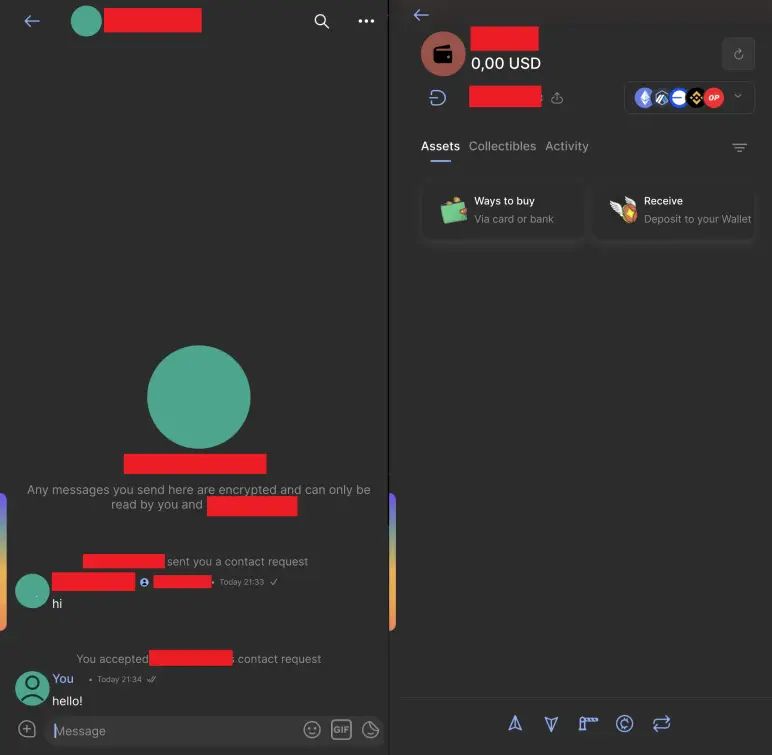
Nevertheless, the messenger effectively handles its primary task—message transmission. Group chats can be set up, but real-time audio/video calls are not available. The developers emphasize that the current version of the application is in early access and is still being tested.
XX Messenger
Although the XX Messenger project is officially frozen, it deserves a mention among messengers from figures in the crypto industry. The application was developed by David Chaum, an American cryptographer often referred to as the “father of modern cryptography.” His work anticipated the development of many blockchain technologies. In 1995, Chaum’s company launched the digital currency eCash—an early form of cryptocurrency. The protocols and solutions he proposed, such as blind signatures, laid the groundwork for modern digital cash and were actively discussed in cypherpunk mailing lists.
XX Messenger is one of the products of the XX Network platform. The application’s main feature is its resilience against hacking through quantum computing. This decentralized messenger, according to the developers, possesses a high degree of privacy—not only due to end-to-end encryption but also through the cMix metadata destruction mechanism.
Unfortunately, after the project was frozen, the application cannot be downloaded from the App Store or Google Play. However, XX Messenger was available for some time as an open-source product. On the official platform website, there is a notice from the developers stating: “The development of the messenger has been halted. There are functioning applications for Android and iOS, although their stable operation cannot be guaranteed.”
DarkIRC
The anonymous chat DarkIRC is another project by renowned cryptographer Amir Taaki. The situation here is quite the opposite. Unlike XX Messenger, this project is not frozen but is in the testing phase. As of April 2026, the program versions are labeled “Alpha.” The application cannot be downloaded from the App Store or Google Play. However, as an open-source project, it can still be installed by enthusiasts and developers, with necessary information available on the official website. The creators of the messenger emphasize that stability is not guaranteed at this stage.
Amir Taaki’s team has ambitious plans. They believe they can offer the world “the most secure anonymous chat available.” The key feature of DarkIRC is the absence of identifiers. The developers state that they created the program in response to “brutal censorship by blockchain developers succumbing to authorities.”
Amir Taaki is also known as an early Bitcoin developer. In particular, he proposed the concept of Bitcoin Improvement Proposals (BIPs).
Telegram — as an exception
It is worth noting that Pavel Durov’s project represents the most well-known example of a mass messenger with an integrated crypto wallet. Durov’s connection to The Open Network (TON) team and the cryptocurrency Toncoin is also evident. Unlike all the aforementioned applications, Telegram has the most ambitious plans for integrating solutions from the cryptocurrency industry, including complex DeFi tools, developer support, the development of a decentralized network intersecting with AI Cocoon, and much more.
Since spring 2026, there have been attempts to block the messenger in Russia, but its use is not prohibited.
Main features of crypto messengers
Many messengers from blockchain developers, with clear exceptions like Telegram and the frozen XX Messenger, are freely accessible in Russia and the vast majority of other countries worldwide.
Regarding Keet, BitChat, and Status—these applications serve fundamentally different purposes. Keet is closest to traditional messengers: it has the essential set of features, including video/audio calls, and its interface is straightforward and intuitive. In contrast, Status is a Web3 solution for the Ethereum ecosystem and is more frequently used by active participants in the second-largest cryptocurrency by market capitalization. Finally, while BitChat can operate without an internet connection, it has limited functionality and a narrow range of use cases.
A common trend among blockchain developers in such products is the rejection of centralized servers, a shift to a peer-to-peer network model, and the use of seed phrases for account recovery.
