Disclaimer: Information found on CryptoreNews is those of writers quoted. It does not represent the opinions of CryptoreNews on whether to sell, buy or hold any investments. You are advised to conduct your own research before making any investment decisions. Use provided information at your own risk.
CryptoreNews covers fintech, blockchain and Bitcoin bringing you the latest crypto news and analyses on the future of money.

Indiana Legislation Proposes Requirement for Bitcoin in Retirement Funds and Protection of Self-Custody Rights

A recently proposed bill in Indiana aims to mandate public retirement programs to provide Bitcoin-related investment options while also restricting the authority of local governments to impose limitations on the use of digital assets.
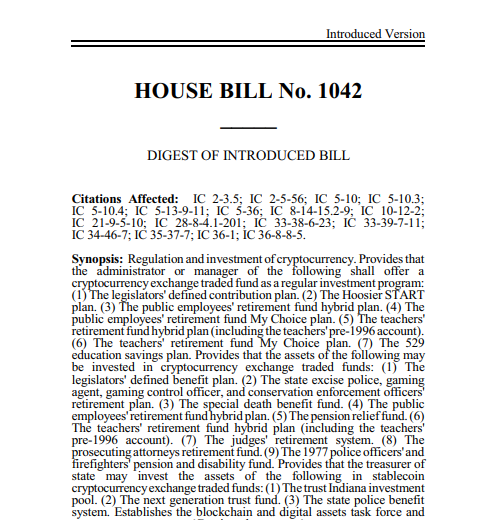
The legislation, introduced on Thursday by State Representative Kyle Pierce, a Republican from Anderson, is known as House Bill 1042 and was discussed during a session of the House Financial Institutions Committee.
This bill seeks to grant public employees access to cryptocurrency investments while establishing clear legal parameters regarding the use, custody, payments, and mining of digital assets.
Indiana Aims for First-in-the-Nation Requirement for Bitcoin in Public Pensions
According to the bill, the administrators of various state-managed retirement and savings plans would be obligated to include cryptocurrency exchange-traded funds as standard investment options.
It would also allow specific public pension funds to invest directly in crypto-linked ETFs and empower the state treasurer to allocate funds from designated accounts into stablecoin-based ETFs.
Pierce stated that the bill is intended to provide Indiana residents with greater financial flexibility as digital assets increasingly integrate into the wider economy.
He further noted that the legislation aims to strike a balance between investment options and regulatory frameworks while enabling the state to investigate potential governmental applications of blockchain technology through pilot initiatives.
 Source: Indiana House Republicans
The legislation extends beyond retirement investments, addressing local regulations as well. Municipalities would be barred from enacting rules that impose “unreasonable” restrictions on digital assets if similar regulations do not apply to conventional financial activities.
This protection would encompass crypto payments, private ownership of digital wallets, and mining operations.
The bill introduces explicit protections for self-custody, stating that private digital asset keys may only be requested through a court order and only when no alternative legal means of access is available.
It would also prevent local authorities from excluding mining facilities from industrial zones and would safeguard appropriately zoned residential mining activities.
If passed, Indiana would be the first state in the nation to mandate publicly managed retirement programs to offer Bitcoin exposure as a standard investment option.
While some states allow limited flexibility for crypto investments, none currently impose such a requirement.
U.S. States Broaden Crypto Access in Pensions, Payments, and Property Regulations
Related Posts
Other states have taken related but more limited actions. Oklahoma enacted a law in 2024 that protects residents’ rights to hold crypto in self-custody wallets and prohibits special taxes on Bitcoin transactions.
In 2025, Kentucky followed suit by officially recognizing self-custody as a protected property right. Wyoming has also passed legislation permitting public pension funds to invest in digital assets.
Additionally, Arizona has introduced a bill allowing Bitcoin ETFs in retirement accounts, while Florida has outlined legal avenues for holding digital assets through ETFs in certain state funds.
Arizona’s initiative to incorporate digital assets into state financial systems is approaching a significant milestone. #Arizona #Bitcoinhttps://t.co/jNb7UnYvX1
— Cryptonews.com (@cryptonews) April 18, 2025
 Arizona’s initiative to incorporate digital assets into state financial systems is approaching a significant milestone. #Arizona #Bitcoinhttps://t.co/jNb7UnYvX1
Indiana’s proposal is distinct in that it makes access to crypto ETFs a requirement rather than an option.
Interest in crypto-linked retirement exposure continues to grow across the country. In August, Michigan’s state retirement system increased its Bitcoin ETF holdings to 300,000 shares, valued at approximately $11.4 million, according to regulatory disclosures.
The State of Michigan Retirement System has expanded its Bitcoin exposure, tripling its holdings in the @ARKInvest 21Shares Bitcoin ETF.#Michigan #Bitcoinhttps://t.co/lUxWycmp4A
— Cryptonews.com (@cryptonews) August 6, 2025
The fund also holds approximately $13.6 million in Ethereum through the Grayscale Ethereum Trust. Wisconsin’s state investment board has reported over $387 million in Bitcoin ETF exposure.
States are also broadening their use of digital assets beyond investments. In September, Ohio finalized plans to accept Bitcoin and other cryptocurrencies for official state payments.
In October, California revised its Unclaimed Property Law to ensure that dormant crypto is not automatically converted into cash when transferred to state custody.
California has become the first U.S. state to formally safeguard unclaimed crypto from being forcibly converted to cash.#California #Bitcoinhttps://t.co/PoV40lmZi9
— Cryptonews.com (@cryptonews) October 14, 2025
 California has become the first U.S. state to formally safeguard unclaimed crypto from being forcibly converted to cash.#California #Bitcoinhttps://t.co/PoV40lmZi9
New York City has also taken measures by establishing a municipal Office of Digital Assets and Blockchain.
This initiative followed an executive order from Mayor Eric Adams aimed at coordinating crypto policy and promoting blockchain development.
Bitcoin NYC Mayor Adams established the “nation’s first-ever” municipal office for crypto and blockchain to position the city as the global crypto hub.#EricAdams #NYCMayor #CryptoOfficehttps://t.co/oVEBRTRp5y
— Cryptonews.com (@cryptonews) October 15, 2025
At the federal level, broader regulatory initiatives are also in progress. Lawmakers are working on new frameworks that could influence how states approach crypto policy, including updated guidance on 401(k) crypto exposure anticipated in 2026.
The post Indiana Bill Would Mandate Bitcoin in Pensions and Shield Self-Custody Rights appeared first on Cryptonews.
