Disclaimer: Information found on CryptoreNews is those of writers quoted. It does not represent the opinions of CryptoreNews on whether to sell, buy or hold any investments. You are advised to conduct your own research before making any investment decisions. Use provided information at your own risk.
CryptoreNews covers fintech, blockchain and Bitcoin bringing you the latest crypto news and analyses on the future of money.


Key Takeaways:
- The escalating threats of large-scale conflict in Europe, the Middle East, and other regions may lead to increased scrutiny of cryptocurrency this year.
- Analysts suggest that crypto companies must be prepared to justify their actions, partnerships, and transactions.
- Additionally, the potential introduction of several CBDCs indicates that the industry is likely to “experience a significant variation of regulatory controls established in 2025.”
The looming threat of a global war continues to cast a shadow over global economies as we approach 2025. The cryptocurrency sector, which marked Bitcoin’s $100,000 achievement in late 2024, will not be exempt.
Moreover, there are several noteworthy regulatory developments to monitor in the upcoming year, including the European Union’s (EU) Markets in Crypto-Assets (MiCA) regulation and Donald Trump’s return to office.
International disputes have historically spurred speculative investments. However, according to four experts who spoke with Cryptonews, they have also led to economic sanctions and increased government oversight of markets.
“Uncertainty can either promote investment where opportunities are identified or trigger profiteering as the war machine gradually activates,” stated Mark Taylor, head of financial crime at crypto exchange CEX.io.
“Conversely, it can deter participation by revealing vulnerabilities and necessitating stronger controls, both locally and globally, through measures such as sanctions,” he added.
Experts indicate that Bitcoin, serving as a proxy for the cryptocurrency sector, introduces a new element to the situation. This is due to Bitcoin’s emerging reputation as a gold-like store of value, capable of withstanding market pressures related to conflict.
According to Taylor, the increasing risks of full-scale warfare in Europe, the Middle East, and other areas may lead to “heightened scrutiny” for cryptocurrency firms this year. He informed Cryptonews:
“They [crypto firms] must be ready to justify their actions, relationships, and transactions, sometimes long after they occur, as their activities may later be evaluated in the context of global geopolitical events. There is no doubt that such events influence markets and confidence.”
For context, geopolitical tensions to monitor in 2025 include:
- The return of assertive and territorial U.S. President Donald Trump to arguably the world’s most powerful position.
- Russian President Vladimir Putin’s threats to cross “red lines,” such as internationally agreed safeguards against nuclear warfare, in response to NATO’s support for Ukraine’s war efforts.
- Ukraine’s counter-offensive actions and Russia’s increasing aggression.
- Rising tensions in the Middle East, with regional powers Israel and Iran exerting influence, while the U.S. and Russia remain involved in the background.
- Regional conflicts to fill the geopolitical vacuum left by the fall of Syrian leader Bashar al-Assad.
Banking ‘Illegal Wars’
Increasing conflict in the Middle East and the threat of global warfare will drive more sanctioned regimes like Russia, Iran, and North Korea to utilize Bitcoin instead of fiat currency, asserts Slava Demchuk, CEO of compliance and blockchain forensics firm AMLBot.
“Russian companies are using crypto assets for cross-border transactions, evading sanctions, and laundering money,” Demchuk claimed.
“We can expect that the G7 and the Western world may introduce new measures focusing on crypto businesses to prevent loopholes that allow Russians to evade sanctions,” he stated in an interview with Cryptonews.
This shift to crypto evasion follows sanctions imposed on Russian banks and their removal from the U.S.-linked SWIFT international payment system.
Dacian Cimpean, a digital marketing specialist at decentralized apps platform MultiversX, noted that instability drives actors toward safe-haven assets.
For instance, he pointed out that oil prices surged above $100 per barrel at the onset of the Russia-Ukraine conflict in 2022, contributing to inflationary pressures and economic policy reassessments globally.
“On one hand, digital assets like Bitcoin are often viewed as alternatives to traditional safe havens, attracting investors during times of turmoil,” Cimpean informed Cryptonews.
“This perception has been evident in countries facing economic instability, where citizens turn to cryptocurrencies to preserve wealth.”
He added:
“Conversely, heightened geopolitical risks can lead to increased regulatory scrutiny and potential restrictions on crypto transactions, as governments aim to prevent capital flight or sanction evasion. Such measures can dampen market sentiment and introduce volatility.”
Is Bitcoin Really a Safe-Haven Asset?
BRICS+, primarily consisting of Brazil, Russia, India, China, and South Africa, are considering the idea of a collective central bank digital currency (CBDC) that could accelerate their de-dollarization efforts.
The initiative to reduce dollar influence using crypto assets faces two significant obstacles. One is the withdrawal of M-Bridge, the Dutch platform that the nations intended to utilize for the project. The other is U.S. President-elect Trump’s threat to undermine the initiative.
The notion that the BRICS Nations are attempting to move away from the Dollar while we stand by and watch is OVER. We require a commitment from these Nations that they will neither create a new BRICS Currency nor back any other Currency to replace the mighty U.S. Dollar or, they…
— Donald J. Trump (@realDonaldTrump) November 30, 2024
In 2020, Venezuela resorted to a government-issued crypto token, Petrodollar, to mitigate the effects of U.S. sanctions on its struggling democracy.
Surprised by sanctions against its nuclear program, North Korea turned to hacking crypto funds to bolster its defense budget. The UN reports that the rogue state raised $2 billion through cybercrime between 2019 and 2020.
Related Posts
These recent incidents illustrate how cryptocurrency has been involved in geopolitical disputes.
However, Bitcoin has not consistently passed the safe-haven test. For instance, BTC dropped 16% as the stock market crash of August 5, 2024, reverberated through crypto markets. In contrast, gold demonstrated greater resilience, retreating just over 1%.
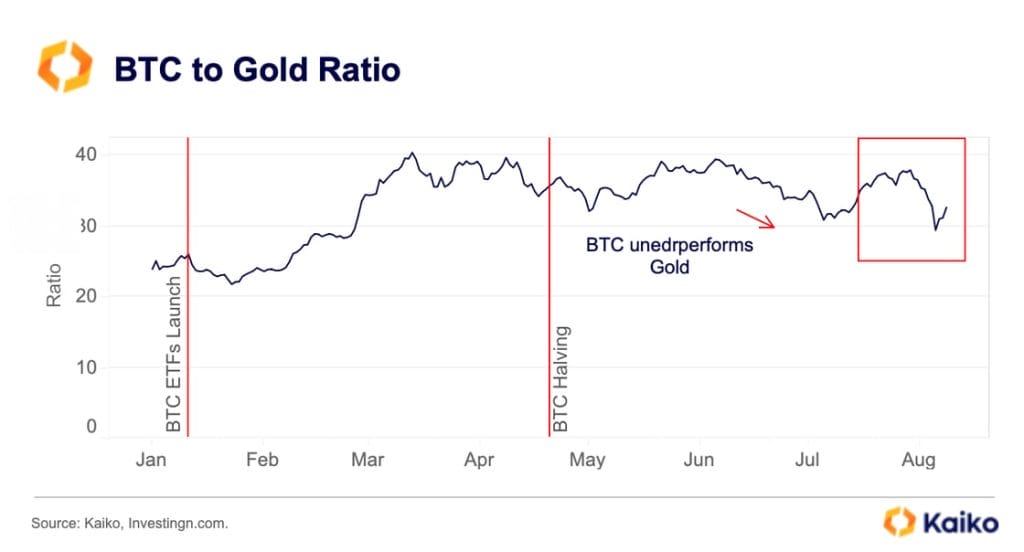
In April, Bitcoin’s market value decreased by 6% despite a surge in demand for safe-haven assets as the conflict in the Middle East intensified.
Conversely, gold increased by 8%, and the U.S. dollar also strengthened. Similarly, in October 2023, Bitcoin remained relatively unchanged following the Hamas attack on Israel.
Regulatory Outlook: ‘Less Onerous, Less Protection’
In the U.S., the Trump administration is back in action, with Bitcoin surpassing the psychological $100,000 threshold following Trump’s election victory.
According to analysts, here are some regulatory developments to monitor in 2025:
- Europe — The MiCA regulation, which took effect on December 30, 2024.
- U.S. — Donald Trump’s election as President and his nomination of crypto-friendly lawyer Paul Atkins to lead the SEC.
- The potential passage of the Clarity for Payment Stablecoins Act to guide stablecoin issuers in the United States.
- Measures to simplify tax reporting, reduce evasion, and ensure the crypto market contributes to tax revenues.
- Rapid passage of clear regulations from a crypto-friendly Parliament in the U.K. — FCA’s newly launched roadmap for crypto regulation.
- Australia — Ongoing government review of crypto-related markets and ASIC’s regulation by enforcement stance.
- Asia — DABA in South Korea, and continued regulatory development in Japan, Hong Kong, China, and Singapore.
- Latin America — emerging crypto regulations.
“All of this, along with the potential launch of several CBDCs, suggests we will likely see a significant variation of controls established globally in 2025,” stated Taylor, the CEX.io financial crime head.
Taylor informed Cryptonews that the inconsistency will depend on whether governments perceive crypto positively or negatively, adding:
“For the U.S., the future appears to indicate there will be less onerous regulation, but consequently potentially less protection. In Europe, we can expect a comprehensive regulatory framework that will help develop markets and strengthen the processes of crypto companies.”
However, the EU may also “introduce complex requirements, including areas like market abuse and trade surveillance, which will be costly and challenging to implement in crypto markets,” he stated.
Such issues may have ripple effects that could drive regulatory expectations and compliance for the next five years or so, Taylor notes, adding:
“Crypto companies will need adaptability, expertise, and resilience to navigate the uncertainty and keep regulators satisfied.”
Luc Froehlich, chief commercial officer at the crypto companies’ free zone RAK Digital Assets Oasis, is largely optimistic about the European Union’s new regulations.
“The EU’s MiCA framework is particularly promising, especially given the size of the market it will open,” Froehlich informed Cryptonews.
On the other hand, the nature of Europe as a bloc presents challenges as there may be friction at the national level, resulting in the need for additional regulation.
“With hubs like Singapore and Hong Kong, Asia has managed to remain more agile and get ahead in the race to attract companies with increasingly crypto-friendly regulations, although with occasional speed bumps,” Froehlich noted.
“This situation places the Middle East, particularly the UAE, in a favorable position, bridging the East and West, providing a launchpad for global companies and demonstrating a clear appetite for blockchain-based solutions,” he stated.
How US Crypto ETFs Might Shape Regulations
When asked about how the U.S. Securities and Exchange Commission’s (SEC) approval of spot Bitcoin and Ethereum exchange-traded funds (ETFs) might influence regulatory frameworks for crypto assets in 2025, AMLBot’s Demchuk stated:
“Institutional ETF flows have historically altered market dynamics. Similar approvals will not only enhance adoption but also encourage regulatory bodies to establish clearer, more consistent guidelines that accommodate both traditional finance (TradFi) players and the broader crypto ecosystem.”
Froehlich disagrees that the SEC’s approval of crypto ETFs is a “watershed moment” for the industry.
He questions the very idea of centralizing ownership of Bitcoin, which many in the crypto community consider the “most decentralized asset.”
“Bitcoin should be evaluated on its own merits and not necessarily regarded as representative of the overall ‘asset class’ or other cryptocurrencies,” he stated.
Cimpean, the MultiversX digital marketing specialist, anticipates the Trump administration will implement “swift legislative action, including the likely passage of the Clarity for Payment Stablecoins Act.”
“This legislation could provide regulatory clarity and promote broader adoption of stablecoins within the financial system,” he stated.
However, he also cautioned that “Stricter oversight might limit stablecoin growth in emerging markets and impose additional burdens on investors and exchanges.”
The post Global Conflict and Tighter Laws Could Derail Crypto in 2025: Experts appeared first on Cryptonews.
