Disclaimer: Information found on CryptoreNews is those of writers quoted. It does not represent the opinions of CryptoreNews on whether to sell, buy or hold any investments. You are advised to conduct your own research before making any investment decisions. Use provided information at your own risk.
CryptoreNews covers fintech, blockchain and Bitcoin bringing you the latest crypto news and analyses on the future of money.


This week, Bitcoin fell below the $90,000 threshold for the first time in seven months, exacerbating a sell-off that has permeated the cryptocurrency market and raising new concerns about whether digital assets are once again signaling potential risks for broader financial assets.
This decline occurs amid ongoing pressure on the global cryptocurrency market.
As per CoinGecko data, the total market capitalization decreased by 2% within 24 hours, reaching $3.08 trillion, accompanied by significant but waning trading activity at $202 billion.
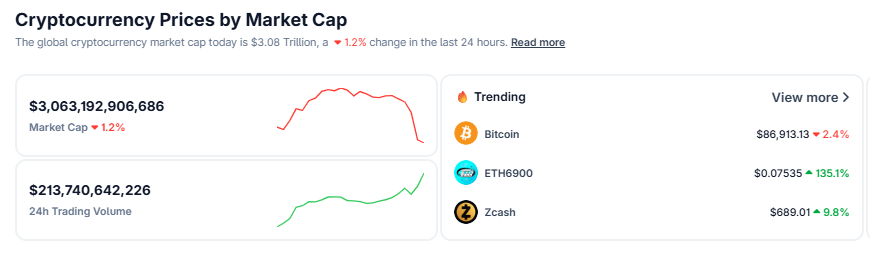 Source: CoinGecko
Bitcoin’s downturn has been consistent across various timeframes: down 2.5% daily and 12.7% weekly, while losing critical support levels that traders have monitored for several months.
 Source: Cryptonews
Ethereum mirrored this trend, experiencing a 14% decline over the week. XRP faced an even sharper seven-day drop of over 17%.
Moreover, the Bitcoin Fear and Greed Index currently indicates “Extreme Fear.”
Bitcoin ETFs Face Challenges as $3B November Outflows Accumulate
Spot Bitcoin ETFs listed in the United States ended a five-day streak of outflows on Wednesday, reporting total inflows of $75.4 million.
The rebound was primarily driven by BlackRock’s IBIT, which attracted $60.6 million. However, this recovery did not compensate for the more than $500 million the fund had lost the previous day.
Grayscale’s Bitcoin Mini Trust also saw positive inflows. In contrast, Fidelity and VanEck recorded a combined outflow of $39 million.
The recent trend of redemptions has been widespread throughout the industry. Data from CoinShares indicates that crypto exchange-traded products experienced $2 billion in outflows last week, marking the highest weekly total since February. U.S. products accounted for nearly all of this amount.
In November, U.S. spot Bitcoin ETFs have lost nearly $3 billion, positioning the category for one of its weakest months on record.
Markets are preparing for an unusually uncertain Federal Reserve meeting in December, following a recent government shutdown that delayed crucial labor data.
Expectations for a rate cut next month have decreased to 41.8% this week. Minutes from the Fed’s October meeting reveal a divided committee, balancing persistent 3% inflation against the risk of premature easing.
Restricted liquidity has been a recurring theme. Analysts at CryptoQuant have noted that similar conditions contributed to Bitcoin’s sharp decline in November, as diminished liquidity tends to heavily impact speculative assets.
Related Posts
Thursday’s U.S. stock session reflected this tension. Following a strong morning rally fueled by Nvidia’s positive earnings, markets reversed course.
The Nasdaq, which had been up nearly 2.5% earlier in the day, fell into negative territory. The S&P 500 also experienced a slight decline.
Investors shifted their attention to the September jobs report, which revealed 119,000 new positions, more than double expectations, but raised new questions regarding the Fed’s next actions.
Bitcoin Declines as OG Wallets Liquidate Billions, Revealing Fragile Liquidity
Global markets exhibited mixed reactions. Gold remained steady near $4,084 per ounce. Analysts observed that the metal’s resilience reflects expectations that the Fed may refrain from implementing another rate cut in December.
The latest Bitcoin sell-off coincides with traders unwinding positions established during October’s record surge.
Intense selling from large holders has amplified the pressure. Numerous Bitcoin OG wallets have indicated intentions to liquidate their holdings.
Earlier in November, BitcoinOG (1011short) deposited approximately 13,000 BTC valued at $1.48 billion to Kraken since October 1, while early adopter Owen Gunden transferred 3,265 BTC worth $364.5 million to Kraken since October 21.
Furthermore, Gunden transferred his final 2,499 Bitcoin, valued at $228 million, to the cryptocurrency exchange Kraken on Thursday.
In total, Gunden’s wallet has sold 11,000 Bitcoin worth around $1.3 billion since October 21, liquidating his entire Bitcoin holdings, according to Arkham.
Analysts indicate that October’s drastic liquidation cascade, which eliminated over $19 billion in leveraged crypto positions, has disrupted market structure.
Liquidity has not fully recovered, leaving prices susceptible to even moderate selling.
Swissblock analysts suggest that Bitcoin has reached “cycle-level exhaustion” near $90,000. They contend that reclaiming $97,000 to $98,500 would be necessary to regain bullish momentum.
Glassnode has identified similar resistance levels around the short-term holder cost basis between $95,000 and $97,000.
Crypto’s weakness has often preceded broader market pullbacks multiple times in 2024 and 2025.
This pattern reemerged in early November when Bitcoin began to decline shortly before equities exhibited signs of stress.
Analysts remain cautious about labeling it a direct warning sign but note that the shared macro conditions, particularly interest rate uncertainty, increase the likelihood of simultaneous stress across markets.
The post Panic Warning: Bitcoin Crashes Under $90K – Early Warning of Risk-Asset Meltdown? appeared first on Cryptonews.
