Disclaimer: Information found on CryptoreNews is those of writers quoted. It does not represent the opinions of CryptoreNews on whether to sell, buy or hold any investments. You are advised to conduct your own research before making any investment decisions. Use provided information at your own risk.
CryptoreNews covers fintech, blockchain and Bitcoin bringing you the latest crypto news and analyses on the future of money.

US Bitcoin enthusiasts tend to lean left, yet a report indicates that political views are less polarized than commonly perceived.

Bitcoin ownership across the United States encompasses a wide range of demographics and political affiliations, challenging prevalent assumptions about its advocates, as indicated by a recent report.
The Nakamoto Project’s latest survey on Bitcoin adoption offers an in-depth examination of ownership patterns among Americans. This study, conducted in collaboration with Qualtrics, included a representative sample of 3,538 adults gathered in two phases from November 2023 to March 2024.
The objective of the survey was to pinpoint significant factors affecting Bitcoin adoption and ownership in the United States, setting itself apart from earlier surveys through its broad population-level approach and specific emphasis on Bitcoin. One of the authors of the report, Troy Cross, encapsulated the findings on X,
“Our survey of 3,538 adults in the US found bitcoin ownership:
-encompasses the entire spectrum of political identity
-is predominantly young and male
-weakly correlates with a distinct set of moral values
-strongly correlates with knowledge of bitcoin”
The results indicate that Bitcoin ownership is not heavily swayed by political affiliation. Despite the divisive political discourse surrounding Bitcoin, the data suggests that Bitcoin enthusiasts are spread across the political spectrum, with a tendency towards moderate viewpoints.
The survey revealed that 21.9% of very liberal participants and 17.6% of very conservative participants own Bitcoin, in contrast to 14.3% of moderates. The data does not support the idea that Bitcoin ownership is primarily a right-leaning or libertarian trend, as Bitcoin owners mirror the broader American political landscape.
Overall, approximately 45% identify as liberal and 41% as conservative, indicating a largely bipartisan backing for Bitcoin.
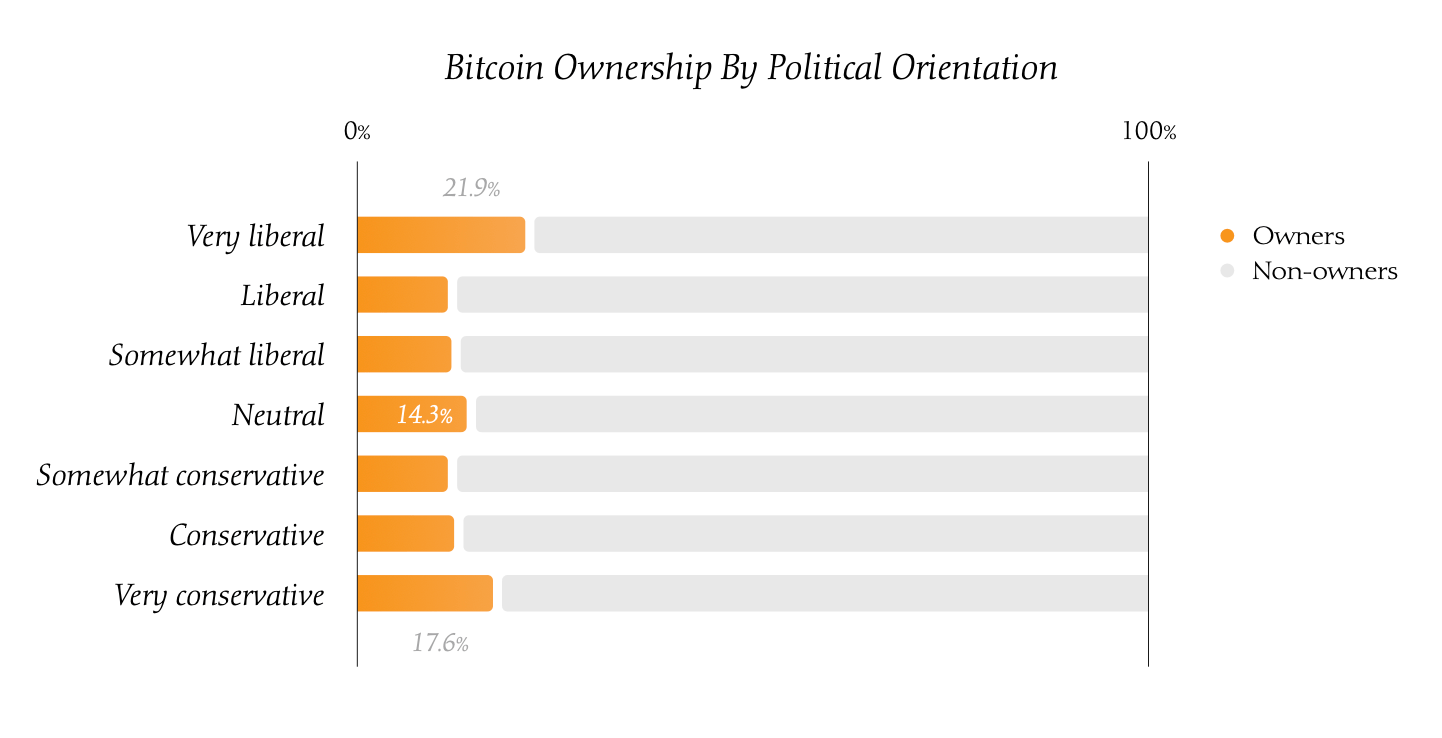 Bitcoin ownership by politics (The Nakamoto Project)
Related Posts
The report states,
“What correlates most strongly with Bitcoin ownership is not who you are, so to speak, but how much you know about Bitcoin, and whether you think it is useful, trustworthy, and good.
The 14% of Americans who own Bitcoin, it turns out, are not members of some particular political tribe. Rather, they are simply Americans who have taken the time to study the technology and formed positive attitudes about it.”
In terms of demographics, Bitcoin owners resemble the general U.S. population regarding race, ethnicity, income, education, and financial literacy. However, there are significant distinctions in age and gender; Bitcoin ownership is more prevalent among younger individuals and males. The survey found that younger people are more inclined to own Bitcoin, with a notable concentration among those under 35 years old. Furthermore, 46.1% of Bitcoin owners are male, compared to 52.3% female in the overall population.
The study utilized the Moral Foundations Theory to investigate the moral and ethical values of Bitcoin owners. Bitcoin enthusiasts display a combination of liberal and conservative moral foundations, emphasizing cultural liberty, equality, and proportionality while aligning with conservatives on purity and loyalty. However, these moral foundations were less indicative of Bitcoin ownership compared to other factors.
Key determinants of Bitcoin ownership identified in the survey include knowledge about Bitcoin, belief in its usefulness, trust in the Bitcoin protocol, and the perceived morality of Bitcoin. These factors were highly interrelated and correlated with Bitcoin ownership. Respondents exhibiting higher levels of knowledge about Bitcoin tended to trust its technology, believe in its practical utility, and view it as morally positive, making them more likely to own Bitcoin.
Trust in the Bitcoin protocol and its perceived morality emerged as crucial differentiators between Bitcoin owners and non-owners. While non-owners generally held neutral or negative views regarding Bitcoin’s trustworthiness and morality, owners expressed strong positive sentiments in these areas. This indicates that individuals who trust Bitcoin’s technology and recognize its social and moral value are more likely to adopt it.
The findings suggest that Bitcoin ownership in the U.S. is driven more by individual knowledge and attitudes towards Bitcoin rather than demographic or political factors. The study contests the notion of Bitcoin ownership as a politically or demographically unique phenomenon, emphasizing that the 14% of Americans who own Bitcoin are diverse and broadly representative of the general population. The survey underscores the significance of education and favorable perceptions in promoting Bitcoin adoption.
The Nakamoto Project’s survey offers valuable insights into the demographics, political affiliations, and key factors influencing Bitcoin ownership in the United States. It demonstrates that Bitcoin enthusiasts are not restricted to any specific demographic or political group but are united by their knowledge, trust, and positive perceptions of Bitcoin.
The post US Bitcoiners lean liberal but report shows politics less divisive than many think appeared first on CryptoSlate.
