Disclaimer: Information found on CryptoreNews is those of writers quoted. It does not represent the opinions of CryptoreNews on whether to sell, buy or hold any investments. You are advised to conduct your own research before making any investment decisions. Use provided information at your own risk.
CryptoreNews covers fintech, blockchain and Bitcoin bringing you the latest crypto news and analyses on the future of money.

Bitcoin value climbs to $78,000 while oil prices increase, establishing a new scenario – essential information to consider.

On April 21, the price of Brent crude increased by 5.4%, closing at $99.89 and reaching an intraday peak of $102.16.
This increase was primarily due to significant disruptions in shipping through the Strait of Hormuz, with reports indicating that only three vessels transited in the previous 24 hours, a sharp decline from the typical daily average of around 140 prior to the onset of the conflict.
Fatih Birol of the IEA described this situation as the most significant energy crisis in history and facilitated an unprecedented release of 400 million barrels from strategic reserves in March.
The energy crisis is already having noticeable repercussions on financial markets, as March US retail sales exceeded expectations, largely driven by a 15.5% increase in receipts from gasoline stations linked to fuel prices influenced by the conflict.
The oil crisis has a direct connection to consumer-level inflation and reinforces the expectations already reflected in the rates market.
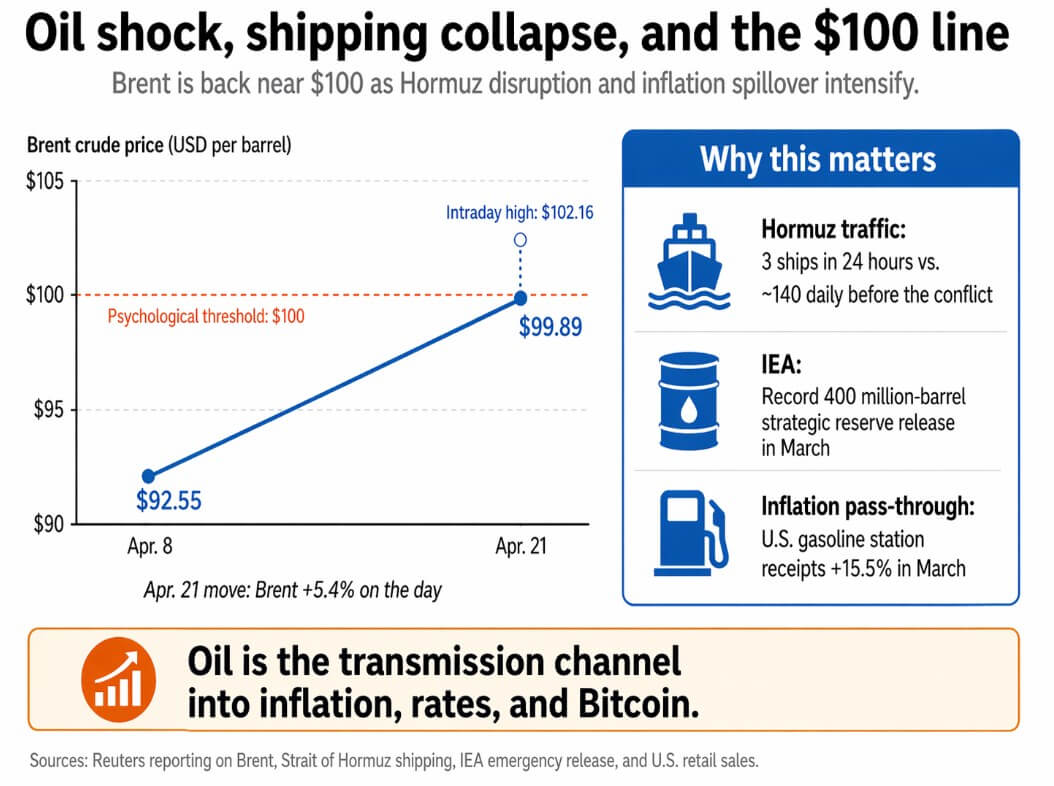 Brent crude finished at $99.89 on April 21, marking a 5.4% increase during the session and hitting an intraday high of $102.16, as traffic through Hormuz dwindled to three ships in 24 hours compared to a pre-conflict daily average of approximately 140.
The rates channel
This week, Bitcoin is trading based on the likelihood that oil prices remain elevated long enough to sustain persistent inflation, firm yields, and delay Federal Reserve rate cuts beyond market expectations.
Fed funds futures had anticipated two quarter-point cuts by December as recently as late February. However, as of April 21, futures were reflecting only a 30% probability of a single 25 basis point cut for the entire year.
This adjustment in the rate outlook is directly linked to the war’s impact on energy prices. On the same day, the 10-year Treasury yield stood at 4.313%, while the 2-year yield was at 3.802%, both showing increases during the session.
On April 21, oil prices rose, the dollar strengthened, Treasury yields increased, and Bitcoin remained stagnant. Even traditional inflation hedges faltered, with gold declining by 2%, as higher real financing conditions and dollar strength overshadowed the usual narrative.
Deutsche Bank highlighted the downstream risk in a call on April 17, suggesting that the Fed may keep rates unchanged until 2026 due to inflation driven by oil prices.
Following a ceasefire announcement on April 7, Brent dropped to $92.55 the next day, yields fell, traders raised the odds of a Fed cut by year-end to 50%, and Bitcoin increased by 2.95% to $72,738.16.
Related Posts
This sequence confirmed that the transmission mechanism is that lower oil prices ease the rate path, which in turn supports BTC.
| Macro variable | Apr. 21 reading / shift | Why it matters for BTC |
|---|---|---|
| Brent crude | Closed at $99.89, touched $102.16 intraday | Higher oil increases inflation pressure and intensifies the macro headwind |
| Fed path | From two quarter-point cuts by December in late February to only a 30% chance of one 25 bp cut for the full year | Less anticipated easing implies reduced liquidity support for BTC |
| 10-year Treasury yield | 4.313% | Higher long-term yields tighten financial conditions |
| 2-year Treasury yield | 3.802% | Higher short-term yields indicate a more restrictive rate outlook |
| Dollar | Strengthened on Apr. 21 | A stronger dollar typically poses a challenge for Bitcoin and other risk assets |
| Gold | Fell 2% | Indicates that even traditional inflation hedges were affected by yields and dollar strength |
| Bitcoin | Recovered toward the high-$70,000s, trading around $78,000 on Apr. 22 | Confirms macro sensitivity, though not outright capitulation |
| Ceasefire comparison | On Apr. 8, Brent fell to $92.55, cut odds improved, and BTC rose 2.95% to $72,738.16 | Reinforces the transmission channel: softer oil → easier rate path → stronger BTC |
The disruption in Hormuz is documented, the inflation pass-through is evident in retail sales data, and futures markets are adjusting to the Fed’s repricing. What remains uncertain is how Bitcoin will navigate the challenges posed by these headwinds while maintaining its current position around $78,000.
Two moves for this week
If Brent remains above $100 and the 2-year Treasury yield continues to rise from its current 3.80%, the market will factor in persistent inflation, fewer rate cuts, and tighter liquidity conditions.
Bitcoin may trade lower, retesting support levels back toward the mid-$70,000s, confirming the view that BTC is a high-beta reflection of rate expectations. The pattern observed on April 21, with rising oil, a stronger dollar, increasing yields, and declining BTC, may repeat with greater conviction.
This scenario represents a more straightforward near-term outlook, as the war-driven adjustment of the Fed’s path has already accomplished much of the structural work.
The bullish scenario becomes tangible if Brent remains near $100, Hormuz continues to experience disruptions, yields stay elevated, and Bitcoin manages to hold steady or strengthen around $78,000 while equities and gold remain under pressure.
This resilience would serve as evidence of relative strength amid a typical macro headwind. A week of such firmness, against ongoing oil stress, would challenge the established narrative that rising oil prices lead to declining BTC.
| Scenario | What Brent does | What yields do | What BTC does | What the market concludes |
|---|---|---|---|---|
| Bear / macro pressure wins | Holds above $100 | 2-year yield climbs above current 3.80% area | BTC breaks below the mid-$70,000s and retests lower support | Bitcoin is still trading like a high-beta rate-sensitive asset |
| Bull / relative strength emerges | Stays near $100 but does not accelerate | Yields stay elevated rather than collapsing | BTC holds flat or firms around $78,000 | Bitcoin is showing resilience despite a textbook macro headwind |
Bitcoin’s session on April 21 already indicated it trades as a macro-sensitive asset in this context. Sustained relative strength over a week would carry more significance, given the challenging macro conditions and the firmness that still occurred.
The three key metrics to monitor closely this week are Brent, the 2-year Treasury yield, and Bitcoin’s capacity to maintain the upper-$70,000s.
The post Bitcoin price surges to $78k even as oil rises again creating new setup – what you need to know appeared first on CryptoSlate.
