Disclaimer: Information found on CryptoreNews is those of writers quoted. It does not represent the opinions of CryptoreNews on whether to sell, buy or hold any investments. You are advised to conduct your own research before making any investment decisions. Use provided information at your own risk.
CryptoreNews covers fintech, blockchain and Bitcoin bringing you the latest crypto news and analyses on the future of money.

Bitcoin prepares for $8 billion options expiration amid concerns over conflict, oil prices, and Federal Reserve actions impacting market stability.

Bitcoin is approaching one of the year’s most significant options expirations at an inopportune time.
Data from CoinGlass indicates approximately $8.07 billion in notional open interest for Deribit’s options set to expire on April 24, divided between 56,300 calls and 49,540 puts. Although the ratio appears bullish, it is occurring against one of the most unpredictable macroeconomic environments seen in recent months.
The expiration occurs three days prior to the Federal Reserve’s meeting on April 28-29 and four days before the Bureau of Economic Analysis releases both Q1 GDP and March PCE inflation figures on April 30.
This represents the most densely packed macro calendar we have encountered in some time, commencing in a context where Fed officials have spent the past week publicly cautioning that inflation driven by oil could maintain elevated borrowing costs for a significantly longer duration than the markets had anticipated.
There is considerable tension within the derivatives structure itself.
On Deribit, which currently holds around $31 billion in total options open interest, exceeding even BlackRock’s IBIT, the April 24 contract shows substantial call positioning, with approximately $395 million concentrated at the $75,000 strike. The max pain for this contract is situated around $71,500 to $72,000, roughly $3,000 to $4,000 below the existing Bitcoin price.
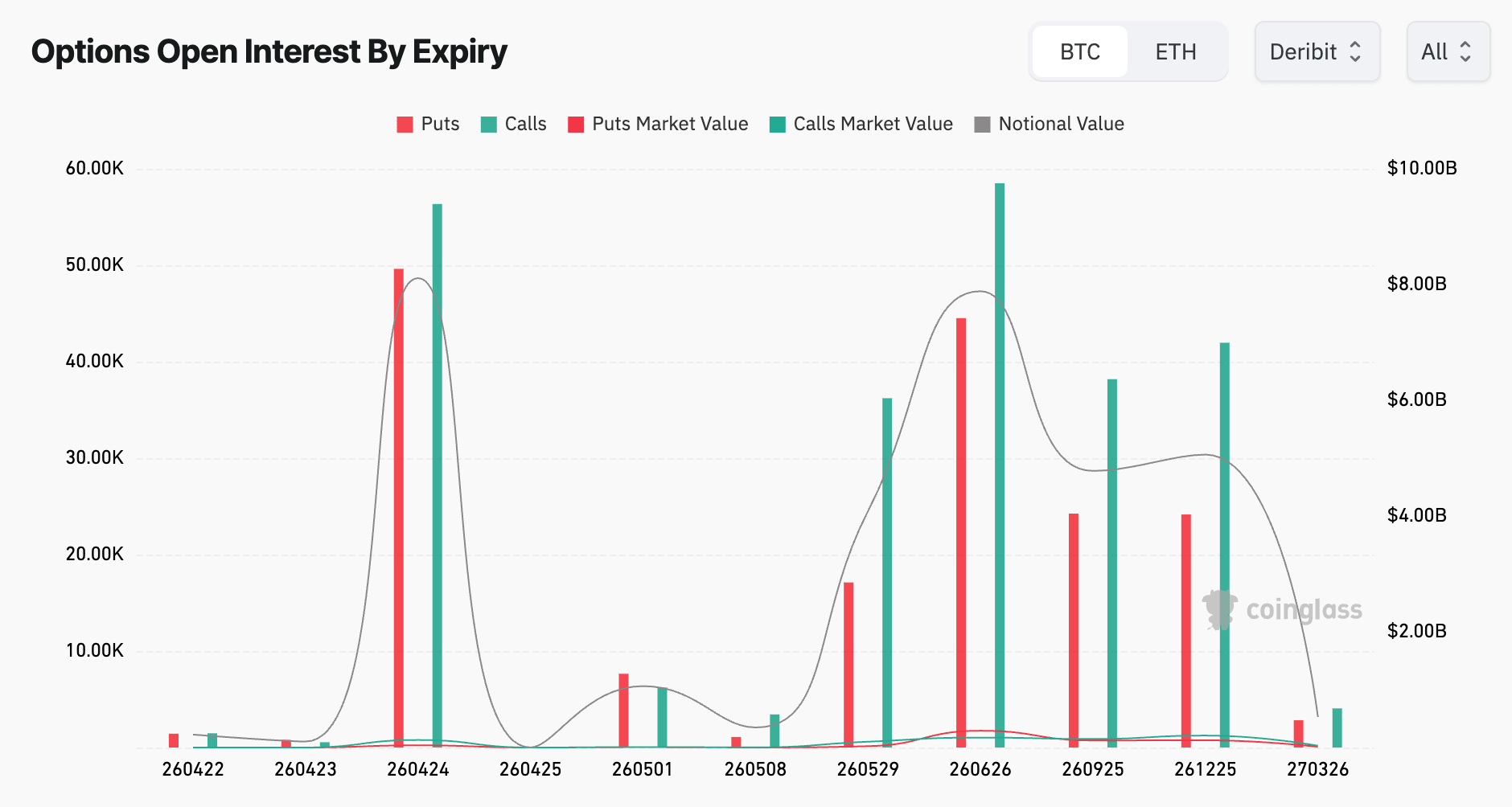 Chart illustrating the open interest for Bitcoin options on Deribit by expiry date on Apr. 21, 2026 (Source: CoinGlass)
In options markets, max pain refers to the price level at which the highest number of contracts expire worthless, benefiting sellers (in this instance, large institutions and market makers) over buyers. This disparity can create a downward gravitational effect as settlement approaches.
The Fed faces a new challenge, originating from the Strait
The conflict that commenced in late February, following coordinated US and Israeli strikes on Iran that led to the closure of the Strait of Hormuz, the narrow passage through which approximately 20% of the global oil supply flows, caused Brent crude prices to exceed $100 a barrel for the first time in years.
Iran’s announcement of reopening on April 17 temporarily alleviated some of that pressure, resulting in Brent dropping about $10 to around $89 a barrel and Bitcoin rising toward the $77,000 to $78,000 range.
However, this relief was short-lived. On Sunday, the US confiscated an Iranian cargo ship heading for the Strait, seemingly undoing the diplomatic progress made at the end of the previous week, and Bitcoin opened Monday approximately 2.5% lower. Ship traffic in the corridor remains over 95% below pre-war levels, with major shipping companies still rerouting vessels around Africa due to insurance companies refusing to cover the passage, while military vessels remain active.
All these factors render the Fed’s actions and statements in the upcoming weeks particularly significant, especially for Bitcoin.
Related Posts
St. Louis Fed President Alberto Musalem stated last week that the oil shock is likely to keep underlying inflation near 3% for the remainder of the year, nearly a full percentage point above the Fed’s 2% target.
This, he explained, supports the argument for maintaining rates within the current 3.50% to 3.75% range “for some time.”
New York Fed President John Williams essentially echoed this sentiment, noting that increases in energy prices are already being reflected in airfares, groceries, fertilizers, and other consumer goods, and that this process has “begun to play out already.” The CME FedWatch tool was indicating a 99.5% probability of a hold heading into the weekend.
The clearest summary of what is at stake came from Fed Governor Christopher Waller in a speech on April 17, likely the last substantial communication from the Fed before the pre-meeting blackout closes the window on new guidance.
Waller characterized the situation as a fork: a swift resolution to the conflict would allow inflation to continue moving toward 2%, preserving the possibility for rate cuts later in the year. Conversely, a prolonged conflict would result in higher inflation becoming entrenched across a broad range of goods and services, with supply chain disruptions increasing. The ceasefire is tenuous enough that both scenarios remain genuinely viable.
Why the Bitcoin options expiry acts as an amplifier
Large options expirations rarely drive prices decisively in one direction, and the macro sensitivity that has characterized crypto markets since late February has rendered most crypto-native positioning signals less dependable than usual.
The more specific risk from Friday’s settlement is structural: a significant expiry concentrated near the peak of the recent range creates hedging dynamics among dealers that can amplify whatever macro signal emerges first.
If the situation in Hormuz stabilizes and the probabilities for rate cuts increase, the call-heavy positioning could lead to a squeeze through $75,000. Conversely, if new escalations occur, the same structure operates in reverse, with max pain near $72,000 serving as the level dealers aim to defend.
Institutions spent much of this quarter offloading upside Bitcoin exposure to generate yield, shifting risk to market makers. This created a structural cushion that vanishes as soon as the contracts expire, leaving Bitcoin more vulnerable to macroeconomic and geopolitical influences.
Waller’s April 17 speech was the last from a Fed policymaker before officials entered their pre-meeting blackout ahead of the April 28–29 gathering.
The FOMC decision will arrive without any guidance since mid-April, and markets will interpret it alongside Q1 GDP and PCE data that will capture, for the first time, the economic impact of the Hormuz closure on the US economy.
Bitcoin’s trajectory over the next ten days will navigate through Friday’s expiry, a Fed decision, and a set of figures that could reshape the entire rates outlook. The derivatives market already has a stance on the first event. We now need to observe whether it holds through the subsequent two.
The post Bitcoin braces for $8B options expiry as war, oil and the Fed threaten a volatility reset appeared first on CryptoSlate.
