Disclaimer: Information found on CryptoreNews is those of writers quoted. It does not represent the opinions of CryptoreNews on whether to sell, buy or hold any investments. You are advised to conduct your own research before making any investment decisions. Use provided information at your own risk.
CryptoreNews covers fintech, blockchain and Bitcoin bringing you the latest crypto news and analyses on the future of money.

Bitcoin rises above $76,000 following a $650 million short squeeze, driven by US inflation data that boosts risk asset performance.

Bitcoin reached its peak level since the sell-off in early February following an increase in US producer prices, although the rise was less than economists had anticipated in March. The rebound in risk assets was further supported by declining oil prices and stronger equity markets.
As per data from CryptoSlate, Bitcoin surpassed the $76,000 threshold during the early hours of US trading, with the overall cryptocurrency market adding approximately $110 billion to its market capitalization in the past 24 hours.
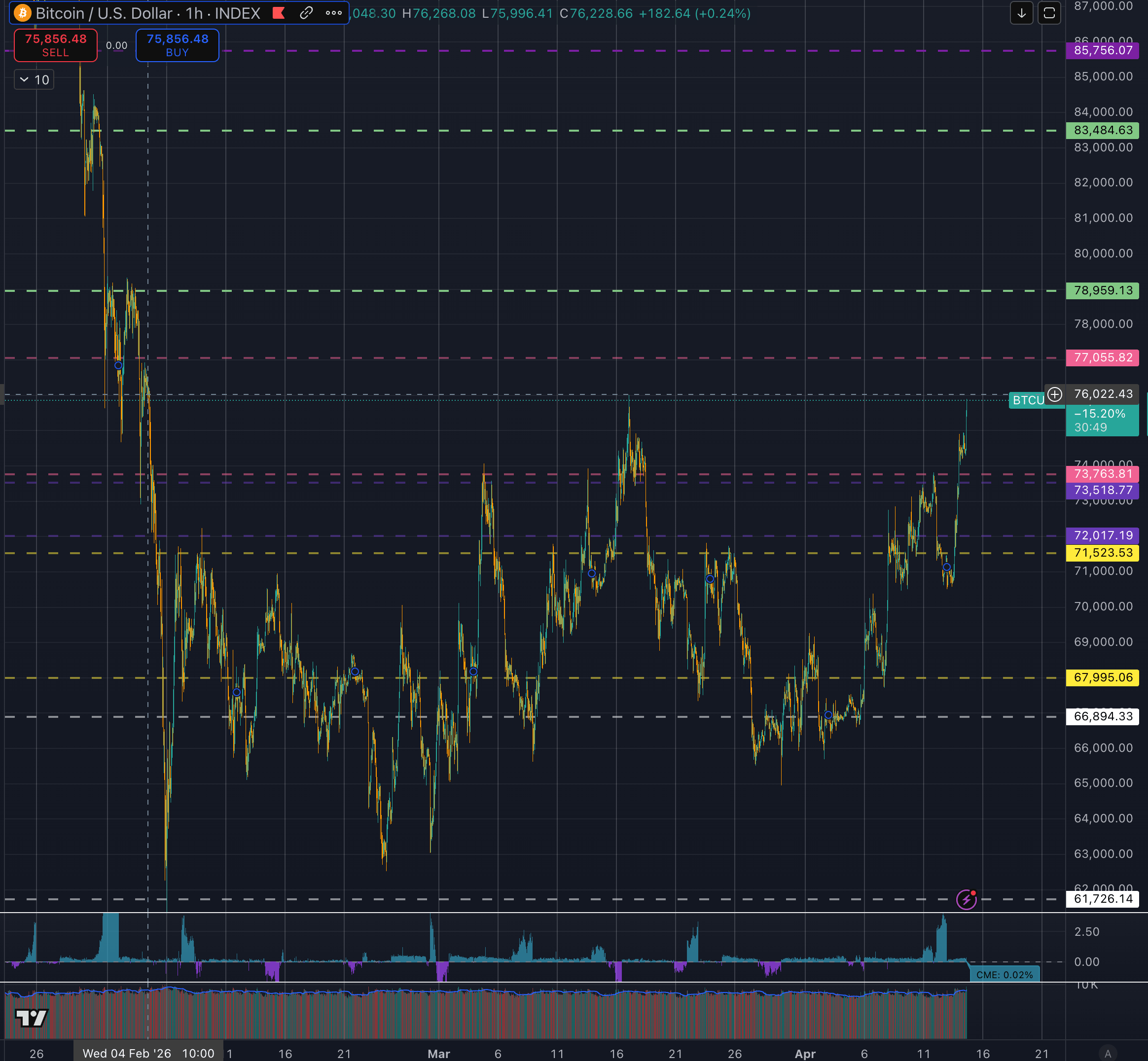 Bitcoin Price Performance
The prevailing optimism in the market has been primarily fueled by changing expectations regarding the Federal Reserve’s monetary policy, alongside unexpected developments in ongoing geopolitical tensions.
US equities surge as short sellers face historic squeeze
In addition, the relief rally extended beyond the cryptocurrency sector.
Bull Theory, a macro-economics platform, observed that traditional financial markets reacted to the inflation data with similar enthusiasm, adding nearly $1.4 trillion in market capitalization to US indices over a two-day period.
The firm reported that the technology-focused Nasdaq Composite jumped 2.85%, contributing $960 billion in value, while the Russell 2000 index of small-cap stocks increased by 3%. The S&P 500 rose by 2.12%, bringing it within 100 points of a new historical high.
At the same time, optimism regarding stabilization in the Middle East led to a significant drop in global energy markets, with West Texas Intermediate (WTI) crude oil falling 6% to settle at $93 per barrel.
For bearish traders betting against a recovery in digital assets, the sudden surge in bullish momentum was detrimental. Data from derivatives market provider CoinGlass indicated that the rapid rise in Bitcoin prices triggered a wave of liquidations.
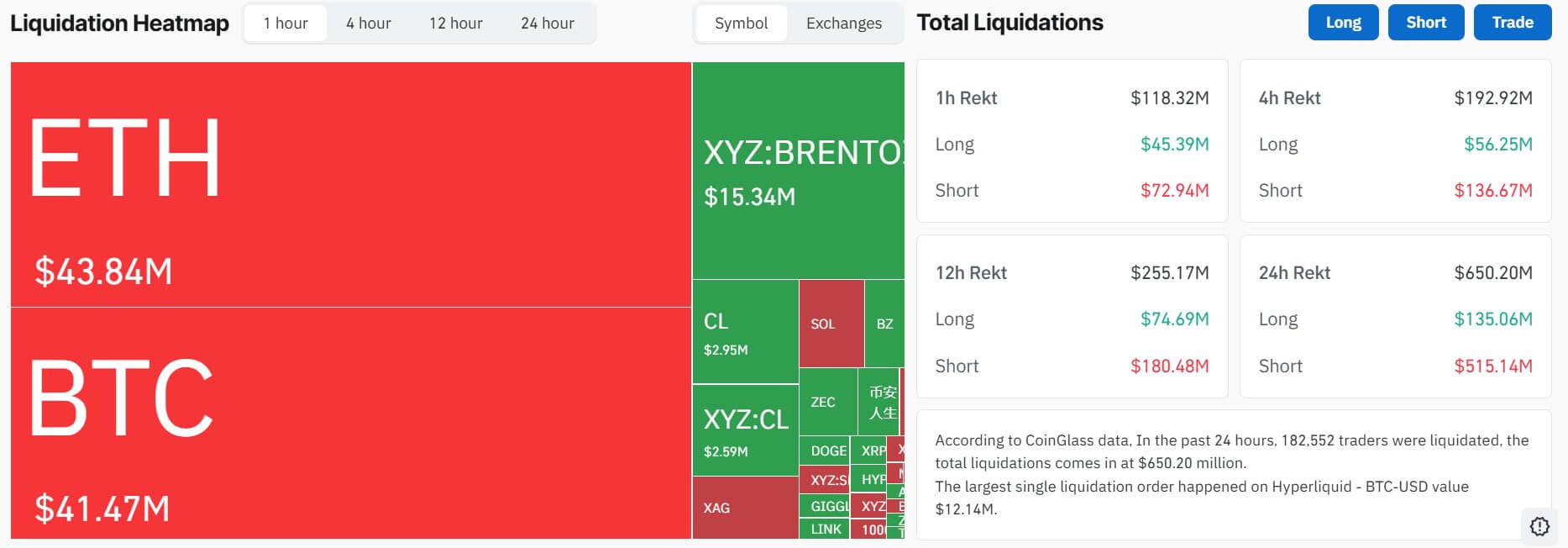 Crypto Market Liquidation (Source: CoinGlass)
Within a single hour, over $100 million in leveraged positions were eliminated. Total market liquidations quickly surpassed the $650 million mark, with short-sellers experiencing the majority of the losses.
Traders anticipating price declines incurred estimated losses of $514.94 million, marking the highest level of short liquidations recorded since the market volatility observed in February.
In this context, Joao Wedson, the CEO of blockchain analytics firm Alphractal, remarked:
“Most of the bears were liquidated today! Exactly on April 14th, which is curiously a peculiar and fractal day for Bitcoin!”
Inflation numbers fuel hawkish pivot fears
The main driver of Tuesday’s risk-on sentiment was the release of the March Producer Price Index (PPI) by the US Bureau of Labor Statistics. The data indicated that wholesale inflation is increasing but remains below Wall Street’s expectations.
The report showed that the headline PPI rose 4% year-over-year in March, falling short of the consensus estimate of 4.7%.
However, this marks a significant acceleration from the 3.6% annual increase recorded in February, representing the highest annual growth rate in three years.
On a monthly basis, the PPI increased by just 0.5%, matching February’s rate but significantly below the 1.1% increase projected by economists.
Related Posts
Core PPI, which excludes the volatile food and energy sectors, remained unchanged at 3.8% year-over-year, falling short of market expectations of 4.2%.
Market analysts linked the rising inflation figures to the US-Iran conflict, which has driven up energy prices and reignited concerns about another inflation surge.
In macroeconomic conditions characterized by persistent or rising inflation data, the Federal Reserve faces increased pressure to uphold a restrictive, higher-for-longer interest rate policy.
Consequently, market participants are compelled to eliminate expectations of near-term rate cuts, betting instead that the central bank will adopt a hawkish stance and tighten monetary policy.
Historically, elevated borrowing costs reduce liquidity in the broader financial system, disproportionately affecting risk-sensitive assets such as Bitcoin and high-growth technology stocks as capital shifts towards yielding safe havens.
The changing narrative around Bitcoin’s role
Meanwhile, BTC’s price recovery has reignited a broader discussion regarding the leading cryptocurrency’s role during times of geopolitical tension.
 Related Reading
Bitcoin price clings to $70,500 support after US-Iran talks collapse and oil spikes past $103
A weekend ceasefire mood shift impacted crypto quickly as equities declined and traders adjusted Middle East risk into inflation concerns.
Apr 13, 2026 · Oluwapelumi Adejumo
Bitwise Chief Investment Officer Matt Hougan stated that Bitcoin has outperformed many traditional assets since the onset of US and Israeli airstrikes on Feb. 28. According to Hougan, Bitcoin increased by 12% during that period, while the S&P 500 fell by 1% and gold dropped by 10%.
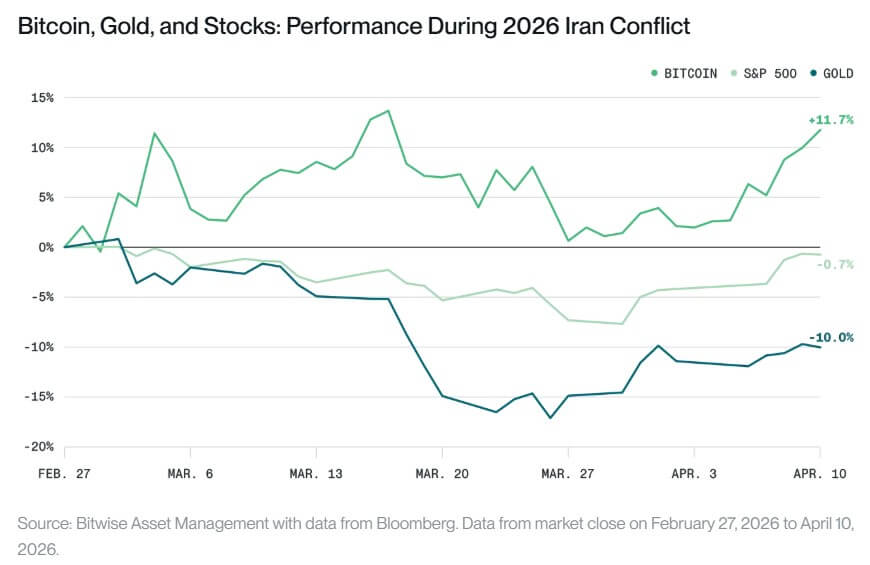 Bitcoin vs Traditional Assets During US-Iran War (Source: Bitwise)
This performance has challenged the perception that Bitcoin should invariably decline during every geopolitical crisis due to its classification as a high-volatility risk asset.
Instead, some market participants increasingly view Bitcoin as fulfilling two overlapping roles. One is its more established function as a scarce digital asset that competes with gold and other stores of value.
The second role is more speculative, linked to its potential use in international settlements in a world where global payment systems are becoming increasingly fragmented.
This latter concept has gained traction since the West moved to exclude major Russian banks from the SWIFT network following Moscow’s invasion of Ukraine. The shift has accelerated the search for alternatives to traditional dollar-based systems, particularly among nations seeking to minimize exposure to Western financial pressures.
In this context, the Middle East conflict has sparked renewed debate over whether Bitcoin could gain from deepening geopolitical divides and the growing appeal of politically neutral payment systems.
This argument remains contentious and has not diminished Bitcoin’s sensitivity to interest rates, liquidity, and equity market fluctuations.
Nonetheless, it has become a more prominent aspect of market discussions whenever geopolitical tensions escalate.
The post Bitcoin surges on $650 million short squeeze, passing $76,000 as US inflation numbers fuel risk asset rally appeared first on CryptoSlate.
