Disclaimer: Information found on CryptoreNews is those of writers quoted. It does not represent the opinions of CryptoreNews on whether to sell, buy or hold any investments. You are advised to conduct your own research before making any investment decisions. Use provided information at your own risk.
CryptoreNews covers fintech, blockchain and Bitcoin bringing you the latest crypto news and analyses on the future of money.

Bitcoin Faces Price Reversal Risk as Hormuz Closure Approaches Ceasefire Deadline in 4 Days

Iran’s announcement on Friday regarding the reopening of the Strait of Hormuz during the ongoing ceasefire led to one of the most significant oil price reversals this year.
Brent crude experienced a decline of 12.95%, settling at $86.52, while WTI fell by 14.26% to $81.19, marking their lowest points since March 11 and the largest single-day drops since April 8. US stocks rallied, bond yields decreased, the dollar weakened, and Bitcoin reached an intraday peak of $78,336.
Traders removed the war premium that had been gradually added to crude prices over the preceding weeks, prompting a repricing of risk assets.
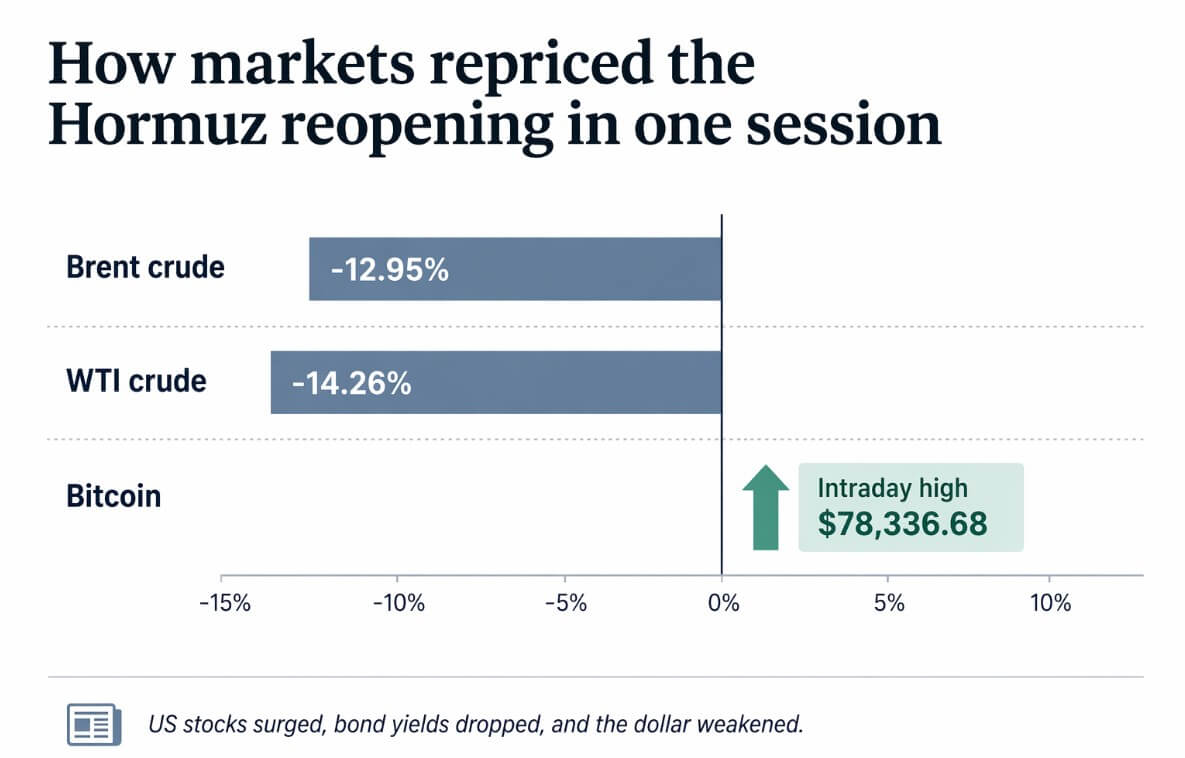 A divergent bar chart illustrates Brent crude’s 12.95% decline and WTI’s 14.26% drop on April 17, alongside Bitcoin’s intraday high of $78,336.68.
On the previous day, the Strait was reopened under Iranian conditions. Commercial vessels needed authorization from Iran’s Ports and Maritime Organization and the IRGC, and were required to navigate through Iran-designated safe lanes, while the US blockade on Iranian shipping remains fully enforced until a broader diplomatic resolution is achieved.
This opportunity has already diminished. As of April 18, Iran announced the closure of the Strait once more, maintaining the US blockade and pushing the market back into a countdown toward the April 22 ceasefire deadline.
Only eight oil and gas tankers operated during the reopening, highlighting how far the route is from returning to normal traffic levels.
 Related Reading
Bitcoin faces critical weekend test as Iran closes Strait after immediately disputing the US narrative on Hormuz deal
Bitcoin’s rally following the Hormuz developments faces a crucial test this weekend as Iran challenges Trump’s claims regarding the deal, while shipping, oil, and bond risks remain unresolved.
April 17, 2026 · Liam ‘Akiba’ Wright
During the brief reopening, the IMO was unable to confirm that the arrangement adhered to freedom-of-navigation standards.
Shipping companies awaited legal and safety clarifications before resuming regular passage, and the US Navy indicated that the mine threat in certain areas of Hormuz is not fully understood.
One Pakistani-flagged tanker carrying approximately 440,000 barrels of UAE crude departed the Gulf on April 17, providing tangible evidence that passage was feasible.
This brief test did not lead to normalization. AP reported that only eight oil and gas tankers transited during the limited reopening before Iran reinstated restrictions, leaving Bitcoin with just four days to determine if the ceasefire can facilitate genuine shipping recovery before April 22.
Bitcoin now finds itself in a position where the market quickly priced in the reopening, while the Strait, as of April 18, is once again closed ahead of the April 22 ceasefire deadline.
The arithmetic of fear
EIA data indicates that the average daily oil flow through the Strait is projected at 20 million barrels in 2024, accounting for roughly 20% of global petroleum liquids consumption, with 84% of crude and condensate and 83% of LNG directed toward Asian markets.
This serves as the concrete threshold behind the market’s countdown: unless traffic rebounds before April 22, the route that transports about one-fifth of global petroleum liquids remains effectively impaired.
Since the onset of the conflict, the war has removed over 500 million barrels of crude and condensate from the global market, resulting in approximately $50 billion in lost output. In contrast, global onshore crude inventories decreased by roughly 45 million barrels in April alone.
As recently as April 7, the EIA anticipated Brent averaging $115 in the second quarter. On April 13, Morgan Stanley projected Brent at $110 for the second quarter and $100 for the third quarter, forecasting only a gradual recovery in exports through October.
At $86.52, Brent is significantly below all major published baselines from less than two weeks ago. The market has preemptively adjusted to a normalization trajectory that neither the EIA nor Wall Street had anticipated.
This asymmetry influences the financial premium, which can dissipate rapidly. The IEA’s chief stated that overall Middle East energy output may take approximately two years to return to pre-war levels.
Why the reopening is still fragile
Iran’s operational message on April 17 closely resembles what its deputy foreign minister stated on April 9, when ships could pass with Iranian coordination, but actual traffic remained below 10% of normal levels. This translates to about seven vessels per day compared to the usual 140.
The diplomatic probability distribution shifted while the passage rules remained largely unchanged. A 10-day ceasefire and renewed US-Iran diplomacy led markets to reinterpret the same basic operational framework as a sign of de-escalation.
Related Posts
| Issue | Current status | Why it matters |
|---|---|---|
| Commercial passage | Allowed with Iranian coordination | Passage is possible, but conditional |
| Authorization | Requires Ports and Maritime Organization + IRGC approval | Shows Iranian control remains central |
| Routing | Iran-designated safe lanes | Not equivalent to normal freedom of navigation |
| IMO standard | Not yet confirmed | Legal/institutional ambiguity remains |
| Mine risk | Still not fully understood | Physical risk still deters normal traffic |
| Insurers / shippers | Waiting for clarity | Operational normalization has not happened |
| US blockade | Still in force | Broader settlement still unresolved |
| Traffic level | Below normal | Reopening is not yet routine |
The truce in Lebanon, which forms part of the diplomatic context, still leaves the Israeli military presence in southern Lebanon and Hezbollah’s disarmament unresolved.
The blockade remains in effect until a broader agreement is reached, and even if vessels begin to move, it takes approximately 21 days for ships to travel from the Gulf to Rotterdam, meaning physical supply relief follows diplomatic announcements with a delay of weeks.
Insurance premiums have not yet returned to normal, no official authority has downgraded the mine warnings, and no major shipping line has publicly declared the route as cleared.
The Bitcoin transmission channel
Bitcoin’s movement today is influenced by a specific macro chain. The decline in oil prices has reduced the near-term inflation outlook and shifted expectations regarding the Federal Reserve’s rate trajectory.
Traders transitioned from pricing the Fed as inactive until well into 2027 to anticipating cuts by December 2026, indicating a significant compression in the expected tightening timeline.
The March FOMC minutes had already indicated that rising crude prices were expected to elevate inflation in 2026 and that a prolonged Middle East conflict risked making the pass-through to core inflation more persistent.
As oil prices fell, that hawkish risk partially unwound. Bonds rallied, the dollar weakened, equities surged, and Bitcoin moved in alignment with the broader risk-on repricing.
Bitcoin has behaved as a liquidity-sensitive risk asset over the past several months, with its trajectory closely following Fed expectations, tech sentiment, and the size of the monetary backdrop.
A sustained de-escalation that keeps oil prices declining long enough to alleviate inflation and support the Fed-cut narrative represents a genuine macro tailwind for Bitcoin.
The paths ahead
While rhetoric has quickly deteriorated following the initial announcement, talks have not yet officially collapsed, and the ceasefire remains intact.
If this extends into a broader US-Iran agreement, traffic could resume along routes approaching internationally accepted standards, mine warnings could diminish, and insurers might relax their positions, allowing oil relief to extend beyond today’s price.
The EIA had already viewed the market as oversupplied prior to the conflict’s onset. A lasting reopening could drain more premium than most traders currently anticipate, with Brent potentially drifting into the mid-$70s to mid-$80s.
In such a scenario, Fed-cut expectations would advance further, the dollar would remain under pressure, and Bitcoin would benefit from the most favorable macro tailwind available in the current cycle.
Citi’s 12-month bullish case of $165,000 represents the upper limit of what a sustained macro thaw of that magnitude could support.
| Scenario | Shipping reality | Brent range | Fed implication | Bitcoin implication |
|---|---|---|---|---|
| Ceasefire holds, and shipping normalizes | Vessel counts rise, mine warnings fade, insurers ease | Mid-$70s to mid-$80s | Cuts pulled forward | Strongest macro tailwind for BTC |
| Ceasefire holds in name, but normalization fails | Controlled lanes, weak ship counts, insurer caution persists | $100–$115 | Higher-for-longer returns | BTC loses de-escalation premium |
The more likely negative outcome is a ceasefire that holds in name but fails to achieve shipping normalization.
Mine warnings continue, politically controlled lanes keep insurers cautious, tanker counts remain significantly below the 140-per-day threshold, and the operational reality never aligns with the diplomatic headlines.
In that scenario, oil prices could rebound toward the $100-$115 range that informed EIA and sell-side forecasts as recently as last week.
The inflation relief would stall before impacting the Fed’s decision-making, rate-cut expectations would drift back out, and Bitcoin would relinquish its de-escalation premium.
Citi’s recessionary downside case of $58,000 marks the lower limit for Bitcoin re-entering a tighter-for-longer macro environment.
These two scenarios will first become evident in shipping counts, insurer behavior, and whether there are any shifts in US blockade language over the next 72 hours.
The ceasefire’s 10-day window provides a built-in expiration for this trade.
Key points to monitor include whether vessel counts rise significantly above April 9 levels, whether the IMO formally endorses the transit arrangement, whether US-Iran discussions yield any revisions to the blockade language, and whether Bitcoin continues to respond to oil relief as part of a Fed-relief narrative.
The post Bitcoin now has just 4 days before ceasefire deadline risks price reversal with Hormuz closed again appeared first on CryptoSlate.
