Disclaimer: Information found on CryptoreNews is those of writers quoted. It does not represent the opinions of CryptoreNews on whether to sell, buy or hold any investments. You are advised to conduct your own research before making any investment decisions. Use provided information at your own risk.
CryptoreNews covers fintech, blockchain and Bitcoin bringing you the latest crypto news and analyses on the future of money.


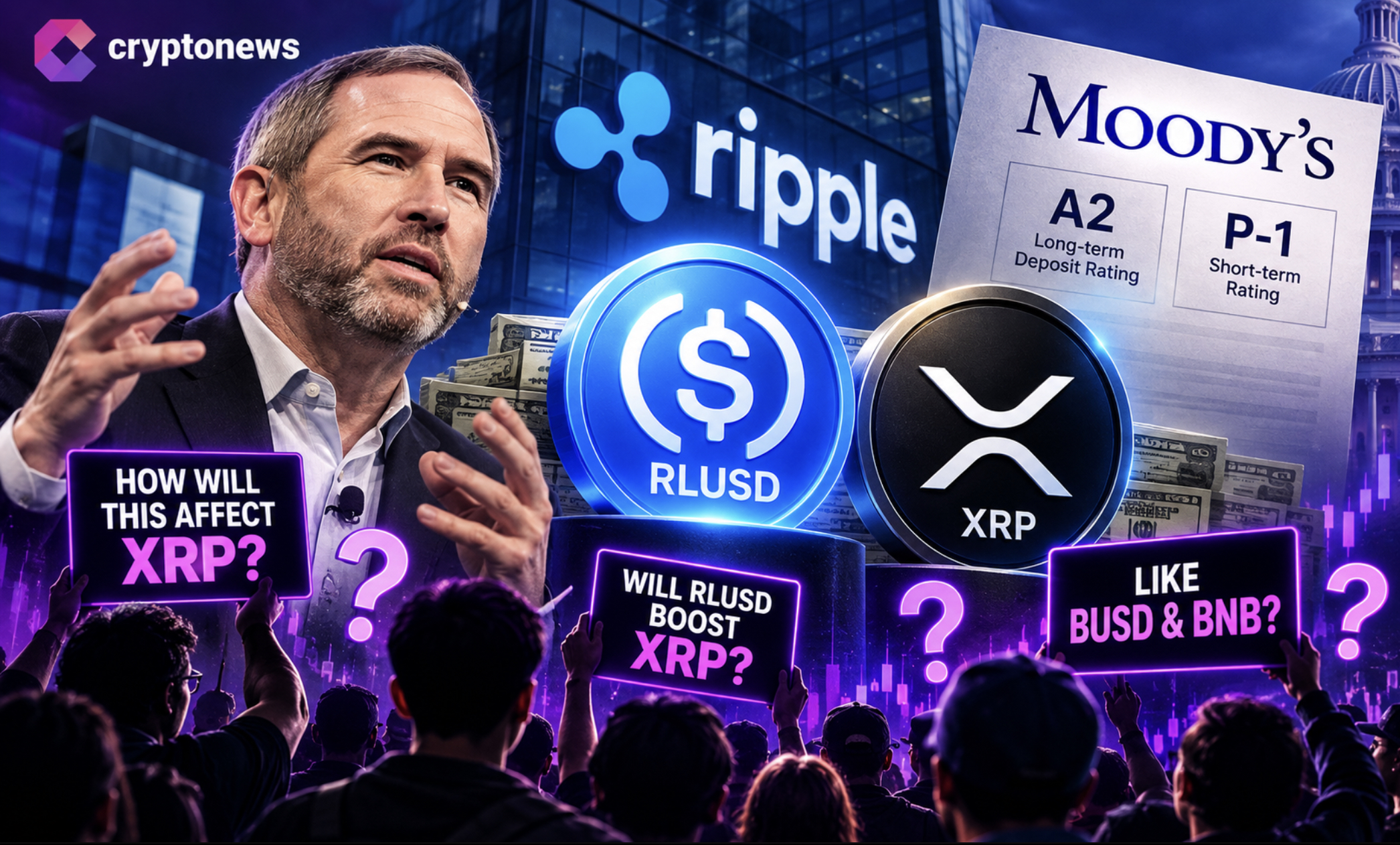
Ripple’s RLUSD has secured a significant boost in institutional credibility by receiving an A2 long-term deposit rating and its highest possible P-1 short-term rating from Moody’s. This assessment covers RLUSD issued on both the XRP Ledger and Ethereum, providing institutions with another benchmark for evaluating the dollar-pegged stablecoin.
More good news for $RLUSD this week – @moodysratings has assigned RLUSD an A2 long-term rating and P-1 short-term rating, the highest possible short-term rating under its new stablecoin framework.
TL;DR: RLUSD is the first stablecoin to have ever received an investment-grade…— Jack McDonald (@_JackMcDonald_) October 28, 2026
The rating announcement coincides with Ripple’s final approval to establish a national trust bank under the Office of the Comptroller of the Currency (OCC). Ripple stated that the new bank will manage RLUSD reserves and provide institutional custody services, while Bank of New York Mellon remains the stablecoin’s primary reserve custodian.
However, the more pressing question concerns XRP and its holders. If RLUSD becomes a major institutional settlement asset, can XRP capture value from that growth? Binance’s historical BUSD and BNB ecosystem offers an interesting comparison, although Ripple’s operational model differs.
Discover: The Crypto Presales This Q4 2026
RLUSD Moody’s Approval and Institutional Push Expand XRP Ecosystem
Moody’s rating provides RLUSD with a formal credit assessment that institutional risk teams can integrate into their evaluations. RLUSD will continue to be issued by Standard Custody & Trust Company, its New York-regulated subsidiary. The new trust bank will manage segregated reserves, act as a collateral trustee, and provide fiduciary digital-asset custody services. Ripple outlined these approved activities on October 26.
These developments could help Ripple compete for institutional payments, treasury operations, and collateral applications. However, for XRP, the opportunity hinges on what institutions do after adopting RLUSD.
 Xrp (XRP)24h7d30d1yAll time
Every transaction on the XRP Ledger requires XRP to pay network fees. Accounts also need XRP to satisfy the ledger’s reserve requirements. Increased RLUSD activity could generate incremental utility for XRP, although these requirements alone may create limited demand.
A more substantial opportunity lies in cross-currency payments. Institutions could use XRP as a bridge asset when converting between currencies, rather than routing every transaction through dollar stablecoins or traditional intermediaries.
Related Posts
Consequently, RLUSD can settle directly without requiring an institution to purchase XRP for the entire payment value. Transfers on Ethereum also do not require XRP for gas fees.
As a result, RLUSD’s market capitalization could grow substantially without generating proportional demand for XRP. The bullish case strengthens if stablecoin adoption also creates deeper XRP liquidity, additional bridge transactions, and new institutional trading activity.
Should Ripple replicate Binance’s BUSD–BNB value-capture model?
Binance’s historical ecosystem demonstrates how a stablecoin can support a broader crypto business. BUSD offered dollar-denominated liquidity, while BNB served multiple purposes across Binance’s exchange and blockchain infrastructure.
BNB provides utility through network fees and trading-fee discounts, alongside a token-burning mechanism that reduces supply over time. These mechanisms give BNB several direct connections to activity across its ecosystem.
Ripple has a different starting point. RLUSD provides dollar stability, while XRP operates as the XRP Ledger’s native asset and a potential cross-currency bridge. Ripple could create a comparable value-capture loop if institutional RLUSD adoption increases the need for XRP liquidity.
Imagine RLUSD growing from $2.5 billion to $25 billion in market capitalization. That would represent a tenfold expansion, potentially giving Ripple a much larger stablecoin business.
However, this would not imply a tenfold increase in XRP’s price. The outcome would depend on transaction volumes, network activity, institutional integrations, and the proportion of payments that actually utilize XRP.
Ripple could pursue a similar ecosystem strategy, but it would need to make XRP more integral to the financial activity surrounding RLUSD. Stablecoin growth alone would not reproduce BNB’s exchange utility or supply burns.
Ripple may be building a substantial regulated dollar business. But can XRP capture meaningful value from that expansion?
