Disclaimer: Information found on CryptoreNews is those of writers quoted. It does not represent the opinions of CryptoreNews on whether to sell, buy or hold any investments. You are advised to conduct your own research before making any investment decisions. Use provided information at your own risk.
CryptoreNews covers fintech, blockchain and Bitcoin bringing you the latest crypto news and analyses on the future of money.


Four Korean financial institutions joined Ripple at XRP Seoul 2026, sparking news and speculation regarding Ripple’s expanding influence. As of today, Jeonbuk Bank has planned the deployment of Ripple Payments, and Kbank’s custody and remittance initiatives have been documented.
Ripple introduced XRP Asia at the Seoul event as a regional initiative to promote the XRP Ledger. In an announcement on August 18, 2026, Ripple stated that Jeonbuk Bank would deploy Ripple Payments for cross-border business remittances. The company described this as the first deployment of the service by a regional bank in Korea, intended to provide near-real-time settlement.
Korean Banks – Kbank, Kyobo Securities, Woori Bank and JB Bank entered the stage at XRP Seoul.
From Cross border payments to Tokenized Deposits. pic.twitter.com/iY76LmTW57— Vet (@Vet_X0) October 3, 2026
Kbank has two distinct Ripple-related initiatives: a remittance pilot targeting the UAE and Thailand, and institutional wallet-as-a-service infrastructure through Ripple Custody. Ripple’s announcement regarding Kbank’s custody infrastructure describes a service for managing digital assets.
Other relationships also require careful attribution. The event account links Kyobo Life, associated with Kyobo Securities, to work on tokenized government-bond settlement, while Woori Bank is described as working with Korean custodian BDACS, which manages XRP for institutional clients.
Payment Software, Custody News, and XRP Settlement
Ripple Payments can coordinate cross-border transfers using conventional currencies such as dollars, won, or yen. Depending on transaction design, the service may also use RLUSD or XRP, so deploying Ripple Payments alone does not reveal which asset settles a particular flow.
Related Posts
A separate bridge-asset model converts value into XRP, moves it through the XRP Ledger, and converts it into the destination currency. That structure can seek to reduce the need to hold funds in advance with foreign intermediary banks, but the Seoul disclosures do not confirm that any participating bank has adopted it.
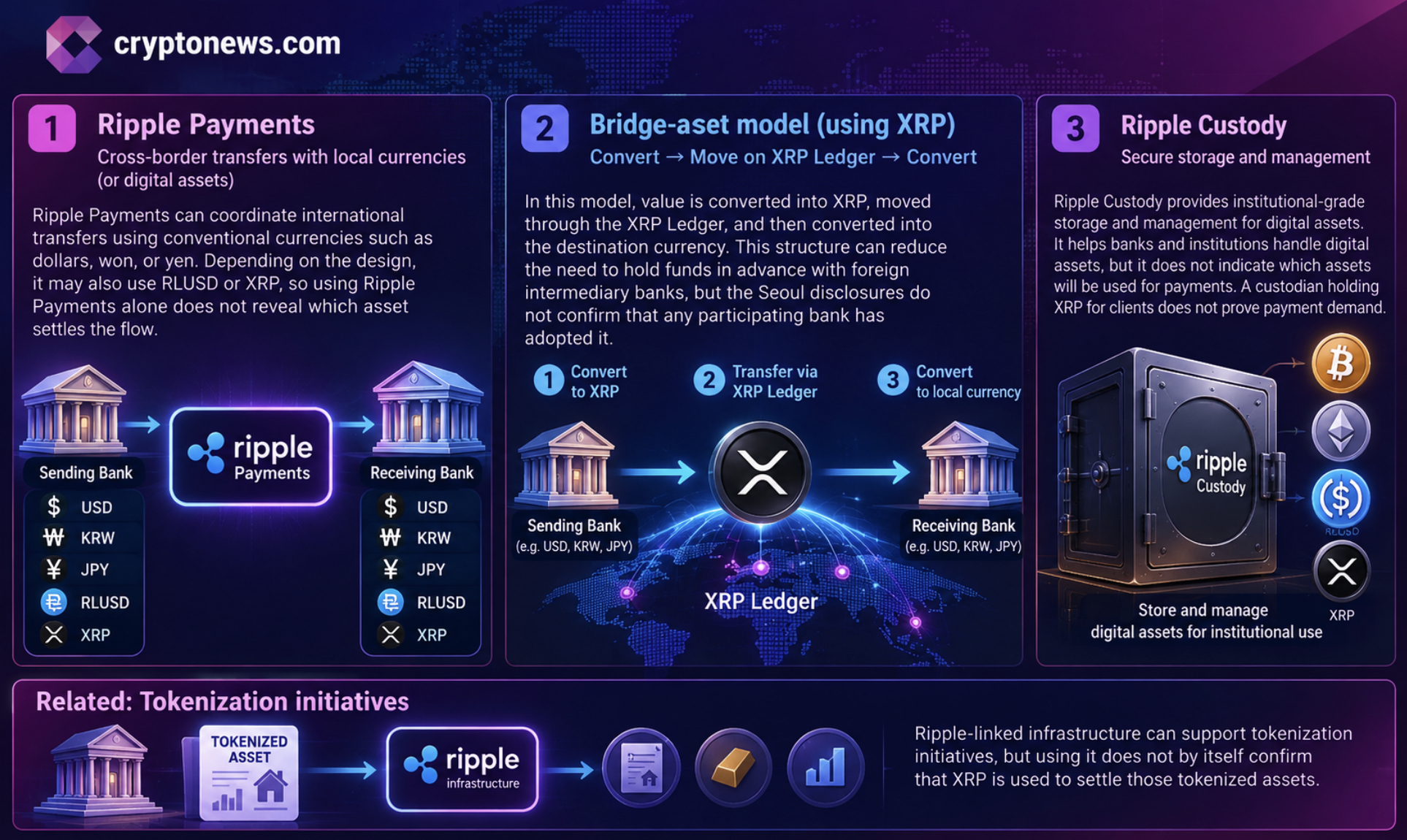
Ripple Custody addresses a different function: storing and managing digital assets for institutional use. Institutional custody infrastructure can expand a bank’s ability to handle digital assets without indicating which assets will be used for payments; likewise, a custodian holding XRP for clients does not prove payment demand.
The same distinction applies to tokenization initiatives, where use of Ripple-linked infrastructure does not by itself confirm XRP settlement.
For XRP, the event is evidence of Ripple’s expanding institutional relationships in South Korea, not a disclosed demand catalyst. A stronger adoption signal would require an explicit settlement-asset designation and measurable transaction flows or a volume commitment; neither appears in the available announcements.
Discover: The Best Token Presales
The post XRP News: Seoul Event Highlights Ripple’s Institutional Reach appeared first on Cryptonews.
