Disclaimer: Information found on CryptoreNews is those of writers quoted. It does not represent the opinions of CryptoreNews on whether to sell, buy or hold any investments. You are advised to conduct your own research before making any investment decisions. Use provided information at your own risk.
CryptoreNews covers fintech, blockchain and Bitcoin bringing you the latest crypto news and analyses on the future of money.


StarkWare announced that researcher Avihu Levy successfully tested an experimental quantum-resistant Bitcoin transaction on the mainnet. The transaction spent a 10,000-satoshi output in block 964,199 without modifying Bitcoin’s consensus rules.
Bitcoin Completes First Quantum Resistant Transaction
StarkWare (@StarkWareLtd) says it has completed the first quantum resistant Bitcoin bitcoin:native transaction.
The method uses signature grinding to limit exposure while transactions wait in Bitcoin’s mempool. It repeatedly… pic.twitter.com/UJlsofzjq7— BSCN (@BSCNews) August 27, 2026
StarkWare described this as the first transaction of its kind. The block was mined by MARA Pool, which received the transaction directly through its Slipstream service because the nonstandard format meant ordinary nodes would not relay it through the public mempool.
StarkWare spokesperson Nathan Jeffay stated that the transaction cost approximately $150 to $200 in computation, and the process took several hours. The demonstration illustrates a method to protect a single output under Bitcoin’s current rules, albeit at a significant computational and operational cost.
Discover: The Best Crypto to Diversify Your Portfolio
How StarkWare Quantum Bitcoin Transaction Works
Levy’s Quantum-Safe Bitcoin (QSB) scheme, first proposed in April, combines hash-based one-time signatures with computational searches that bind authorization to a specific transaction. This construction is designed to prevent forgery even if a sufficiently capable quantum computer breaks the elliptic-curve cryptography used by Bitcoin.
In March, Google researchers estimated that a sufficiently capable quantum computer could theoretically derive a Bitcoin private key nine to 12 minutes after a public key becomes visible. Google noted this could allow an attacker to replace a pending transaction during Bitcoin’s confirmation window.
Levy’s April proposal estimated that generating a transaction would require $75 to $150 in GPU computation; StarkWare reported the cost of the completed transaction at around $150 to $200.
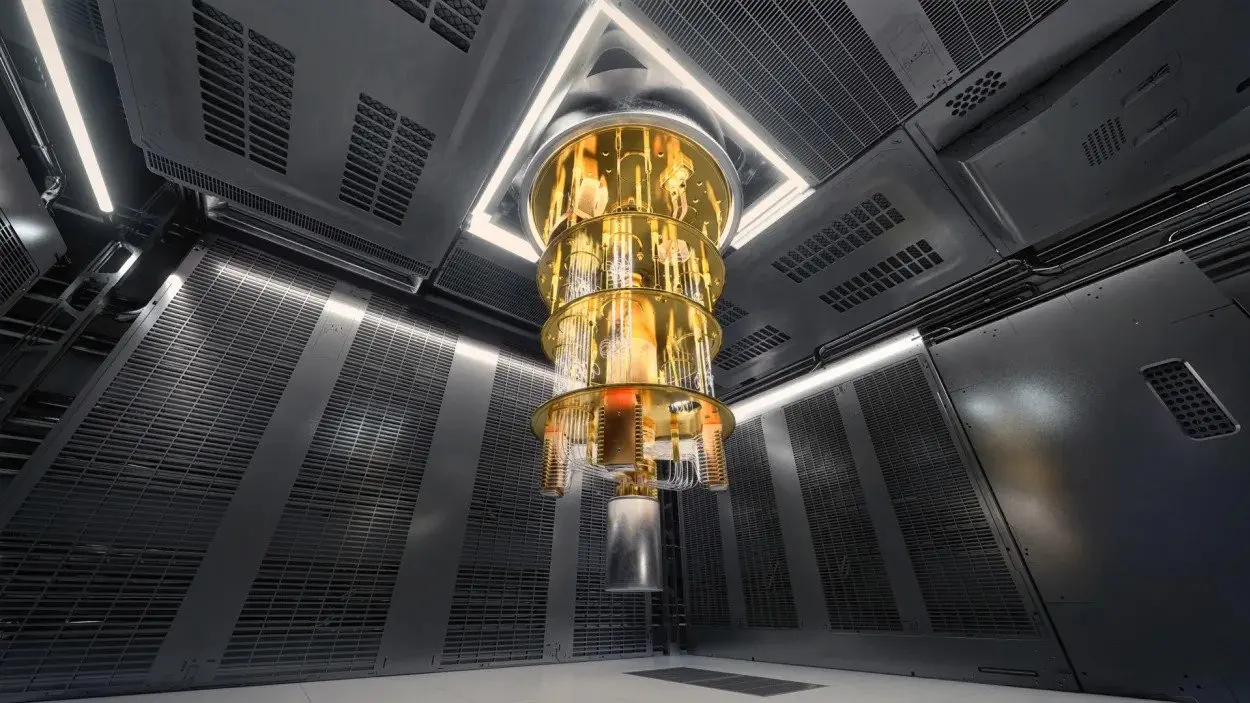 A Google Sycamore quantum processor inside its cryogenic cooling chamber.
QSB applies to individual Bitcoin transactions rather than upgrading cryptography across the entire network. It allows coins to be moved into an output with additional protection without changing the Bitcoin protocol, but it does not protect coins whose public keys were exposed prior to migration. In such cases, a potential attacker could have time to analyze those keys before a protected transaction is sent.
Related Posts
The transaction’s nonstandard classification under Bitcoin Core’s default relay policy presents a practical constraint. Ordinary nodes do not propagate the transaction before confirmation, so it must be submitted directly to a cooperating miner through a service such as MARA’s Slipstream. Consequently, the method requires prepared transactions and direct miner access.
StarkWare CEO Eli Ben-Sasson stated that QSB provides a safety net while protocol-level protections are developed. The demonstration establishes a workaround under the existing rules, rather than changing Bitcoin’s underlying cryptography across the network.
 Eli Ben-Sasson, co-founder of StarkWare
Trade Bitcoin on Bybit and Get a Chance to Win Our $1,000 USDT Airdrop
The Protocol-Level Alternative
Bitcoin developers are separately considering proposals, including BIP-360, a proposed soft fork that would introduce a Pay-to-Merkle-Root output type while removing Taproot’s quantum-vulnerable key-path spend. That approach would require network-wide coordination and activation.
Bitcoin (BTC)24h7d30d1yAll time
QSB does not wait for a protocol change. The mainnet test shows that Bitcoin’s existing consensus rules can accommodate one form of quantum-resistant spending, while broader protocol-level protections remain under consideration.
Discover: The Best Token Presales
The post StarkWare Quantum Bitcoin Transaction: First Quantum-Resistant BTC Transaction Hits Mainnet appeared first on Cryptonews.
