Disclaimer: Information found on CryptoreNews is those of writers quoted. It does not represent the opinions of CryptoreNews on whether to sell, buy or hold any investments. You are advised to conduct your own research before making any investment decisions. Use provided information at your own risk.
CryptoreNews covers fintech, blockchain and Bitcoin bringing you the latest crypto news and analyses on the future of money.


Riot Platforms divested 3,778 Bitcoin in Q1 2026, yielding $289.5 million—a figure that significantly surpasses its 1,473 BTC production for the same timeframe by a factor of 2.6.
The firm concluded Q1 with 15,680 BTC in its possession, representing an 18% decrease from the 18,005 coins it held at the end of 2025. The disparity between Riot’s mining output and its sales figures warrants further examination.
Blockchain analytics firm Arkham identified an additional 500 BTC outflow from a wallet linked to Riot on Thursday, indicating that the selling activity persisted beyond the conclusion of Q1.
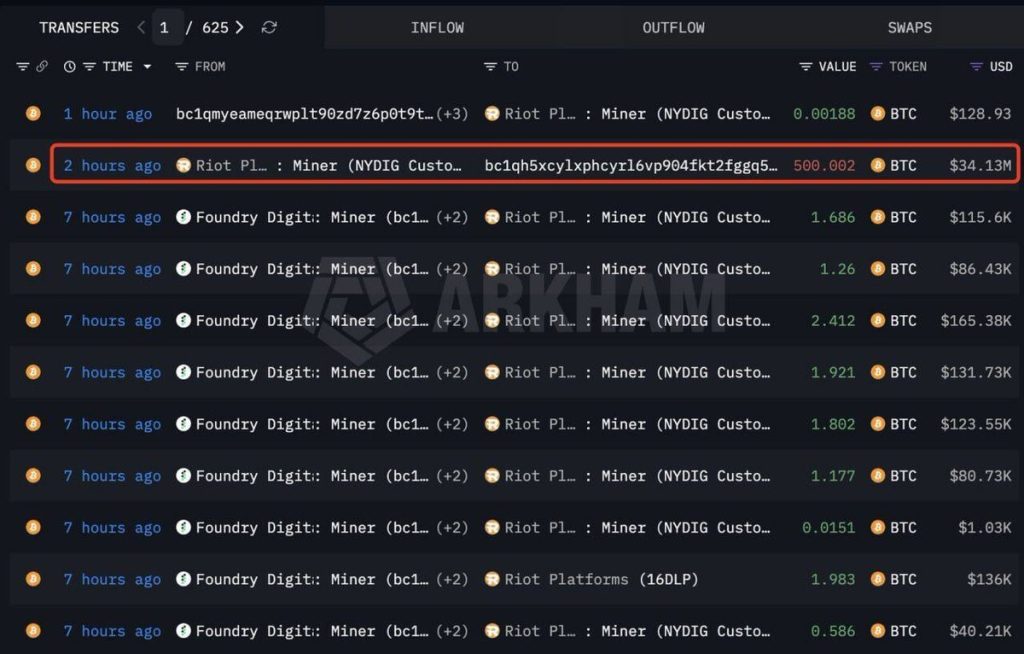 Source: Arkham
The company is also advancing into high-performance computing colocation, transitioning its business model from solely mining to infrastructure hosting—a shift that necessitates capital investment, which partly accounts for the rapid liquidation rate.
Energy expenses represent another critical aspect of the situation. Kadan Stadelmann, a blockchain developer and co-founder of AI firm Compance, noted that miners are liquidating assets due to rising energy costs—exacerbated by the ongoing Middle East conflict since February—which are squeezing margins throughout the sector.
“This results in a decline in hashrate and difficulty in Bitcoin mining. This facilitates easier and more profitable Bitcoin mining for those miners who remain operational,” Stadelmann stated, anticipating further exits from less efficient operators.
Key Takeaways:
- Sales volume: Riot sold 3,778 BTC in Q1 2026, generating $289.5 million against quarterly production of just 1,473 BTC.
- Treasury drawdown: BTC holdings decreased 18% quarter-over-quarter, from 18,005 to 15,680 BTC.
- Power cost improvement: All-in power cost fell 21% year-over-year to 3.0¢/kWh, even as selling intensified.
- Hash rate expansion: Deployed hash rate increased 26% to 42.5 EH/s, indicating infrastructure reinvestment over accumulation.
- Power credits: Riot generated $21.0 million in power credits during Q1—more than double the amount from the previous year.
- Industry-wide selling: MARA Holdings, Genius Group, and Nakamoto Holdings collectively sold 15,501 BTC in just the last week.
Discover: The Best Crypto to Get Right Now
Selling Above Production Rate – Operational Pivot or Distress Signal?
Divesting 2.6 times your quarterly production does not align with traditional treasury management; it indicates a structural drawdown.
This is significant as it suggests that Riot is not merely covering operational expenses; it is financing something larger, whether that involves hash rate expansion, colocation infrastructure development, or balance sheet restoration in anticipation of ongoing Bitcoin price pressures.
Related Posts
The operational metrics contradict a purely distress interpretation, however. Riot improved its all-in power cost by 21% year-over-year to 3.0¢/kWh and expanded its deployed hash rate by 26% to 42.5 EH/s. Additionally, it generated $21.0 million in power credits during Q1—more than double the amount from the same period last year—by utilizing renewable energy agreements and grid services.
 Bitcoin (BTC)24h7d30d1yAll time
This does not depict a miner in distress; rather, it illustrates a miner aggressively reallocating capital into infrastructure while market conditions remain unstable.
Riot is not isolated in this trend. MARA Holdings, Genius Group, and Nakamoto Holdings collectively sold 15,501 BTC in the past week.
Genius Group took it a step further by liquidating its entire Bitcoin reserve. The industry is evidently shifting from passive accumulation to active treasury management, marking a departure from the hodl-first strategy that characterized miner operations during the 2021 bull market. If Bitcoin prices do not rebound in Q2, it is likely that Riot’s treasury will approach the 14,000 BTC mark within two quarters at the current liquidation rate.
Discover: The Best Crypto Presales Live Right Now
Miner Selling and BTC Supply Pressure: How Much Does It Move the Market?
Bitcoin mining difficulty decreased from approximately 145 trillion to 133 trillion on March 20—a 7.7% drop—while the network hash rate fell from 1,160 exahash to around 990 exahash as of Friday.
Weaker miners are exiting the market, as Stadelmann anticipated, which structurally benefits remaining miners like Riot through reduced difficulty and increased per-block rewards.
The supply dynamics become more intricate when considered alongside demand. Bitcoin ETFs ended a four-month outflow streak with $1.32 billion in inflows during March, indicating that institutional demand is partially absorbing the miner supply entering the market.
Riot alone does not influence BTC prices; however, the combined selling from Riot, MARA, Genius Group, and Nakamoto in the same week constitutes a coordinated pressure event that will be clearly reflected in on-chain miner outflow metrics.
The condition for invalidation is straightforward: if BTC recovers and maintains a position above $90,000 in Q2, Riot’s treasury strategy may shift from defensive liquidation to premature selling at cycle lows. Until that occurs, the selling appears rational given the broader market pressures on holders and the increasing cost environment exacerbating miner margin compression globally.
Explore: The best pre-launch token sales with asymmetric upside potential
The post Riot Platforms Sells 3,778 Bitcoin in Q1 as Miner Strategy Shifts appeared first on Cryptonews.
