Disclaimer: Information found on CryptoreNews is those of writers quoted. It does not represent the opinions of CryptoreNews on whether to sell, buy or hold any investments. You are advised to conduct your own research before making any investment decisions. Use provided information at your own risk.
CryptoreNews covers fintech, blockchain and Bitcoin bringing you the latest crypto news and analyses on the future of money.


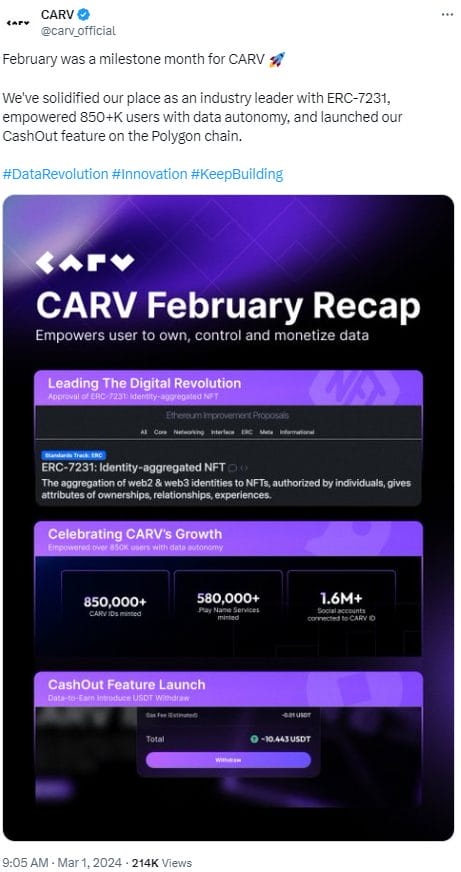
CARV, an oracle for self-sovereign identity and an AI-driven gaming application, has recently revealed the final endorsement of a new ERC-7231 NFT standard that signifies identity-aggregated non-fungible tokens (NFT).
As stated in the press release, this standard has received support from Ethereum for CARV’s initiative aimed at data self-sovereignty.
CARV emphasized that this represents “a significant advancement in connecting various digital identities and empowering users to possess their online history, connections, and experiences across different platforms.”
“Reaching this milestone has been an exhilarating journey,” remarked CARV Co-Founder Victor Yu in an interview with Cryptonews.
The ERC-7231 initiative was launched by CARV with a proposal submitted in June 2023.
After several drafts and modifications, the Ethereum Foundation officially approved the proposal with a final call and acceptance at the beginning of February.
Additionally, ERC-7231 is now publicly accessible.
Yu mentioned that the team anticipates the ecosystem’s adoption of this standard and the involvement of users in the value creation of their data.
Integrating Multiple Identities Into One
The announcement clarified that ERC-7231 connects various Web2 and Web3 identities into a single NFT, achieving encrypted aggregation of identity data across multiple domains.
According to CARV,
“The outcome is an ‘identity of identities’ that facilitates self-authentication, social overlap, and the generation of commercial value from targeted user data.”
Yu noted that “this solution dismantles identity silos and redefines the principles of data ownership.”
He added that the new standard ushers in a “new era of data-to-earn” within and beyond blockchain gaming. “Data self-sovereignty is now a tangible reality across Ethereum, and the possibilities are limitless,” Yu stated.
The standard provides three advantages:
- the protocol’s compatibility with account abstraction wallets simplifies onboarding for Web2 and Web3, thus enhancing adoption;
- the consolidation of multiple identities into one fosters improved interoperability among various platforms and services;
- users maintain authority over their data, determining its usage.
Users have the option to share specific on-chain and off-chain identity details and can earn passively whenever brands utilize this information.
CARV’s not loud, but our impact is clear
ERC-7231 is now an official standard, consolidating every aspect of your online identity securely in your control.
Own your data, safeguard your privacy.
Join us in this quiet revolution
Learn more: https://t.co/4lrWGscXw7#CARV…— CARV (@carv_official) February 22, 2024

 Own your data, safeguard your privacy.
Furthermore, CARV ID is integrated with this standard.
According to the announcement, over 800,000 users are engaging in games and earning rewards through CARV’s solution, which encompasses various layers, from the foundational data stack to its gaming-centric application layer.
It was noted that ERC-7231 is “the key to connecting everything,” as stated.
Experiencing High Engagement
Yu reported to Cryptonews that CARV has already witnessed substantial integration and utilization of the standard.
CARV ID, which adheres to ERC-7231, has been embraced by more than 900,000 users worldwide across Southeast Asia, Japan, CIS, the US, the UK, and Latin America.
Related Posts
Daily active users approach 500,000 across various games and ecosystems.
Prior to this standard, Yu contended that understanding gamers posed challenges for game developers.
Users are increasingly opting out of app tracking (IDFA), and evolving privacy regulations (CCPA) complicate data collection.
With ERC-7231, users can not only aggregate, possess, and manage their reputation, identities, and behaviors across Web2 and Web3, but this high-quality zero- and first-party data can assist games and artificial intelligence (AI) companies in crafting personalized experiences.
Looking ahead, CARV intends to collaborate with additional Web2 and Web3 studios. The team aims to facilitate users’ seamless movement across platforms.
On the technical front, “we invite all user identity solutions to adopt ERC-7231 and usher in a new era of identity-aggregated NFTs,” Yu stated.
ERC-7231 and ERC-404: Key Distinctions
ERC-404, introduced shortly before ERC-7231, made a notable impact in early February and quickly gained popularity.
The ERC-404-based collection Pandora, although no longer in the top position, still ranks among the top 10 NFT collections by sales volume, according to CryptoSlam.
According to GitHub, ERC-404 is an experimental, mixed ERC20 / ERC721 implementation featuring native liquidity and fractionalization. This indicates that it merges the ERC-20 (token standard) and ERC-721 (NFT standard).
Which ecosystem should we bring 404s to next?
— Pandora (@Pandora_ERC404) March 16, 2024
Subsequently, in the latter half of February, CARV introduced ERC-7231.
“First and foremost, ERC-404 is an experimental standard that has yet to be formally proposed for inclusion in Ethereum Improvement Proposals (EIPs),” Yu informed Cryptonews. In contrast, ERC-7231 is a fully finalized and sanctioned ERC standard.
However, according to Yu,
“It should be noted that both 7231 and 404 contribute to democratizing asset ownership and the distribution of value creation – this is a positive development. Nevertheless, each standard operates differently.”
ERC-404 is a semi-fungible token that permits multiple wallets to possess an NFT. Conversely, ERC-7231 links various Web2 and Web3 identities to a single NFT holder.
Through this holder NFT, users can standardize their identities, adjust the NFT based on behavior (data aggregation), and participate in value generation from user targeting whenever brands utilize it on-chain and off-chain.
“The outcome is an ‘identity of identities’ that accomplishes encrypted aggregation of multi-domain identity data, providing advantages for both games and gamers. A data win-win,” Yu remarked.
CARV is initially focusing on gaming, but there are numerous potential applications for this technology.
“Envision AI-driven healthcare solutions achieving groundbreaking advancements with access to clean and encrypted user data, subsequently rewarding these users with the monetary value generated by such breakthroughs, facilitated by smart contracts,” Yu concluded.
Notably, in mid-February, a separate group of developers announced the introduction of the ‘Divisible NFT’ standard (DN404), describing it as “a hybrid ERC20/721 token.
This team’s strategy involved creating two contracts: a “base” ERC-20 and a “mirror” ERC-721. More information can be found here.
Ethereum’s Dencun upgrade @ethereum represents a significant step towards a more open and free economy.
At CARV, we are proud to align with this vision. Our major achievement? The final endorsement of CARV’s ERC-7231 identity-aggregated NFT standard! Together, we’re building a more… pic.twitter.com/3nZjn52U31— CARV (@carv_official) March 13, 2024
The post New ERC-7231 NFT Standard Enters The Space appeared first on Cryptonews.
