Disclaimer: Information found on CryptoreNews is those of writers quoted. It does not represent the opinions of CryptoreNews on whether to sell, buy or hold any investments. You are advised to conduct your own research before making any investment decisions. Use provided information at your own risk.
CryptoreNews covers fintech, blockchain and Bitcoin bringing you the latest crypto news and analyses on the future of money.

Looking to enter the crypto field? University courses may provide an advantage for job applicants.

As discussions surrounding the Bitcoin halving, exchange-traded funds, and various macroeconomic factors suggest the onset of the next bull market cycle for cryptocurrencies, many individuals may be contemplating a career in this field. This transition is common among those engaged with Bitcoin (BTC), blockchain, or cryptocurrencies.
Initially, they may identify as “investors,” conducting research and acquiring assets within this emerging digital asset class. For some, this evolves into a motivation to enter the blockchain and decentralized ledger technology sector. Numerous individuals have chosen to pursue employment opportunities and develop the necessary skills to embark on careers in this domain.
Since the inception of the blockchain and cryptocurrency sector, the majority of individuals have secured positions through informal networks or demonstrable abilities.
Although it has become somewhat more challenging to penetrate this expanding industry today, educational institutions have responded with a solution. Formal blockchain degree programs are now available worldwide, enabling individuals to master the foundational concepts of the sector while also networking and establishing connections within the industry.
Following the bear market and the subsequent slowdown in the blockchain sector in late 2021, significant workforce reductions have occurred at crypto-focused companies such as Coinbase, Gemini, and Consensys.
The latter half of 2023 has recently witnessed increasing speculation and potential indicators that the commencement of the next bull market is imminent. Heightened activity within the blockchain sector implies a growing demand for talent to address the anticipated needs, prompting many individuals to seek entry into crypto firms and explore ways to distinguish themselves within the industry.
Not everyone is a prominent figure like Jon Dalby, who transitioned from his position as chief financial officer at Bridgewater Associates to join New York Digital Investment Group (NYDIG) in 2021. Dalby brought valuable traditional finance expertise to NYDIG.
However, not all academic qualifications seamlessly translate into the blockchain sector, as individuals must comprehend both the technical and functional aspects to appreciate the unique value propositions this emerging industry offers.
The blockchain sector is reported to be on a trajectory of substantial growth, with a projected continuous average growth rate of 59.9% from 2023 to 2030. According to PwC, there will be over 40 million jobs related to the blockchain industry globally by 2030. Analyzing the average salaries for various common blockchain roles in the United States, it appears that broader job responsibilities correlate with a greater necessity for advanced degrees.
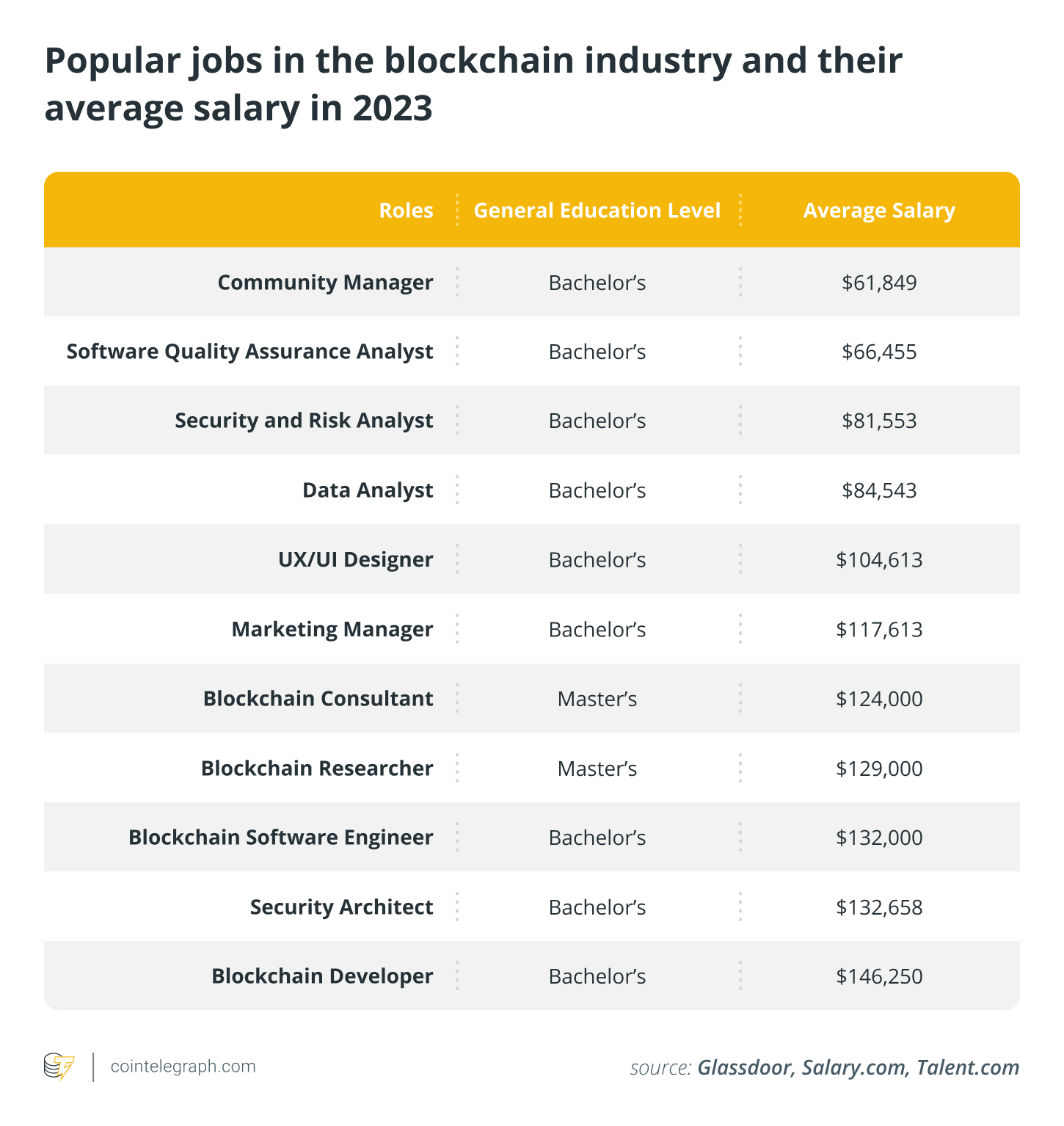
Traditional educational institutions, including colleges and universities worldwide, now provide degree programs centered on blockchain technology. Some of these programs are strictly technical, while others integrate business and technology components.
The existence of these programs raises the question: Are these formal degrees regarded as valuable in a still-evolving industry? Do they confer an advantage to degree holders in the current job market? Is this indicative of the industry’s maturation, suggesting that we should view these academic credentials as a marker of a certain level of competence?
What do blockchain educators say?
Cointelegraph reached out to various university program directors globally to gather their insights on the objectives of formal blockchain education programs.
Brian Houillion, program coordinator for the University of the Cumberlands’ master’s program in global business with blockchain technology, informed Cointelegraph that the program aims to “prepare our business students to serve in roles that partner and support the roles of entrepreneurs and developers.”
Magazine: Terrorism & Israel-Gaza war weaponized to destroy crypto
He noted that one of the most critical skills required in the blockchain sector is a comprehensive understanding of regulatory matters, particularly to ensure that innovation is “not stifled before it can develop” by enabling these emerging blockchain professionals to collaborate with lawmakers as the industry evolves.
The head of the European Blockchain Center, Roman Beck, stated to Cointelegraph, “Formal degrees facilitate signaling and positioning the topic alongside more established degrees, thereby enhancing the visibility of the blockchain industry,” which provides greater legitimacy within the traditional realm.
He believes the sector requires more individuals equipped with the skill sets to “develop economic models that enable decentralized businesses to create and capture value, which is the most pressing skill and mindset for blockchain architects and developers.”
Michael Jones, director of the University of Cincinnati’s Cryptoeconomics Lab, shared with Cointelegraph that formal degrees lend legitimacy and credibility to the industry as a whole. Beyond signaling to the traditional sector that decentralized ledger and blockchain technologies warrant further exploration, he emphasized “the networking opportunities with students from diverse disciplines such as computer science, mathematics, or economics.”
The primary skill Jones identifies as essential for the industry is “risk assessment and risk management.” Merely possessing technological skills without a “fundamental understanding of market risk, operational risk, counterparty risk, protocol risk, regulatory risk, etc.” will lead to the adoption of blockchain technology being “slow and uneven.”
Related Posts
Each of these programs has produced industry professionals who have gone on to work at companies like Chainalysis, MakerDAO, Brainbot, TradeLens, ZTLment, Januar, Concordium, and Reality+, among others.
For instance, the European Blockchain Center and the University of the Cumberlands proudly highlight alumni Demelza Hays and Michael Tabone, respectively, who are employed by Cointelegraph as economists and researchers.
All the program directors interviewed expressed varied opinions regarding the current state of the blockchain industry and its valuation of formal education.
Jones remarked that while the industry does not particularly prioritize formal degrees, “universities haven’t necessarily been effective industry partners. Universities can be slow to introduce new and innovative curricula, and many are reluctant to offer competitive salaries to attract industry experts to educate students.”
Houillion noted that it seems the “industry is seeking anyone capable of filling positions,” but that “a formal degree within the space would be advantageous, particularly for non-developer/programmer roles.”
Beck perceives the industry as valuing formal degrees, but asserts that “what they truly value is an education that fosters a mindset to think decentralized, enabling students to envision and realize distributed value co-creation networks.”
What do blockchain recruiters say?
The higher education institutions mentioned above are proactive in equipping students for careers in the blockchain and decentralized ledger technology sectors. However, the hiring process in Web3 is not as conventional and does not necessarily rely on formal qualifications.
Cointelegraph sought to explore the other side of the discussion and consulted several Web3/blockchain recruiters for their perspectives on formal degrees and their potential implications for the industry in the future.
All the recruiters interviewed reported that they have seen clients secure positions with formal degrees. The degrees that transition most easily into the blockchain sector and are in highest demand tend to be technical in nature, such as coding and cryptography.
This aligns with the reality that the most specialized skills need to be filled first, especially in a nascent, developing industry. Nevertheless, all believe that the demand for individuals with additional qualifications but a solid technical foundation will rise as the sector expands.
“I think that degree paths engage people earlier, and it will further legitimize the space,” Ryan Hawley, head of recruiting at Crypto Recruiters, told Cointelegraph. He added, “In time, [formal blockchain degrees] will be universally recognized.” He identified cryptography, smart contracts, database management, and compliance as the top four skills employers are seeking.
David Lamb of CB Recruitment conveyed to Cointelegraph that formal blockchain degrees may currently be undervalued, as references are often more informal in Web3.
However, establishing formal degree pathways would enhance credibility not only for the industry as a whole but also for a new cohort of individuals who might not have entered the field without these programs.
From Lamb’s viewpoint, a formal degree in blockchain signifies, at the very least, a commitment to the sector, along with a basic exposure to the various components essential for becoming a blockchain professional:
“Demand is returning to the market, and there are not enough qualified developers available. However, I would contend that non-technical specialists are equally crucial to the industry as it evolves into a multitrillion-dollar sector.”
He proceeded to enumerate marketing, operations, finance, legal, sales, and research analyst roles as equally vital positions that Web3 companies will require as the industry matures.
Recent: How the crypto bull run can impact Web3 gaming beyond play-to-earn
Connor Holliman of Proof of Talent echoed some of these sentiments to Cointelegraph: “[Formal blockchain degrees] create an opportunity for scalability within the space. Current processes for onboarding individuals to utilize blockchain technology resemble learning a foreign language. As someone who previously had no background in blockchain, I have faced numerous challenges to genuinely learn how to transact on and utilize various blockchains. The more individuals who enter this space with formal backgrounds, the easier it will be to onboard the next billion users.”
Holliman stated that as blockchain applications broaden, soft skills such as communication across different facets of a Web3 business will be highly valued. Engineers, cryptographers, and developer relations are three in-demand career paths in Web3 today.
While no guaranteed method exists to secure a Web3 position solely based on a degree, it may provide candidates with a potential advantage over their competitors in the future. It also serves as a platform for collaboration with other like-minded individuals who will all be striving to enter the field simultaneously. This networking opportunity may be worth the investment, allowing students to potentially create the next groundbreaking Web3 project in this environment.
