Disclaimer: Information found on CryptoreNews is those of writers quoted. It does not represent the opinions of CryptoreNews on whether to sell, buy or hold any investments. You are advised to conduct your own research before making any investment decisions. Use provided information at your own risk.
CryptoreNews covers fintech, blockchain and Bitcoin bringing you the latest crypto news and analyses on the future of money.


Fundstrat’s Chief Investment Officer Tom Lee has warned that institutional investors might alter Bitcoin’s conventional four-year cycle, as ongoing institutional capital inflows over the last two years have introduced counter-cyclical elements to the market.
In a recent discussion with Mario Nawfal, Lee, who is also the Chairman of Bitmine, clarified that Bitcoin’s four-year cryptocurrency cycle is rooted in its halving mechanism.
Tom Lee: Will the Crypto Four-Year Price Cycle Cease to Be Effective?
In an interview with Mario Nawfal, Tom Lee, Chairman of Bitmine, noted that the foundation of the four-year cryptocurrency cycle can be traced back to Bitcoin‘s halving mechanism. In the early decentralized… pic.twitter.com/Oil06eXV1y— Wu Blockchain (@WuBlockchain) September 8, 2025
Lee pointed out that the market has evolved beyond retail dominance, highlighting that 2024 has seen corporate purchasers and ETF launches providing steady capital inflows to Bitcoin, moving away from the supply scarcity-driven rallies that previously fueled the entire crypto market.
Tom Lee: “Equity Market Liquidity Has Ended Bitcoin’s Traditional Four-Year Cycle”
Lee stated that the cryptocurrency market faces two significant challenges: whether Bitcoin will continue its traditional downward cycle next year or whether it will decouple from equity markets, with which it has maintained a strong correlation.
If both scenarios occur, discussions centered around cycles in the cryptocurrency market may gradually fade.
For over a decade, Bitcoin’s market trends appeared highly predictable.
Every four years, the halving event, a programmed decrease in mining rewards, would trigger a cascading effect.
Prices would rise to new heights, then plummet into severe “crypto winters,” before the cycle would restart.
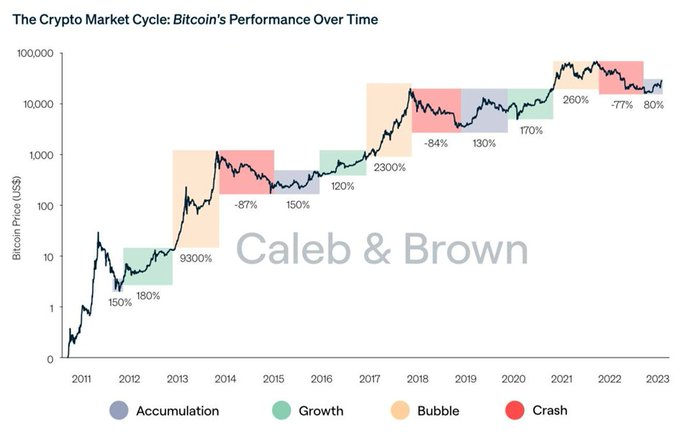 Source: X/ QuintenFrancois
This pattern became almost sacrosanct among crypto traders. However, some of the industry’s leading analysts now suggest that this phase may be concluding.
Supporting Lee’s viewpoint, Pierre Rochard, CEO of The Bitcoin Bond Company, also argues that the traditional cycle has diminished in significance, as stated in a recent social media update.
His rationale points to a fundamental change, with only 5% of Bitcoin left to be mined, making the halving’s supply impact considerably weaker than before.
There is only 5,15% of #Bitcoin left to mine.
Think about it! pic.twitter.com/GLViwCD0BJ— Rand (@crypto_rand) September 7, 2025
In Bitcoin’s formative years, reducing miner rewards caused significant market flow disruptions.
Currently, the main market drivers may include institutional inflows, regulated investment products, and global macroeconomic conditions.
Jason Dussault, CEO of Intellistake.ai, similarly perceives the emergence of institutional buyers as indicative of a structural shift.
Related Posts
“The halving remains relevant, but it’s no longer the primary catalyst,” he conveyed to CryptoNews.
Price fluctuations are now equally affected by global liquidity conditions, ETF capital movements, and investor sentiment as they are by on-chain supply factors.
“Bitcoin increasingly reacts to the same influences affecting equities, bonds, and commodities,” he remarked.
In July, Bitwise Chief Investment Officer Matt Hougan suggested that the historically noted four-year crypto cycle may no longer dictate current market dynamics.
During a joint discussion with Bitcoin advocate Kyle Chassé and Bloomberg ETF analyst James Seyffart, Hougan asserted that the historical framework is weakening, potentially paving the way for a prolonged, more sustainable growth phase.
He emphasized the significance of the July enactment of the GENIUS Act, arguing that the legislation allowed Wall Street to develop crypto-focused financial products.
Glassnode Data Contends that Bitcoin’s Traditional Four-Year Cycle is Still Intact
However, not all analysts are ready to declare the cycle’s demise.
In an interview with CryptoNews, Connor Howe, CEO of Enso, contended that the halving’s influence has been diminished rather than eradicated.
“The halving continues to be important for mining economics and long-term scarcity narratives, but traders can no longer rely on a rigid four-year framework.”
Moreover, recent research from Glassnode indicates that Bitcoin’s traditional four-year cycle retains its structural integrity.
 Source: Glassnode
The blockchain analytics firm found that Bitcoin’s current cycle duration and long-term holder profit-taking behaviors closely mirror previous cycles, with all-time highs in both the 2015-2018 and 2018-2022 cycles occurring 2-3 months beyond the current timeline.
This data suggests comparable cycle maturity to historical patterns rather than an end to the fundamental four-year structure.
On the 4-hour Chart, Bitcoin fell to weekend lows of $109,977 before rebounding toward $112,150 at press time, although investor confidence remains tenuous.
This situation has tempered bullish sentiment, with investors now questioning whether BTC can surpass last month’s peak of $124,128.
Recent market polling reveals that nearly 70% of respondents expect a drop to $105,000 before any potential upward movement.
The post Institutional Buyers May Break Bitcoin’s Traditional Four-Year Cycle, Tom Lee Warns appeared first on Cryptonews.
