Disclaimer: Information found on CryptoreNews is those of writers quoted. It does not represent the opinions of CryptoreNews on whether to sell, buy or hold any investments. You are advised to conduct your own research before making any investment decisions. Use provided information at your own risk.
CryptoreNews covers fintech, blockchain and Bitcoin bringing you the latest crypto news and analyses on the future of money.


The European Central Bank (ECB) has officially endorsed a proposal to shift the oversight of crypto-asset service providers to the European Securities and Markets Authority (ESMA) – a change that would unify 27 disparate national licensing systems into a centralized enforcement framework based in Paris.
The ECB’s statement, released in reaction to the European Commission’s 2025 capital markets package (COM/2025/941, 942, 943), positions ESMA as the primary supervisor for systemically significant crypto-asset service providers throughout the EU.
This initiative is already facing opposition from member states that have developed their regulatory frameworks – and licensing income – around the MiCA’s national competent authority model.
Ireland, Luxembourg, and Malta have become favored jurisdictions for crypto licensing under the existing system. Centralized oversight by ESMA would eliminate that competitive edge almost instantly.
The issue is not whether the ECB supports this change; it clearly does. The real question is whether the Commission’s capital markets package can withstand member state opposition long enough to be enacted into law.
Key Takeaways:
- ECB Position: The ECB officially advocates for the transfer of CASP oversight from national competent authorities to ESMA as part of the Commission’s 2025 capital markets package.
- MiCA Impact: Centralized oversight by ESMA would replace 27 national enforcement frameworks with a single authority, removing licensing arbitrage among EU jurisdictions.
- ECB Institutional Request: The ECB seeks non-voting membership on ESMA’s new Executive Board for discussions related to CASPs, along with direct data access and risk-sensitive capital requirements for crypto firms.
- Stablecoin Exposure: The ECB is advocating for limits on e-money tokens utilized as settlement assets in the absence of central bank money – a direct limitation on the scale of euro-pegged stablecoins.
- Timeline: The transitional periods for MiCA conclude in Q1 2026; if adopted, ESMA’s expanded responsibilities would likely coincide with EBA significance assessments occurring simultaneously.
- Licensing Hub Risk: Member states with established crypto licensing frameworks risk losing supervisory authority and competitive differentiation if ESMA centralization is approved.
- Watch: Ongoing negotiations by the Commission regarding the 2025 capital markets package – any concession on ESMA’s direct authority indicates that the centralization initiative may be losing political traction.
Discover: Top Crypto Presales to Watch This Month
What Changes Will ECB ESMA-Led Supervision Bring for Exchanges and Crypto Stablecoin Issuers Operating in the EU?
Currently, under the MiCA framework, crypto-asset service providers receive authorization from their home member state’s national competent authority and then passport that authorization throughout the EU. This model is similar to the operation of traditional financial firms under MiFID II.
In theory, it provides access to a single market. However, in practice, it creates enforcement disparities: a CASP licensed in a jurisdiction with lenient NCA oversight faces significantly different compliance pressures compared to one licensed in a stricter environment, despite both having EU-wide passporting rights.
Direct supervision by ESMA would close that gap. Exchanges exceeding a specified systemic threshold would report to ESMA instead of their home NCA – resulting in uniform enforcement standards, inspection frequencies, and penalty structures, regardless of the firm’s incorporation location.
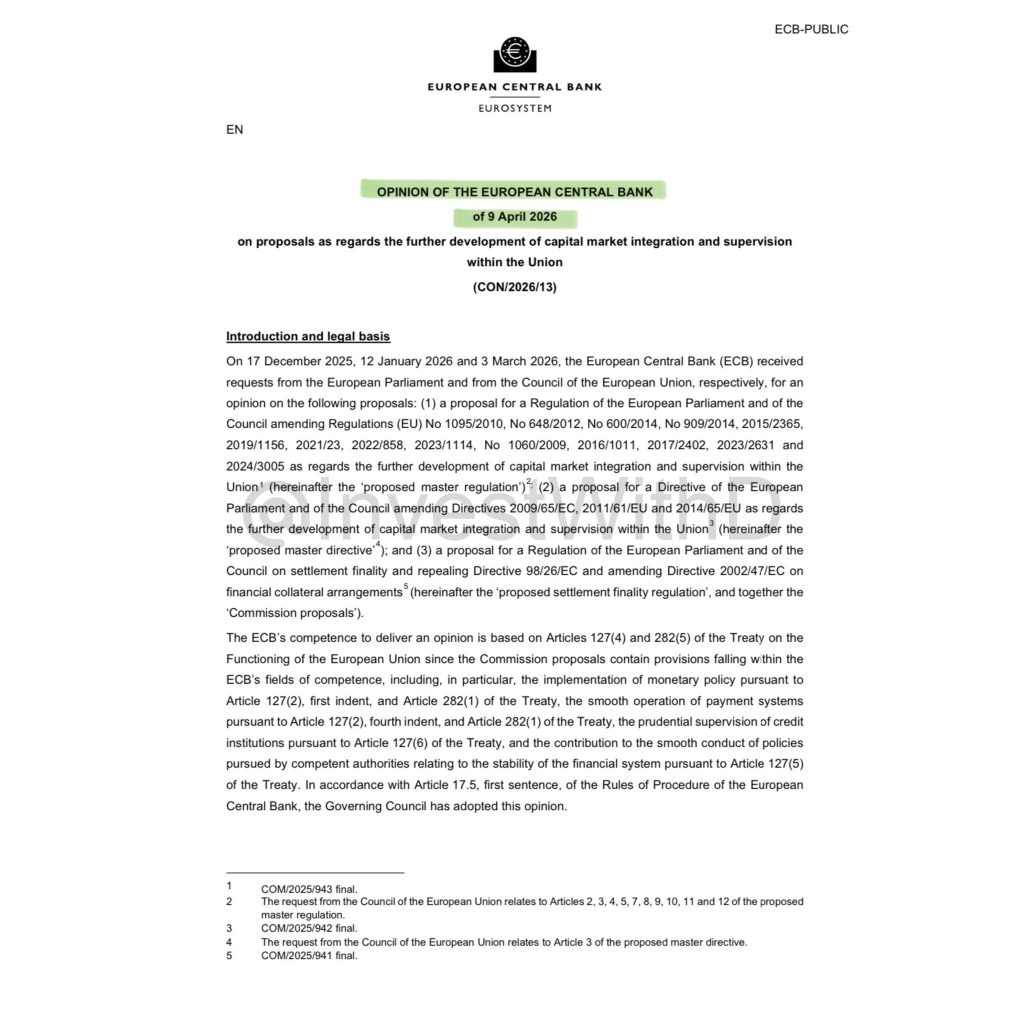 Source: ECB
ESMA already maintains a public registry of ART and EMT issuers and has the authority to enforce a blacklist for non-compliant CASPs. Direct supervisory authority over major CASPs expands that role from registry management to active enforcement, representing a fundamentally different institutional function.
Related Posts
For stablecoin issuers, the ECB’s advocacy for limits on e-money tokens as settlement assets – in the absence of central bank money – introduces an additional layer of constraints. Significant EMT issuers already trigger EBA oversight at €5 billion in reserves or 10 million users.
An ECB-supported settlement cap would impose volume restrictions on top of those thresholds, irrespective of EBA significance status. Major exchanges engaged in large-scale stablecoin settlements – including Binance and OKX, whose reserve disclosures have faced ongoing market scrutiny – would be directly affected by this constraint if it progresses to final rulemaking.
Discover: The best crypto to diversify your portfolio with
Why Is the ECB Advocating for This Now – and What Does Its Institutional Request Indicate?
The ECB’s opinion was not spontaneous. The European Commission introduced three legislative proposals in late 2025 – COM/2025/941, 942, and 943 – aimed at enhancing the Capital Markets Union by broadening ESMA’s direct powers over systemically important CCPs, CSDs, CASPs, and trading venues.
The ECB’s formal response to that package is where the support for ESMA was articulated, along with a specific institutional request: non-voting membership on ESMA’s new Executive Board for discussions concerning crypto-asset service providers.
 Photo: ECB
This request is significant. Non-voting board membership provides the ECB with a permanent seat in ESMA’s supervisory discussions without necessitating legislative expansion of ECB authority.
It serves as a mechanism for influencing monetary policy over crypto supervision without formal jurisdictional overlap – and it indicates that the ECB considers CASP activities to be directly pertinent to monetary stability, not merely financial market integrity.
The ECB also highlighted staffing needs, cautioning that ESMA requires “adequate staffing and financial resources” to manage expanded supervisory duties without operational strain.
This is not a mere formality. ESMA’s January 2025 statement urging NCAs to enforce restrictions on non-MiCA-compliant ART and EMT issuers by the end of Q1 2025 has already tested the authority’s coordination capabilities.
Introducing direct CASP supervision without increasing headcount would place additional stress on the same institutional framework. This regulatory direction parallels developments in other regions – Japan’s reclassification of crypto under the Financial Instruments and Exchange Act reflects a similar global trend: major jurisdictions transitioning crypto from payment-adjacent frameworks into comprehensive securities-style oversight with direct supervisory authority.
Discover: The best pre-launch token sales
The post ECB Backs ESMA-Led Crypto Supervision in EU: Tighter MiCA Enforcement Incoming appeared first on Cryptonews.
