Disclaimer: Information found on CryptoreNews is those of writers quoted. It does not represent the opinions of CryptoreNews on whether to sell, buy or hold any investments. You are advised to conduct your own research before making any investment decisions. Use provided information at your own risk.
CryptoreNews covers fintech, blockchain and Bitcoin bringing you the latest crypto news and analyses on the future of money.

“Crystal CEO Discusses How a Single Change in Mindset Could Prevent 80% of Cryptocurrency Scams”

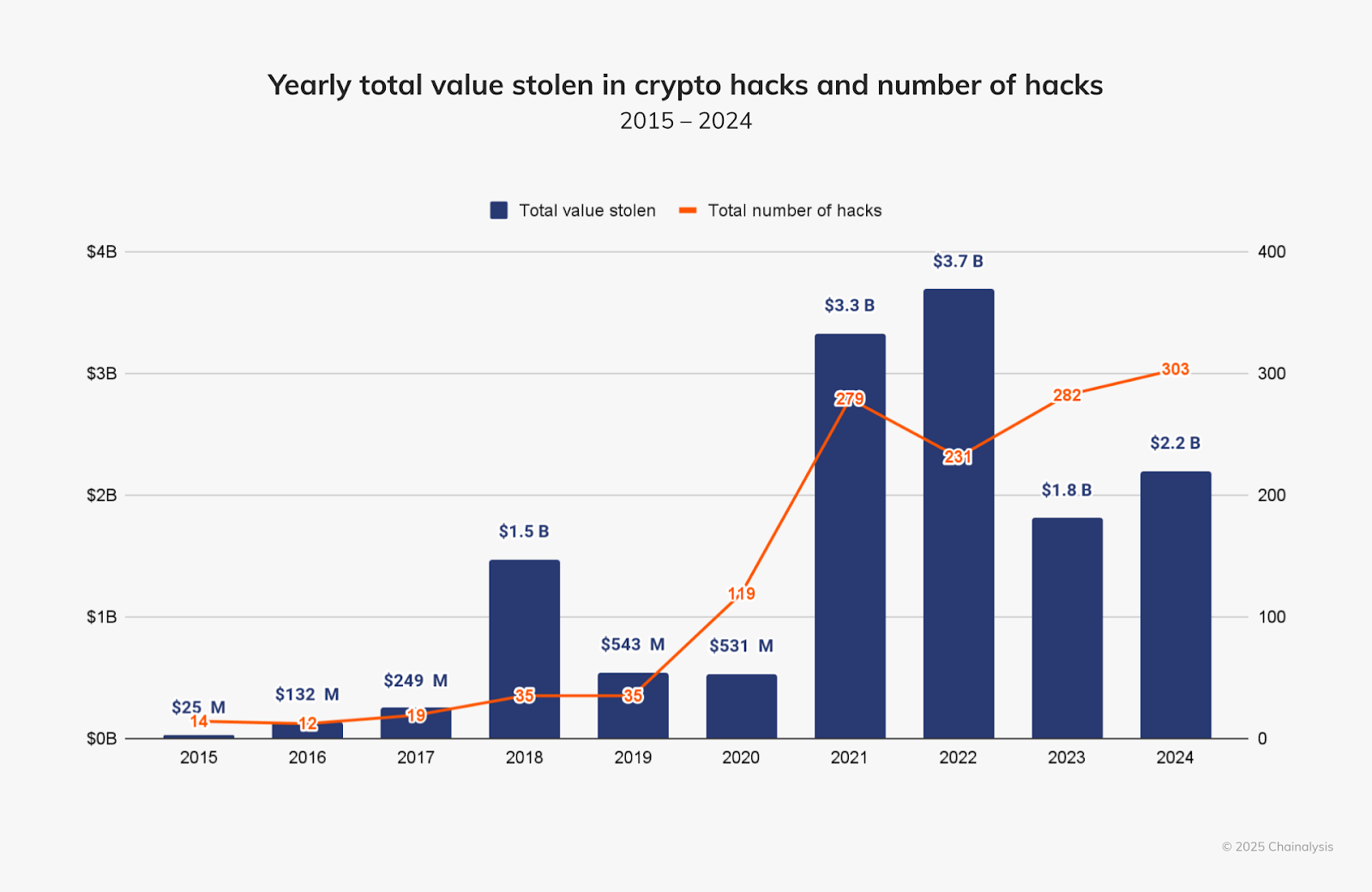
The swift expansion of the cryptocurrency sector has generated significant prospects for innovation while also providing a conducive environment for crypto-related fraud. The extent of this exploitation became glaringly evident in 2024, when Americans alone suffered losses amounting to a staggering $9.3 billion due to crypto-related offenses, marking a severe 66% rise from the prior year’s $5.6 billion.
The FBI’s Internet Crime Complaint Center documented nearly 150,000 complaints related to cryptocurrency in 2024, suggesting that what was once perceived as isolated occurrences has now evolved into a systematic threat to digital finance.
 Source: Chainalysis
Perhaps most concerning is the targeting of specific demographics, with individuals over 60 reporting the highest losses at $2.8 billion. Concurrently, data from Chainalysis indicates that North Korean hackers alone pilfered $1.34 billion from crypto exchanges in 2024, accounting for 61% of all stolen assets.
Crystal, a prominent blockchain analytics firm, is at the forefront of combating this issue. The company’s tools assist in tracking illicit cryptocurrency transactions and offer essential intelligence for ongoing investigations.
We engaged with Navin Gupta, who has been the CEO of Crystal since early 2024, regarding the advanced manipulation strategies that fuel contemporary crypto fraud. With over 23 years of leadership experience in fintech powerhouses such as Citigroup, HSBC, and Ripple, Gupta provides a distinctive viewpoint on how traditional financial crime prevention methods can be applied to the decentralized realm of cryptocurrency.
Our discussion uncovers how fraudsters exploit basic human psychology, the inadequacy of technical solutions alone, and the measures individuals and businesses can take to safeguard themselves.
The Psychology Behind Crypto Manipulation
CN: Based on your experience, what are the most prevalent psychological strategies scammers employ to gain trust from their victims?
Gupta: The most frequently used strategies center around urgency, authority, and familiarity. Scammers impersonate individuals of perceived authority, such as project founders, influencers, or even customer support personnel, to fabricate a sense of legitimacy. They leverage FOMO by instilling time pressure with statements like, “You’ll miss your chance if you don’t act now.” Additionally, they replicate the visual branding of legitimate platforms, tapping into the victim’s trust in established brands.
These attacks are meticulously planned campaigns that deeply understand human psychology. The cryptocurrency space is particularly vulnerable as many users operate under a high-risk, high-reward mentality, rendering them more prone to urgency-driven manipulation.
CN: How do scammers take advantage of personal relationships or social proximity – the so-called “trust trap” in modern crypto fraud schemes?
Gupta: We’ve observed a rise in what we term “social infiltration.” Attackers gradually integrate themselves into communities such as Discord servers, Telegram groups, or even private direct messages, presenting themselves as helpful members. They cultivate rapport over time, sometimes for weeks, before suggesting a fraudulent investment or a fake tool. The trap is effective because it doesn’t appear as fraud; it feels like a friend offering advice. The victim’s defenses are lowered due to emotional familiarity.
This is particularly nefarious as it capitalizes on one of crypto’s greatest strengths: community. These close-knit groups, formed around shared interests and investment strategies, become ideal hunting grounds for patient predators.
 Source: Chainalysis
Recent data from Chainalysis indicates that “pig butchering” scams, which heavily rely on creating false relationships, have experienced an 85-fold increase since 2020. Victims frequently lose between $2-4 million individually, largely due to the emotional manipulation that makes them willing to transfer larger sums over time.
The psychological tactics are alarmingly effective as they appeal to fundamental human needs for belonging and trust. When someone who has been supportive and friendly for weeks suddenly presents an “exclusive opportunity,” victims may assess the investment while attempting to preserve a valued relationship.
Evolution of Social Engineering Tactics
CN: Social engineering is advancing rapidly. What new behaviors or emotional triggers are attackers utilizing in 2024–2025 that we didn’t observe five years ago?
Gupta: In 2024–2025, we’re witnessing an increase in hyper-personalized attacks. With the aid of leaked data and AI-driven profiling, scammers customize messages that reflect the victim’s language, portfolio history, or even previous interactions. Another emotional trigger that has gained traction is empathy. Scammers fabricate medical emergencies or family-related issues to solicit cryptocurrency under emotional pretenses. Additionally, there’s a rise in “VIP scams” — attackers pretending to offer exclusive investment opportunities, exploiting status-driven FOMO.
AI has proven to be a highly destructive tool for scammers. They can now create convincing personas, imitate writing styles, and even produce deepfake videos of trusted individuals.
Just a few years ago, the level of personalization we’re witnessing would have necessitated teams of social engineers; now, it can be automated.
Chainalysis research suggests that AI is making fraud “more scalable and affordable for malicious actors to execute,” which clarifies why we’re observing such significant increases in both sophistication and volume.
This hybrid approach has led to investment fraud becoming the most costly category, resulting in $5.7 billion in losses in 2024 alone, a 24% rise from the previous year.
CN: Could you provide an example where the victim was manipulated using privileged or sensitive personal information? How do attackers typically acquire such data?
Gupta: In one case analyzed by Crystal, a victim received a phishing email that referenced a private wallet address and a transaction from three years prior. The scammers had scraped blockchain data and cross-referenced it with leaked emails from past exchange breaches. This made the phishing message appear highly credible. They even included the victim’s city and device type in the email footer. Such data is often purchased on darknet forums or extracted through malware and SIM-swaps.
What’s particularly alarming is how the transparency of blockchain data, which is generally a beneficial feature, becomes a vulnerability when combined with traditional data breaches. Scammers can create remarkably detailed profiles by linking on-chain activity with off-chain personal information.
High-Stakes Social Engineering
CN: Could you share a case Crystal investigated that offers a strong lesson about how social manipulation operates in scams?
Related Posts
Gupta: We looked into a case where a top manager at a mid-sized crypto fund was deceived by someone impersonating their CEO on Telegram. The attacker spoofed the CEO’s Telegram ID, imitated their writing style, and requested an “urgent liquidity transfer.” What’s particularly shocking is that the attacker timed their approach for when the real CEO was traveling — information likely sourced from social media. This serves as a clear illustration of how scammers combine social engineering with timing and reconnaissance. The breach was both emotional and contextual.
This case highlights why traditional corporate security training often falls short in the crypto domain. The speed and irreversibility of crypto transactions do not allow for the usual verification processes that might catch such attacks in traditional finance.
CN: Have you observed an uptick in scams targeting high-net-worth individuals or companies through tailored, “luxury” phishing attempts? If so, how do these differ from mass-market scams?
Gupta: Certainly. High-net-worth targets are approached with a higher level of sophistication. These phishing attempts frequently come through LinkedIn, exclusive invite-only communities, or even via introductions from compromised contacts. The language is refined, the visuals mimic premium branding, and the attackers often reference private investment rounds or bespoke DeFi tools. The distinction lies in the preparatory work. Mass-market scams are quick and generic, whereas “luxury” scams are slow, curated, and often involve weeks of social engineering.
Attackers dedicate months to cultivating relationships with high-value targets. They participate in virtual events, engage in discussions, and establish credibility before making their move. The return on investment justifies this level of effort when a single successful attack can yield millions.
This trend aligns with broader market data indicating that individuals aged 50-59 lost $164 million in Q1 2025 alone to investment scams, despite representing a smaller victim demographic than younger age groups.
The sophistication extends beyond the approach, as these attackers frequently compromise legitimate contacts within a target’s network first and then leverage those trusted relationships as entry points.
The patience and resources required suggest these are not isolated bad actors, but organized operations with significant backing.
Technical Vulnerabilities and Human Error
CN: What are some of the less obvious yet dangerous mistakes individuals or businesses make that expose their funds to risk?
Gupta: One significant issue is excessive trust in platforms. Individuals assume that because a dApp appears polished or a Telegram bot has numerous users, it must be secure. Another concern is inadequate key compartmentalization. Teams often store keys in shared environments like cloud folders or messaging threads. Businesses also neglect decentralized approval processes: if a single person can authorize large transactions, you’re just one social hack away from a breach.
The decentralized nature of cryptocurrency means there’s no customer service department to contact when issues arise. This finality necessitates a completely different security mindset than traditional finance, yet many users have not adjusted their behaviors accordingly.
CN: SIM-swap attacks remain an alarmingly effective method. Can you explain how a SIM-swap can lead to a complete asset drain?
Gupta: In a SIM-swap, attackers persuade a telecom provider to transfer your number to a SIM card they control. From that point, they intercept 2FA codes, reset email passwords, and gain access to exchange accounts. Within minutes, they can deplete wallets, liquidate NFTs, or even use saved cards to steal fiat. To safeguard against this, one should utilize hardware security keys, avoid SMS-based 2FA, and establish a separate device/email for financial transactions that isn’t linked to public contact points.
The rapidity of a SIM-swap attack is what renders it so devastating in the crypto space. Unlike traditional finance, where fraud detection systems or transaction delays might exist, cryptocurrency operates at the speed of the blockchain, typically within minutes or even seconds.
Building Scam-Resistant Behaviors
CN: When examining crypto scam victims, what is more frequently the underlying cause: technical deficiencies or human error?
Gupta: It’s generally human error that opens the door, while technical deficiencies exacerbate the situation. Consider it as a chain: an emotional decision leads to a click, and then poor architecture (like the absence of a withdrawal whitelist) allows funds to exit instantly. Human behavior acts as the spark, and weak security design serves as the accelerant. The most effective scam prevention strategies must address both: behavioral hygiene and technical safeguards.
This is why education is emphasized alongside other technical solutions. You can create the most advanced security system, but if a user willingly shares their private keys because they trust a convincing impersonator, no technology can shield them.
CN: What tools should users seek to identify early signs of social engineering or potential scams?
Gupta: We recommend tools that assess behavioral anomalies — for instance, extensions that flag new domains mimicking existing dApps, or wallets that display risk scores on new token contracts. Additionally, always be on the lookout for inconsistencies: slightly altered URLs, urgency in language, or unexpected account activity. Most importantly: no tool can replace the need for pause and verification. Taking your time is safer in crypto.
The cryptocurrency industry must develop improved user experience patterns that naturally promote verification without being overly cumbersome. The current landscape often forces users to choose between security and convenience, which is an unfavorable situation.
The Ultimate Defense Against Crypto Fraud
CN: If you could instill one reflex in every crypto holder’s mind to make them immune to scams, what would it be?
Gupta: Assume every unsolicited message is a potential attack. That mental shift alone could eliminate 80% of threat vectors. If someone contacts you with urgency, secrecy, or flattery — pause. Your best defense is a healthy dose of skepticism.
The cryptocurrency environment moves quickly, but your funds don’t have to. The few minutes spent verifying a request could prevent you from losing everything you’ve worked to achieve in this space.
About Navin Gupta
Navin Gupta has served as the CEO of Crystal since early 2024. He is an experienced international executive with over 23 years of leadership expertise in fintech and financial services. Before joining Crystal, Navin held significant positions including Vice President at Citigroup, Head of Growth at HSBC, and Managing Director at Ripple.
The post “80% of Crypto Scams Could Be Stopped by One Mental Shift” — Crystal CEO | Interview appeared first on Cryptonews.
