Disclaimer: Information found on CryptoreNews is those of writers quoted. It does not represent the opinions of CryptoreNews on whether to sell, buy or hold any investments. You are advised to conduct your own research before making any investment decisions. Use provided information at your own risk.
CryptoreNews covers fintech, blockchain and Bitcoin bringing you the latest crypto news and analyses on the future of money.

CryptoQuant Suggests Bitcoin Could Be in Significant Value Declines or on the Verge of a Bear Market

Key Takeaways:
- Market sentiment is weakening as technical indicators change.
- Accumulation trends and ETF actions indicate a broader reluctance.
- Indicators suggest this is not a typical pullback but rather a more significant adjustment.
- Underlying weaknesses may alter long-term trends.
Bitcoin’s valuation metrics are indicating bearish conditions, and according to a CryptoQuant analyst, the market may be balancing between low price levels and the beginning of a bear market.
https://twitter.com/cryptoquant_com/standing/1899464577966018585
CryptoQuant’s analysis, published on March 11, shows that nearly every major indicator now signals caution.
The Bitcoin Bull-Bear Market Cycle Indicator is currently at its most bearish point this cycle—a position that, in previous cycles, has either preceded a sharp correction or marked the start of a downturn.
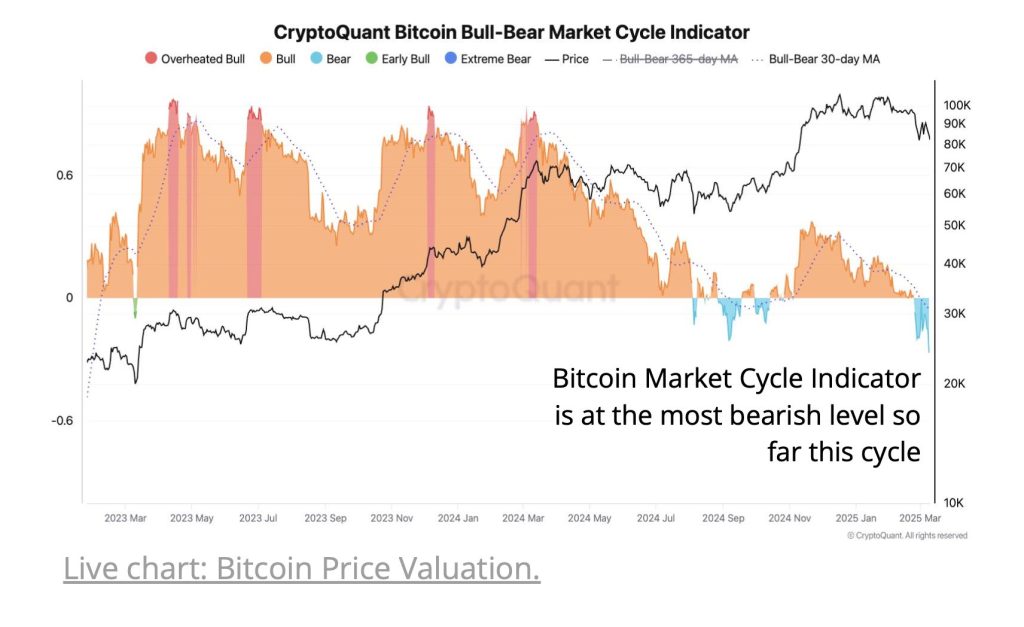
Simultaneously, the MVRV Ratio Z-score has dipped below its 365-day moving average, indicating that Bitcoin’s previously sustained upward momentum has significantly waned.
This change in sentiment is reflected in the noticeable decline in Bitcoin demand.
Recently, the apparent demand for Bitcoin fell by 103,000 BTC in just one week, marking the fastest rate of contraction observed since July 2024.
Bitcoin Whales Slow Accumulation, Indicating Reduced Demand
This sharp decline indicates clear buyer hesitation and diminishing market support.
Major whales, who have historically influenced market movements through their substantial accumulations, have also reduced their rate of Bitcoin purchases.

U.S.-based spot ETFs have turned into net sellers of Bitcoin this year, further exerting downward pressure on prices.
While Bitcoin’s current 22% price decline may seem consistent with corrections seen during previous bull market cycles, the valuation metrics present a more concerning picture.
The metrics suggest that this is not a standard pullback but rather a deeper, more fundamental correction.
Related Posts
Bitcoin is trading around $81,000 as of this writing—a range slightly below the trader’s on-chain realized price lower band, a crucial support level.
This precarious situation was exacerbated Tuesday as the broader crypto market dropped 6% amid investor anxiety triggered by President Donald Trump’s latest trade policies.
Increased tensions over tariffs aimed at major U.S. trading partners—Canada, Mexico, and China—have unsettled markets, leading to a wave of sell-offs across risk assets.
If Bitcoin fails to maintain this support, its next significant target is around $63,000.
This level aligns with the trader’s minimum on-chain realized price band, a threshold that has historically served as a last line of defense during severe price corrections.
The insights provided by the CryptoQuant analyst emphasize a convergence of factors that are heightening market uncertainty.
Given the bearish signals, diminished demand, slowing whale accumulation, and ETFs becoming net sellers, Bitcoin’s market is at a critical juncture.
Investors face an important question: Are these signals merely short-term anomalies, or do they indicate deeper, structural weaknesses within the Bitcoin market?
How stakeholders interpret these signals in the upcoming weeks may determine whether Bitcoin rebounds strongly or continues to slip into bearish territory.
Frequently Asked Questions (FAQs)
What could a deeper correction imply for Bitcoin’s long-term outlook?
A deeper correction might indicate a market reset, revealing underlying vulnerabilities while providing strategic entry points. This phase can recalibrate inflated valuations and potentially encourage a more robust, sustainable long-term Bitcoin growth.
How might institutional actions influence the current Bitcoin trend?
Changes in institutional behavior, such as shifts in ETF strategies and slower accumulation, can impact broader market sentiment. Their actions affect liquidity and may significantly shape Bitcoin’s price trajectory.
What broader economic factors might amplify Bitcoin’s current market dynamics?
Wider economic changes, such as political instability and alterations in trade regulations, could make markets more volatile. These external pressures often make Bitcoin more responsive to investor sentiment, accelerating price fluctuations.
The post Bitcoin May Be at Deep Price Ranges or Start of a Bear Market: CryptoQuant appeared first on Cryptonews.
