Disclaimer: Information found on CryptoreNews is those of writers quoted. It does not represent the opinions of CryptoreNews on whether to sell, buy or hold any investments. You are advised to conduct your own research before making any investment decisions. Use provided information at your own risk.
CryptoreNews covers fintech, blockchain and Bitcoin bringing you the latest crypto news and analyses on the future of money.

Could Stablecoins Address U.S. Debt? Standard Chartered Projects $1 Trillion in Treasury Demand

Crypto stablecoins may be on the verge of transforming a segment of the US debt narrative. Recent analysis from Standard Chartered indicates that this sector could generate up to $1 trillion in additional demand for US Treasury bills by 2028.
As the number of stablecoin issuers increases, they are anticipated to become significant purchasers of government debt, converting digital dollars into a substantial influence within traditional finance.
Key Takeaways
- $2 Trillion Trajectory: Analysts forecast that the overall stablecoin market capitalization will escalate to $2 trillion by the conclusion of 2028, rising from approximately $300 billion currently.
- Treasury Scarcity: Issuers are projected to acquire around $1 trillion in short-term T-bills, potentially leading to a supply deficit unless adjustments are made by the Treasury.
- Regulatory Drivers: The GENIUS Act framework requires reserves to consist of high-quality liquid assets, compelling issuers to focus their holdings in the 0-3 month debt category.
Why Are Stablecoins Becoming a Financing Powerhouse?
Stablecoins have evolved beyond mere trading instruments. They are becoming consistent purchasers of US government debt. Following the passage of the GENIUS Act in July 2025, regulated issuers must maintain reserves in high-quality liquid assets, primarily short-dated Treasuries.
Current supply is around $300 billion. Standard Chartered perceives the recent slowdown as a temporary phase and anticipates robust growth ahead, particularly from emerging markets.
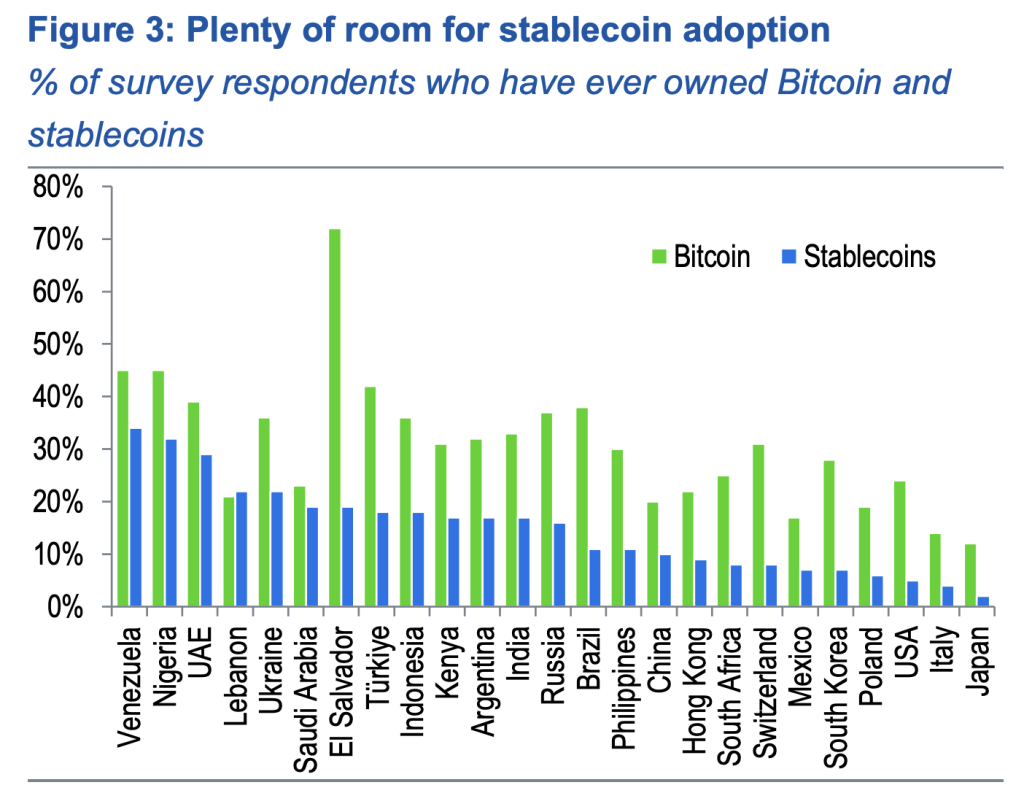
As individuals in high-inflation countries transition to dollar stablecoins, the backing reserves are directed into US debt. The demand from crypto supports Treasury markets in the background.
Breaking Down the $1 Trillion Projection
Analysts Geoffrey Kendrick and John Davies from Standard Chartered analyzed the underlying mechanics.
They predict that stablecoins will approach a $2 trillion market cap by 2028. This growth alone could generate between $0.8 trillion and $1 trillion in new demand for short-dated Treasury bills, primarily at the front end of the yield curve.
Related Posts
 Source: MacroMicro
In straightforward terms, stablecoin issuers could emerge as some of the largest purchasers of T-bills. If issuance trends remain consistent, the report estimates approximately $0.9 trillion in excess demand over the next three years.
About two-thirds of this growth is expected to originate from emerging markets. Furthermore, most of it would represent net new demand rather than merely reallocating existing Treasury holdings.
This indicates a significant structural demand developing for US debt.
Implications for U.S. Debt Issuance
The magnitude is substantial enough that the US Treasury cannot overlook it.
If issuance does not adapt, short-dated T-bills could face tight conditions. Treasury Secretary Scott Bessent has already suggested that stablecoins might play a crucial role in financing the US government.
This creates a mutually beneficial scenario. The dollar enhances its position in digital markets, while the government secures a reliable buyer for its debt.
However, closer integration necessitates increased oversight. As new regulations for stablecoins progress, collaboration between private issuers and public debt management will intensify.
Innovation is occurring around various collateral models, yet Treasuries remain central for regulatory endorsement.
Discover: Here are the crypto likely to explode!
The post Could Stablecoins Fix U.S Debt? Standard Chartered Sees $1T in Treasury Demand appeared first on Cryptonews.
