Disclaimer: Information found on CryptoreNews is those of writers quoted. It does not represent the opinions of CryptoreNews on whether to sell, buy or hold any investments. You are advised to conduct your own research before making any investment decisions. Use provided information at your own risk.
CryptoreNews covers fintech, blockchain and Bitcoin bringing you the latest crypto news and analyses on the future of money.


Key Takeaways:
- Perpetual decentralized exchanges (perp DEXs) are gaining traction: platforms such as Hyperliquid and Aster have propelled decentralized exchanges to trading volumes previously associated with centralized exchanges (CEXs).
- CEX tokens experienced a surge prior to the market correction in September, indicating renewed interest from institutional investors and greater regulatory clarity.
- Industry experts concur that CEXs continue to excel in liquidity, fiat on- and off-ramps, and compliance, making them vital for institutions and novice users.
- DEXs offer privacy, transparency, and access to small-cap tokens, benefits that centralized platforms are unable to replicate.
- Hybrid models are emerging as a promising future direction, merging the scale and usability of CEXs with the independence of DEXs.
The introduction of Hyperliquid (HYPE) has altered the landscape of the crypto exchange market. Its hybrid model has demonstrated that a new platform can integrate features of centralized exchanges (CEXs) with those of decentralized exchanges (DEXs). This combination has been pivotal to its success.
Throughout 2025, Hyperliquid maintained its position at the forefront of perpetual decentralized exchanges, or perp DEXs. However, in September, a new player emerged: Aster, along with its native token. The initiative has support from Changpeng Zhao (CZ), suggesting informal backing from Binance.
Aster Disrupts the Perp DEX Market
This could represent the exchange’s strategy to enter the perp DEX market to prevent Hyperliquid from capturing too much of its clientele. So far, the data indicates that this approach is effective. As reported by DeFiLlama, Aster’s trading volume in the past week exceeded $100 billion. Lighter followed with $56 billion, while Hyperliquid secured third place with $64.6 billion (note: it ranks third due to lower daily volume).
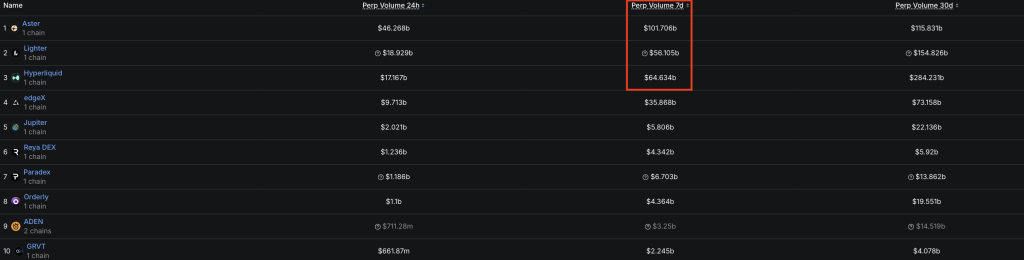 Source DeFiLlama
It remains premature to assess the seriousness of these competitors or whether this will replicate the narrative of Pump.Fun and other launchpads. Initially, competing platforms surged due to hype, but Pump.Fun eventually regained its lead. In the case of perp DEXs, the primary concern is not their ranking but the substantial volume of funds transacting through them. Just a year ago, such figures would have been unimaginable for decentralized exchanges.
This brings up a critical question: can CEXs endure the rise of perp DEXs and maintain their position in a market that is progressively shifting towards decentralized options? Experts provide their insights below.
Why Perp DEXs and CEXs Are Interdependent
Frank Combay, COO of Next Generation NGPES, a platform that connects traditional financial systems with digital assets, contends that the increase in exchange tokens, which began in late August before the recent market correction, signifies more than mere short-term excitement. He cites heightened institutional demand and regulatory clarity as the primary factors:
Institutional investors have shown renewed interest in exchange-based crypto tokens, which significantly enhanced their performance throughout August. This renewed confidence coincides with a rise in regulatory initiatives, fostering a more predictable and secure investment landscape.
He further noted that these conditions have driven higher volumes on centralized exchanges and are likely to sustain demand for CEX tokens well into 2026. Combay asserts that liquidity, tighter spreads, and fiat on- and off-ramps remain enduring advantages for centralized platforms.
Farzam Ehsani, co-founder and CEO of VALR, a centralized crypto trading platform, believes that the future of exchanges is not about one model supplanting the other but rather how both can fulfill distinct needs:
While CEXs and DEXs certainly compete on certain levels, it’s more beneficial to view these venues as complementary in their service to society.
He pointed out that decentralized exchanges may offer anonymity and early access to small-cap tokens, while centralized platforms are better suited for newcomers due to usability, support, and liquidity.
In Ehsani’s perspective, institutional adoption will continue to favor CEXs, while DEXs will maintain an advantage in privacy and innovation:
The future of finance doesn’t need to be uniform. CEXs and DEXs, along with traditional financial institutions, can coexist and collaborate to address the diverse needs of society.
Lionel Iruk, senior advisor to Nav Markets and managing partner at Empire Legal, echoed the sentiment of balance but cautioned against overinterpreting the rise of CEX tokens:
Related Posts
The recent increase in exchange tokens like OKX, Cronos, and KuCoin reflects a growing investor interest in platforms that provide utility and governance within their ecosystems. However, it’s crucial to distinguish between short-term market fluctuations and long-term value propositions.
Iruk emphasized that centralized exchanges still excel in liquidity management, compliance, and governance. Simultaneously, both CEXs and DEXs face ongoing risks, including security breaches, regulatory scrutiny, thin liquidity pools, and vulnerabilities in smart contracts.
The Significance of Hybrid Models
Lionel Iruk views hybrid models as a natural progression for the market. By merging the liquidity and governance of CEXs with the transparency and independence of DEXs, exchanges can address each other’s shortcomings:
Such models can provide improved liquidity, user control, and compliance. As the regulatory environment evolves, exchanges will need to adapt and innovate to satisfy the demands of a varied user base.
Farzam Ehsani emphasizes that CEXs still offer critical advantages that are essential for both institutions and newcomers:
CEXs possess clear benefits in areas such as user experience, security, accountability, and regulatory compliance. This makes them particularly suitable for institutional investors as well as users who prioritize trust and reliability in their trading environment.
At the same time, he acknowledged the distinct appeal of DEXs:
Privacy is often highlighted as a vital aspect of the decentralized trading experience, with anonymity and access to small-cap tokens as fundamental features. DEXs enable users to trade directly from their non-custodial wallets, granting them control over assets and early access to emerging, albeit volatile, digital assets.
Frank Combay described hybrids as a logical advancement that directly addresses the most significant limitations of both models:
By merging CEX liquidity and performance with DEX transparency and self-custody, these hybrids alleviate scalability challenges on one side and custodial risks on the other.
Perp DEXs Are Capturing a Larger Market Share
The DEX-to-CEX spot volume ratio illustrates how swiftly perp DEXs have gained traction. From late 2023 through early 2025, their share of spot volumes gradually increased from below 10% to approximately 20–25%. In the spring of 2025, the pace quickened, with the ratio briefly exceeding 60% before stabilizing around 30–35%.
 Source: Blockworks
Even following the correction, the level remains significantly higher than in previous years. This indicates that the rise of perp DEXs is not merely a temporary trend but a fundamental shift in market dynamics.
For CEXs, the message is unmistakable: they no longer command liquidity in the manner they once did. Whether through hybrid models or new competitive strategies, centralized platforms must adapt if they wish to maintain their central role in crypto trading.
In summary, experts agree that CEXs continue to excel in areas such as liquidity, accessibility, and regulatory compliance, which are crucial for institutions and new market participants. However, DEXs provide privacy, transparency, and access to emerging tokens that centralized platforms cannot offer.
Rather than a winner-takes-all scenario, the future of trading may reside in hybrid models that integrate the efficiency and scale of CEXs with the openness and self-custody of DEXs. Frank Combay emphasizes:
DEXs present a range of risks, primarily low liquidity and price slippage. Thin liquidity pools on smaller or newer platforms can result in high slippage and unfavorable trade execution. Additionally, users may encounter regulatory uncertainty, cyber threats, and vulnerabilities in smart contracts.
The post CEXs vs Perp DEXs: Who Will Win? Experts Weigh In appeared first on Cryptonews.
