Disclaimer: Information found on CryptoreNews is those of writers quoted. It does not represent the opinions of CryptoreNews on whether to sell, buy or hold any investments. You are advised to conduct your own research before making any investment decisions. Use provided information at your own risk.
CryptoreNews covers fintech, blockchain and Bitcoin bringing you the latest crypto news and analyses on the future of money.

Bitget CEO Gracy Chen Labels Hyperliquid as a Non-Genuine DEX, Sparking Reactions on Crypto Twitter

On April 7, Bitget CEO Gracy Chen took to X to label Hyperliquid as ‘immature, unethical, and unprofessional,’ characterizing the platform as an overhyped imitation of a crypto DEX that presents ‘FTX 2.0′ risks for users. This statement created a significant stir on Crypto Twitter, sparking one of the most intense debates between CEX and DEX proponents the industry has witnessed in years.
This is not merely background chatter. Hyperliquid has been generating substantial trading volume, consistently exceeding $1 billion in daily perpetual trades, which directly impacts the perpetual trading operations of both mid-tier and leading centralized exchanges, including Bitget.
Key Takeaways:
- The accusation: On April 7, Gracy Chen, CEO of Bitget, publicly criticized Hyperliquid as an ‘overmarketed’ imitation DEX, cautioning about systemic risks akin to those posed by FTX and labeling it an ‘offshore CEX with no KYC/AML.’
- The trigger: On March 26, Hyperliquid’s limited validator group unanimously decided to delist the JELLY memecoin perpetual market and forcibly settled positions at $0.0095 after an attacker exploited the HLP vault with a $6 million short, revealing the platform’s centralized emergency override feature.
- The structural critique: Chen contended that Hyperliquid’s mixed vaults expose all users to collective risk from individual market manipulators, and that foundational interventions in open markets create a ‘dangerous precedent.’
- The volume context: The growth of Hyperliquid’s HYPE token and platform poses a direct challenge to CEX perpetual revenue, positioning Chen’s critique as a blend of principled concern and competitive interest.
- Industry split: BitMEX co-founder Arthur Hayes echoed concerns regarding decentralization but minimized the potential long-term damage; Hyperliquid’s community strongly countered, accusing Chen of merging valid criticism with CEX protectionism.
- What’s next: Hyperliquid has indicated plans for validator expansions and HLP upgrades following the JELLY incident; Bitget’s Q2 2026 volume figures will reveal whether the controversy has affected market share.
Discover: The Best Crypto Exchanges for Active Traders
What Chen Actually Said and Why It Resonated With Hyperliquid
Chen’s statement was straightforward: Hyperliquid functions like an ‘offshore CEX with no KYC/AML’ disguised as a DeFi platform, and the JELLY incident validated her claims. Her main assertion – that the decision to shut down the JELLY market and force-settle positions ‘sets a dangerous precedent’ – specifically targeted the mechanism Hyperliquid employs to distinguish itself from traditional finance: on-chain, non-custodial execution with validator consensus.
Update: Bitget CEO Gracy Chen calls out Hyperliquid saying it operates more like an offshore CEX than a true DEX.
She pointed to the 2025 JELLY token incident where the platform closed the market and forcibly settled positions, causing major user losses.
This reignites the… pic.twitter.com/uy1zxCgLK2— OGAudit
Crypto Reviews (@OGAudit) April 7, 2026
The JELLY incident on March 26 provided substance to Chen’s critique. An attacker initiated a $6 million short on the newly introduced JELLY memecoin perpetual – a token launched in January 2025 by Venmo co-founder Iqram Magdon-Ismail – then artificially inflated the token’s on-chain price to trigger self-liquidation, endangering over $10 million in losses for the HLP vault.
Hyperliquid’s validators reacted by unanimously delisting the market and enforcing settlement at $0.0095, protecting the vault but overriding open user positions in the process.
This intervention serves as the tangible evidence Chen references. Hyperliquid has established its reputation – and the valuation of its HYPE token – on the premise of decentralization. The act of force-settling user positions through coordinated validator actions contradicts the principles of decentralization. Chen articulated this point emphatically, referencing FTX in her remarks.
Explore: The best pre-launch token sales with asymmetric upside potential
Why Bitget Is Really Engaging – and What Hyperliquid Crypto Has at Stake
The underlying issue extends beyond executive disagreements. It centers on volume. Hyperliquid has consistently achieved over $1 billion in daily perpetual volume – the primary product category that centralized exchanges, like Bitget, rely on for fee income.
Related Posts
As the dynamics of centralized exchanges evolve and traders become increasingly comfortable with on-chain execution, every dollar that transitions to Hyperliquid represents a dollar that is not processed through a CEX order book.
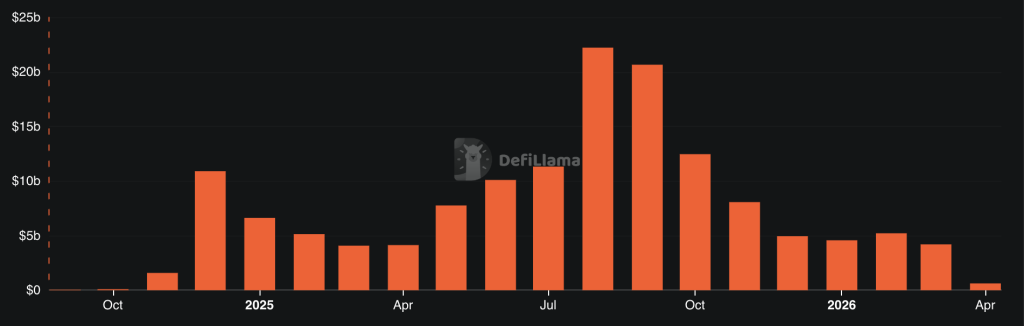 Source: Hyperliquid DEX Volume / DefiLlama
Chen’s timing is significant. Her statement followed approximately two weeks after the JELLY incident, which provided her with a concrete example of structural failure to highlight.
This is not coincidental; it reflects the competitive strategy of a CEO observing market share shift on-chain and pinpointing the moment when the migration narrative falters.
AP Collective founder Abhi had already publicly outlined the $6 million short self-liquidation tactic; Chen broadened the structural critique to a wider audience by framing it with FTX-level stakes.
The HYPE token also plays a role in this situation. Hyperliquid’s native token has become a speculative investment on the platform’s sustained volume growth and its positioning within the expanding DeFi infrastructure landscape. Challenging the platform’s decentralization credentials directly undermines the rationale behind HYPE’s valuation – a fact that every holder in the community is aware of.
Is Hyperliquid Actually Decentralized?
Hyperliquid operates on a specially designed L1 utilizing HyperBFT consensus, featuring on-chain order matching and a non-custodial settlement model through its HyperLiquidity Provider vault.
In theory, this is significantly different from a CEX, with no withdrawal risks and no opaque internal matching. However, the validator set is small, permissioned, and managed by a close-knit group – and the Hyper Foundation retains emergency intervention capabilities, which were exercised in the JELLY incident without a community governance vote.
The only thing we’re buying right now is $HYPE
— Arthur Hayes (@CryptoHayes) April 8, 2026
BitMEX co-founder Arthur Hayes remarked that the community should ‘stop pretending Hyperliquid is decentralized’ – echoing Chen’s perspective from a less commercially biased standpoint.
Hayes later moderated his stance, suggesting that initial reactions may have overestimated the reputational impact and encouraged a focus on the platform’s resilience.
Nonetheless, the structural question remains unresolved despite his reassessment.
Discover: The Best Crypto Presales Live Right Now
The post Bitget Boss Gracy Chen Calls Hyperliquid a Fake DEX And Crypto Twitter Explodes appeared first on Cryptonews.
