Disclaimer: Information found on CryptoreNews is those of writers quoted. It does not represent the opinions of CryptoreNews on whether to sell, buy or hold any investments. You are advised to conduct your own research before making any investment decisions. Use provided information at your own risk.
CryptoreNews covers fintech, blockchain and Bitcoin bringing you the latest crypto news and analyses on the future of money.


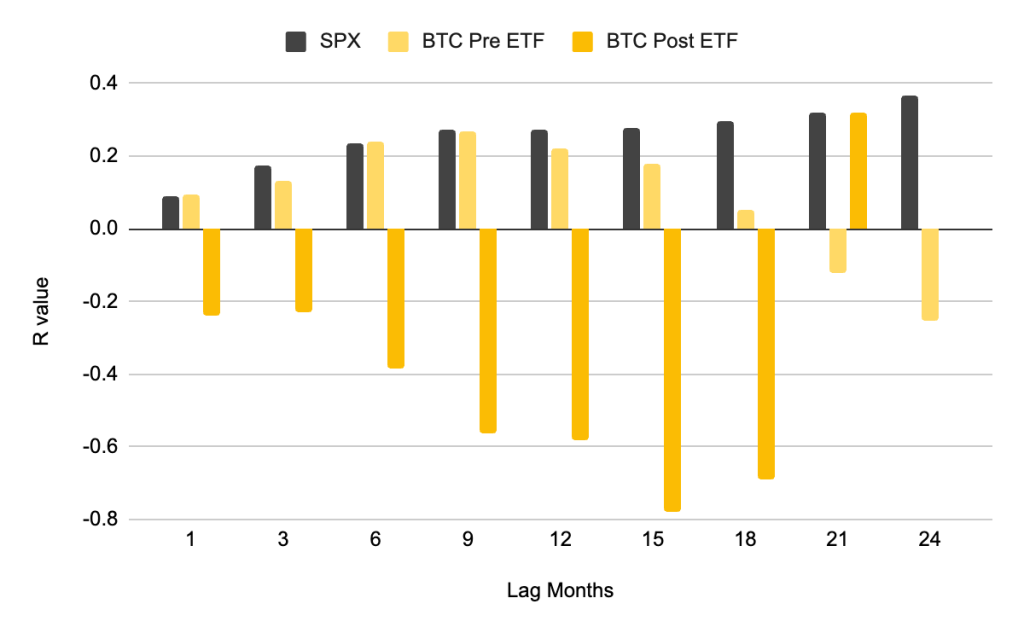
The correlation between Bitcoin’s price and Binance Research’s Global Easing Breadth Index, which monitors monetary policy trends across 41 central banks, has shifted from +0.21 prior to the approval of spot ETFs to −0.778 in 2026.
This change signifies not a mere weakening of the previous relationship, but a complete structural reversal, now nearly three times stronger in the opposite direction.
The latest case study from Binance Research suggests that Bitcoin has transitioned from being a macro lagging indicator to a leading price setter, anticipating Federal Reserve interest rate decisions instead of merely responding to them, and showing increasing indifference to ETF flow news that previously influenced the market within hours.
If this theory is accurate, it undermines the entire macro strategy that active traders have relied on for the last decade.
Previously, CPI reports, FOMC communications, and interest rate trajectory models were the key factors in any serious BTC investment. In 2026, data from Binance indicates that these triggers have been downgraded, and understanding what has taken their place is now the competitive advantage.
Key Takeaways:
- Correlation inversion: Bitcoin’s correlation with Binance’s Global Easing Breadth Index changed from +0.21 before ETF approval to −0.778 in 2026, indicating a complete structural reversal rather than a gradual shift.
- Institutional positioning lead: Institutional investors driven by ETFs are now establishing BTC positions 6–12 months in advance of Fed policy changes, positioning Bitcoin as a forward-looking price discovery tool rather than a reactive risk asset.
- ETF market scale: Total Bitcoin ETF inflows reached $56 billion by Q1 2026, with assets under management at $87.5 billion—approximately 6% of Bitcoin’s overall market capitalization.
- Flow reversal signal: Following $6.4 billion in outflows from November 2025 to February 2026, Bitcoin ETFs attracted $1.3–$2.5 billion in inflows in March 2026, indicating that institutions view price dips as opportunities for accumulation.
- Supply shock trajectory: Bitwise forecasts that ETFs will acquire more than 100% of all new Bitcoin issuance in 2026, creating a demand-supply dynamic unprecedented in BTC’s market history.
- On-chain confirmation: The depletion of exchange reserves and high long-term holder (LTH) supply supports the Binance macro data—internal accumulation metrics, rather than Fed communications, are now the primary price drivers.
Discover: The Best Crypto Presales Live Right Now
What the Binance Data Actually Shows – and Why the Old Correlation Is Now Running in Reverse
The −0.778 correlation figure between Bitcoin’s price and the Global Easing Breadth Index is the key statistic, but understanding the mechanism behind it is crucial.
Prior to the launch of spot Bitcoin ETFs in the United States in January 2024, retail traders were the primary drivers of BTC price discovery, quickly reacting to macroeconomic signals, selling on rate-hike announcements, and buying when easing breadth expanded.
This behavior resulted in a mild positive correlation: increased global central bank easing led to heightened risk appetite, benefiting BTC.
 Source: Binance
Institutional investors utilizing ETF vehicles operate on a fundamentally different timeline. Binance Research indicates that these participants now establish positions 6–12 months ahead of anticipated policy shifts, effectively pricing in Fed decisions before they are officially announced.
The outcome: when the Fed eventually eases, BTC has already reacted, resulting in a negative correlation for any observer measuring it in real time.
Related Posts
On-chain data supports this structural argument. Long-term holder (LTH) supply has remained at historically high levels through Q1 2026 despite price fluctuations, indicating accumulation rather than distribution.
 Source: Coinglass
Exchange reserves continue to decline—Bitcoin held on centralized exchanges has decreased throughout the cycle, signaling that coins are being moved into cold storage instead of being directed toward sell-side liquidity.
The MVRV ratio, which compares market capitalization to realized capitalization, has remained below 2.0 during early 2026, suggesting the market is still far from the euphoric zone that has historically preceded significant peaks.
Collectively, these on-chain metrics illustrate a market structure characterized by contracting supply and dominant patient capital—conditions that render BTC less responsive to short-term macro fluctuations, not more.
The data solidifies the decoupling theory: Bitcoin is not disregarding the Fed due to trader irrationality. It is ignoring the Fed because the marginal buyer has shifted, and this new marginal buyer is already aware of the Fed’s forthcoming actions.
What the Decoupling Means for How You Position in Q2 2026
The practical implication of the Binance thesis is a reordering of signal hierarchy. Traders who consider CPI reports and FOMC meetings as primary BTC catalysts are relying on outdated indicators.
The new signal hierarchy, as suggested by the data, prioritizes: ETF weekly flow data first, LTH supply and exchange reserve metrics second, legislative and regulatory developments third, and Fed communications a distant fourth.
The bullish scenario requires three conditions to remain intact: ETF inflows must stay above $1 billion per month through Q2, exchange reserves must continue to decline (currently trending toward multi-year lows), and LTH supply must remain above 14.5 million BTC without a significant distribution event.
If these three conditions are met simultaneously, the supply-demand dynamics support a price structure where $90,000 acts as support rather than resistance, and the Bitwise supply-shock theory transitions from projection to observable market behavior.
The bearish scenario would be triggered if institutional confidence falters. A return to sustained ETF outflows, particularly two consecutive months exceeding $2 billion in net negative outflows, would indicate that the marginal buyer has retreated, removing the demand support that has maintained the decoupling structure.
In such a case, macro sensitivity could partially reemerge, and the $70,000–$72,000 on-chain support range identified in current technical analysis would become the first significant test level.
Binance Research stated clearly: a peak in global easing may already be outdated news for BTC. Monitor monthly ETF flow totals and LTH supply in Q2; these two figures will validate or refute the decoupling theory more swiftly than any Fed announcement.
Explore: The best pre-launch token sales with asymmetric upside potential
The post Binance Case Study: Bitcoin Price Is Decoupling From the Fed and ETFs in 2026 appeared first on Cryptonews.
