Disclaimer: Information found on CryptoreNews is those of writers quoted. It does not represent the opinions of CryptoreNews on whether to sell, buy or hold any investments. You are advised to conduct your own research before making any investment decisions. Use provided information at your own risk.
CryptoreNews covers fintech, blockchain and Bitcoin bringing you the latest crypto news and analyses on the future of money.


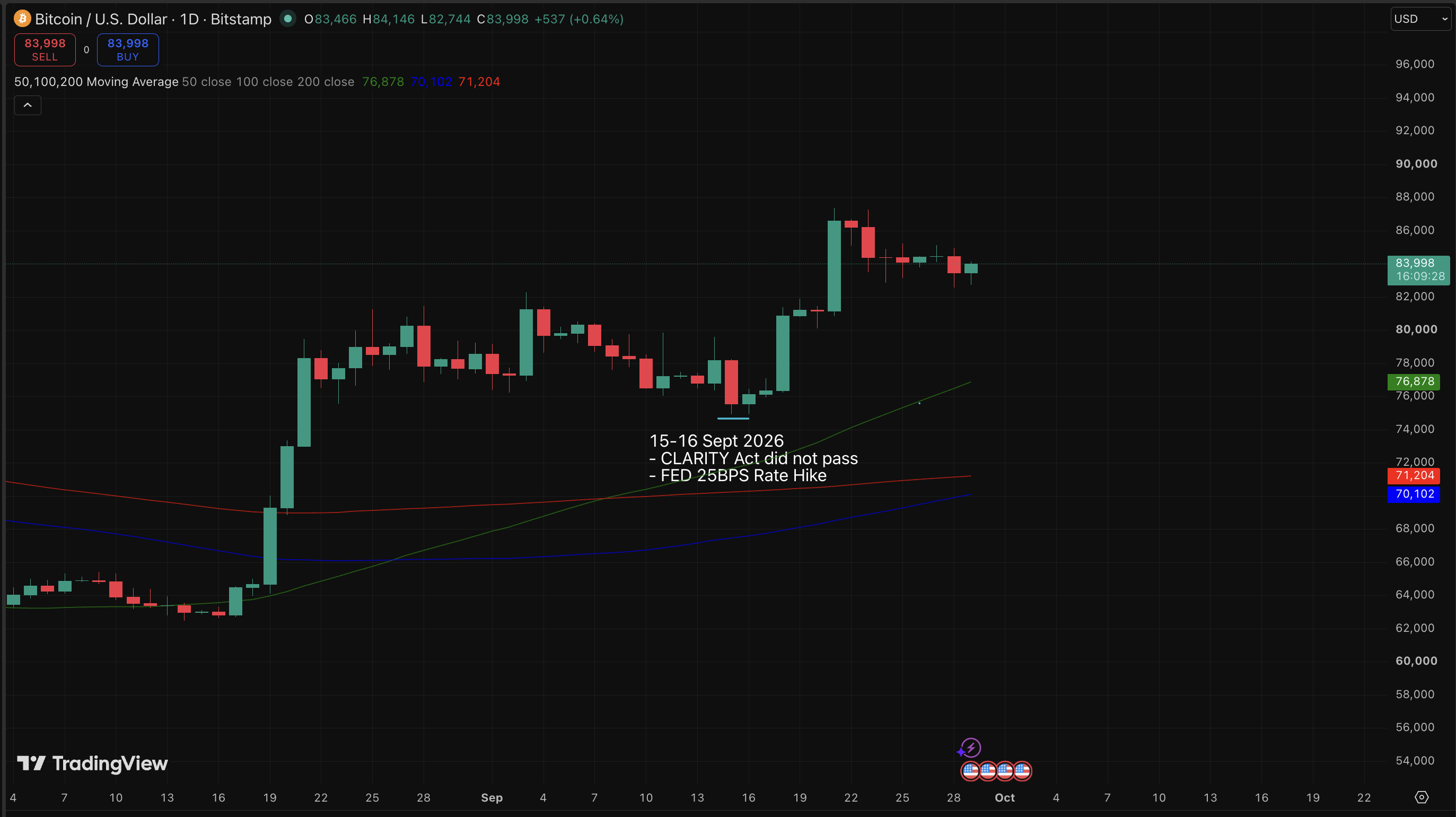
Bitcoin is trading in the $83,000-$83,600 range, even as Polymarket indicates a 61% probability that Democrats will win control of both chambers of Congress in the 2026 midterms. The gap between a rising political-risk signal and a flat price chart raises an obvious question: are crypto markets treating an election outcome as background noise while something else sets the tape?
The answer appears structural. Bitcoin’s reaction to a legislative defeat and to a Federal Reserve rate decision in the same week suggests that Federal Reserve policy is exerting more influence on price than the shifting balance of power on Capitol Hill.
 BTC USD, Tradingview
The U.S. Senate rejected the CLARITY Act on September 15, a bill designed to delineate which federal regulator oversees which category of digital asset. Bitcoin rebounded afterward in a counterintuitive move if regulatory uncertainty were the market’s dominant concern.
One day later, on September 16, the Federal Reserve raised its policy rate to a range of 3.75%-4%, tightening liquidity directly. With 16 of 18 Fed officials expecting further hikes this year, the signal indicates that restrictive policy could persist rather than fade. With the costs of a legislative stalemate already priced in, the rate decision carried far more weight than a failed Senate vote.
What the Bitcoin Price Action Proves
Bitcoin’s price anchor appears to have decoupled from the political maneuvering in Washington and is tracking Federal Reserve decisions more closely. A legislative loss produced a bounce; a rate hike produced drag. However, co-movement across two data points in one week is not proof that election risk has stopped mattering to Bitcoin price.
It is equally possible that traders are pricing midterm outcomes as a slower-moving, more binary risk that only gets marked-to-market as November 3 approaches, rather than a factor they have dismissed outright. Prediction markets have moved substantially over the past three weeks, and that repricing has not been static.
The September 28 Polymarket figure shows prediction markets placing a 61% probability on Democratic control of both chambers, even as Bitcoin’s spot price held a relatively narrow band. The divergence supports the idea that traders are weighing rate expectations and liquidity conditions more heavily in the near term, without settling the question of what happens if odds keep climbing into November.
Related Posts
The Regulatory Overhang Hasn’t Gone Away
 The Federal Reserve building in Washington, D.C.
The CLARITY Act’s failure matters beyond the single-day price reaction. The bill sought to clarify which agency, the SEC or the CFTC, holds jurisdiction over specific token categories. The result is a regulatory landscape that remains fragmented, with both agencies continuing to advance separate rulemaking tracks and no unified statutory framework in place.
That fragmentation is a standing risk for crypto markets, independent of who controls Congress after the midterms. A digital-commodity classification issued earlier this year is not permanent, and regulators retain the ability to revisit it.
The November 3 midterms remain the next hard political catalyst, but legislative gridlock is unlikely to break in the short term regardless of the outcome, while the Federal Reserve’s tightening cycle continues on its own separate timeline.
If rate expectations stay hawkish through the rest of the year, that framework implies continued pressure on Bitcoin even as Democratic control odds rise or fall.
Conversely, if Bitcoin holds its current range through further hikes, that would suggest the market’s tolerance for higher rates is building rather than eroding. Either way, the coming weeks give traders a cleaner test: watch whether Bitcoin price moves on the next Fed signal or on the next swing in midterm probabilities, and treat whichever one actually moves price as the real driver.
Discover: The Best Token Presales
The post Bitcoin Price in Limbo: Congress Lost the Vote, but Fed Sets The Tone appeared first on Cryptonews.
