Disclaimer: Information found on CryptoreNews is those of writers quoted. It does not represent the opinions of CryptoreNews on whether to sell, buy or hold any investments. You are advised to conduct your own research before making any investment decisions. Use provided information at your own risk.
CryptoreNews covers fintech, blockchain and Bitcoin bringing you the latest crypto news and analyses on the future of money.

Adam Back emphasizes the significance of Bitcoin ETF impact, cautioning against underestimating its potential value of $100K BTC.

The COVID-19 pandemic, soaring inflation, and regional conflicts have significantly impacted Bitcoin’s (BTC) value decline over the last two years. Nevertheless, 2024 is expected to be a period of recovery, as stated by Blockstream CEO Adam Back.
The cryptographer, who was instrumental in developing the proof-of-work algorithm utilized in Bitcoin’s protocol, informs Cointelegraph that the leading cryptocurrency is currently lagging behind the historical price trend line observed during prior mining reward halving events.
“Biblical” events negatively impacted Bitcoin
Back commented on the potential price movements of Bitcoin as the next halving approaches, which will reduce Bitcoin miners’ block reward from 6.25 BTC to 3.125 BTC. These block reward halvings are systematically embedded in Bitcoin’s code, occurring after every 210,000 blocks.
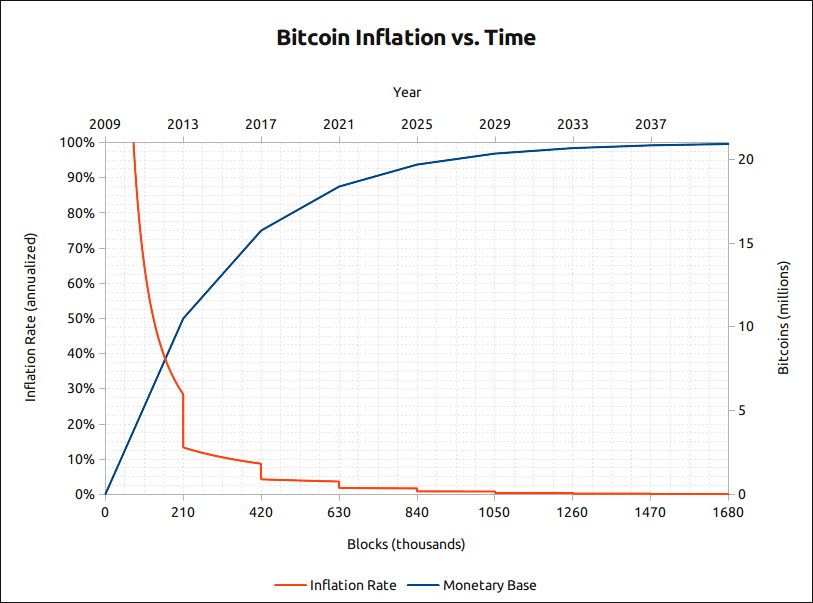 Bitcoin’s supply issuance is embedded in its protocol, with BTC mining rewards halving every 210,000 blocks. Source: bitcoinblockhalf.com
Back indicates that the combined averages from previous market cycles and halvings show that Bitcoin’s relative value is falling short of widely accepted forecasts. Various events have contributed to the decline in BTC’s price, a trend also seen in traditional financial markets:
“The last few years were like biblical pestilence and plague. There was COVID-19, quantitative easing and wars affecting power prices. Inflation running up people, companies are going bankrupt.”
The repercussions have significantly impacted markets and portfolio management, according to Back. Investment managers have had to navigate risk and losses in recent years, leading to the liquidation of more liquid assets.
“They have to generate cash, and at times they’ll sell the valuable assets because they are liquid, and Bitcoin is extremely liquid. This used to happen with gold, and I believe that’s a factor for Bitcoin in the last couple of years,” Back clarifies.
Bitcoin could have reached $100,000 already
As 2023 draws to a close, many of the macro events that Back mentioned have subsided, while additional industry-specific failures have also been addressed. This has been mirrored in Bitcoin’s recent price increase from November 2023 onwards.
“The wave of contagion, the companies that went bankrupt due to their exposure to Three Arrows Capital, Celsius, BlockFi, and FTX — that’s mostly resolved. We don’t anticipate many more significant surprises ahead,” Back stated.
Related: Blockstream targets continued Bitcoin miner surplus with Series 2 BASIC Note
Related Posts
The Blockstream CEO previously forecasted that Bitcoin would reach $100,000 in the next market cycle and reiterated this point. He believes BTC would have already achieved this milestone if not for the macro factors previously mentioned.
Back also referenced the Bitcoin “stock-to-flow” model developed by the pseudonymous former institutional investor PlanB as a benchmark for Bitcoin’s potential upside in 2024.
Back explains that PlanB’s model and heuristics indicate that astute Bitcoin investors have historically acquired BTC six months prior to a halving event and sold during significant price surges that have occurred in the 18 months following the reduction in mining rewards:
“People thought it was a bit of a crazy assertion that we might get to $100,000 pre-halving because I said it when the price was around $20,000.”
He adds that Bitcoin’s price reaching $44,000 multiple times in December 2023 suggests that his earlier prediction may not be as unrealistic as it seemed.
The Bitcoin ETF impact
Notable investors and market analysts have also emphasized the potential influence of the approval of several spot Bitcoin exchange-traded fund (ETF) applications by the United States Securities and Exchange Commission (SEC).
Senior ETF analysts Eric Balchunas and James Seyffart have expressed optimism regarding these applications receiving approval in early 2024. Galaxy Digital’s co-founder Michael Novogratz has also forecasted substantial institutional investment inflows into BTC-backed products, a sentiment echoed by Back:
“I think Bitcoin could reach $100,000 even before the ETF and before the halving. But I certainly believe the ETF should not be underestimated in its impact.”
A significant reason cited by the Bitcoin advocate is that entire segments of traditional markets, including major fund managers like BlackRock and Fidelity, are simply prohibited from investing directly in assets like Bitcoin.
Related: Bitcoin ETFs will drive institutional adoption in 2024 — Galaxy Digital’s Mike Novogratz
“If they’re managing a mutual fund, they have regulations, either externally imposed or as part of their fund, that restrict them to purchasing only public stocks and ETFs. They can’t invest in startups, they can’t buy precious metals physically. They can’t engage in any of that,” Back stated.
This remains a crucial reason why a spot Bitcoin ETF could lead to significant capital inflows into the sector. Back adds that this investment vehicle provides access to Bitcoin exposure for various types of funds, particularly in the U.S., that are more inclined to do so through Fidelity or BlackRock rather than through a cryptocurrency exchange.
Magazine: ‘Elegant and ass-backward’: Jameson Lopp’s first impression of Bitcoin
