Disclaimer: Information found on CryptoreNews is those of writers quoted. It does not represent the opinions of CryptoreNews on whether to sell, buy or hold any investments. You are advised to conduct your own research before making any investment decisions. Use provided information at your own risk.
CryptoreNews covers fintech, blockchain and Bitcoin bringing you the latest crypto news and analyses on the future of money.

Optimism network initiates testnet for reliable system aimed at achieving decentralization.

OP Labs, the creator of the Optimism network, has introduced a testnet version of its fault-proof system, as detailed in a blog post dated Oct. 3. Upon completion of testing, this system will facilitate “a more decentralized and efficient Superchain,” according to the announcement. The new system is presently operational on the Optimism Goerli network.
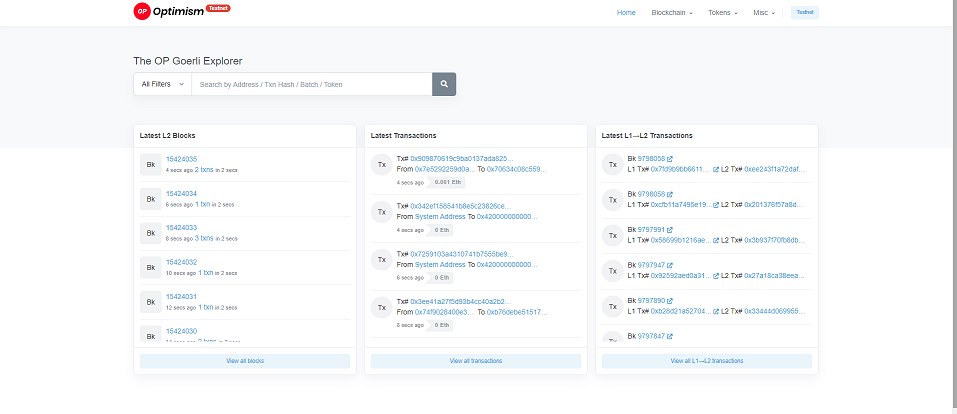 Optimism Goerli block explorer. Source: Etherscan
At this time, networks based on the OP Stack utilize centralized sequencers to aggregate transactions and relay them to Ethereum. Users are unable to submit fraud proofs to prevent the sequencer from transmitting incorrect information, which raises the risk of fraudulent transactions being validated if an attacker gains control. L2Beat has highlighted this concern in its report on Optimism, noting, “users need to trust block Proposer to submit correct L1 state roots.”
Networks like Optimism and Base that are based on the OP Stack are designed to function as optimistic rollups—a category of layer 2 that depends on Ethereum for its security. In a January 2021 essay, Ethereum co-founder Vitalik Buterin contended that optimistic rollups must permit users to submit fraud proofs to block illegitimate withdrawals to Ethereum. Otherwise, they do not achieve true decentralization.
In November 2022, Buterin suggested that certain rollups might have “training wheels” that keep them temporarily centralized while they develop a fraud-proof system, but he emphasized that they should strive for decentralization.
Related Posts
OP Labs asserts that the new fault-proof system will assist in achieving the decentralization objective for OP Stack networks: “The system is designed to eventually enable secure bridging without central fallback.”
Related: BNB Smart Chain Optimism-powered layer-2 opBNB hits mainnet
Furthermore, it stated that the new system is modular, enabling each network to create its own mechanism for fraud prevention. It comprises three distinct components: a fault-proof program (FPP), a fault-proof virtual machine (FPVM), and a “dispute game protocol.” Since these components can be implemented independently, it allows each network to “custom-build a fault proof system.”
The post indicated that this will enhance diversity within the Optimism Superchain, ultimately contributing to the overall security of the ecosystem. A network might even opt to utilize zero-knowledge proofs (ZK-proofs) as a form of fraud-proof, the team noted. ZK-proofs are typically employed in zero-knowledge rollups, but not in Optimistic ones.
OP Labs has been working to establish an interconnected network of blockchain systems referred to as the “Superchain.” To achieve this, it developed the OP Stack, a collection of software tools that can be utilized to create tailored blockchain networks. The Avail network has produced “OpEVM” software aimed at achieving the same goal while using Avail as the foundational layer instead of Ethereum. Other examples of competitors in the Superchain space include Polygon’s ZK Supernets and the zero-knowledge Ethereum Virtual Machine Hyperchain.
Collect this article as an NFT to preserve this moment in history and show your support for independent journalism in the crypto space.
