Disclaimer: Information found on CryptoreNews is those of writers quoted. It does not represent the opinions of CryptoreNews on whether to sell, buy or hold any investments. You are advised to conduct your own research before making any investment decisions. Use provided information at your own risk.
CryptoreNews covers fintech, blockchain and Bitcoin bringing you the latest crypto news and analyses on the future of money.

DePIN: Why Decentralized Physical Infrastructure Will Be a Key Crypto Investment This Decade

Blockchain technology has revolutionized industries ranging from finance (DeFi) and gaming (GameFi) to Web2 brands like Nike for digital fashion and Starbucks for Web3 customer loyalty. However, one sector has remained largely unchanged: physical infrastructure.
Traditionally, the deployment and management of physical infrastructure—such as telecom networks, cloud services, mobility networks, and power grids—have been dominated by large corporations due to high capital requirements and logistical challenges.
This dominance has given these corporations a near-monopoly on pricing, conditions, and services offered to end-users, leading to limited competition and innovation. That dynamic has begun to shift with the entry of blockchain and Web3.
While most are familiar with DeFi, GameFi, SocialFi, and decentralized autonomous organizations (DAOs), DePIN (Decentralized Physical Infrastructure Networks) is a rising use case with real-world exposure. It utilizes tokens to bootstrap the deployment of physical infrastructure, creating a network effect that unlocks a novel design space for real-world-based decentralized applications (DApps).
DePINs are an emerging crypto trend that leverages blockchain technology to build and operate real-world physical infrastructure and hardware networks in a permissionless, trustless, and programmatic manner.
Related: Brian Armstrong promised me $100 in Bitcoin — so where is it?
These DePINs represent the next evolution of the Internet of Things (IoT) for the Web3 ecosystem: a decentralized IoT where users, device owners, and businesses can own and monetize their assets. DePINs enable globally distributed individuals to collectively build, maintain, and operate people-owned physical infrastructure networks without relying on a single centralized entity.
By leveraging crypto-economic protocols, DePINs incentivize supply-side participants to build the network, offering end-users more cost-effective and innovative services than traditional models.
The origin of DePIN
In November 2021, IoTeX became the first Web3 project to name this emerging economy, calling it MachineFi. Messari was the first to reference it as DePIN in July 2022.
Token Incentivized Physical Infrastructure Networks (TIPINs) surfaced the same month. TIPIN describes a network that uses token incentives to motivate individuals to contribute to the deployment and operation of physical infrastructure and hardware networks, creating a more efficient and equitable model for infrastructure deployment.
In August 2022, Proof of Physical Work (PoPW) emerged, referring more specifically to incentive structures that allow anyone to permissionlessly contribute to shared objectives. Helium, for example, allows users to contribute to decentralized wireless networks using hotspots, enabling people to connect smart devices in a secure, low-cost, and energy-efficient way.
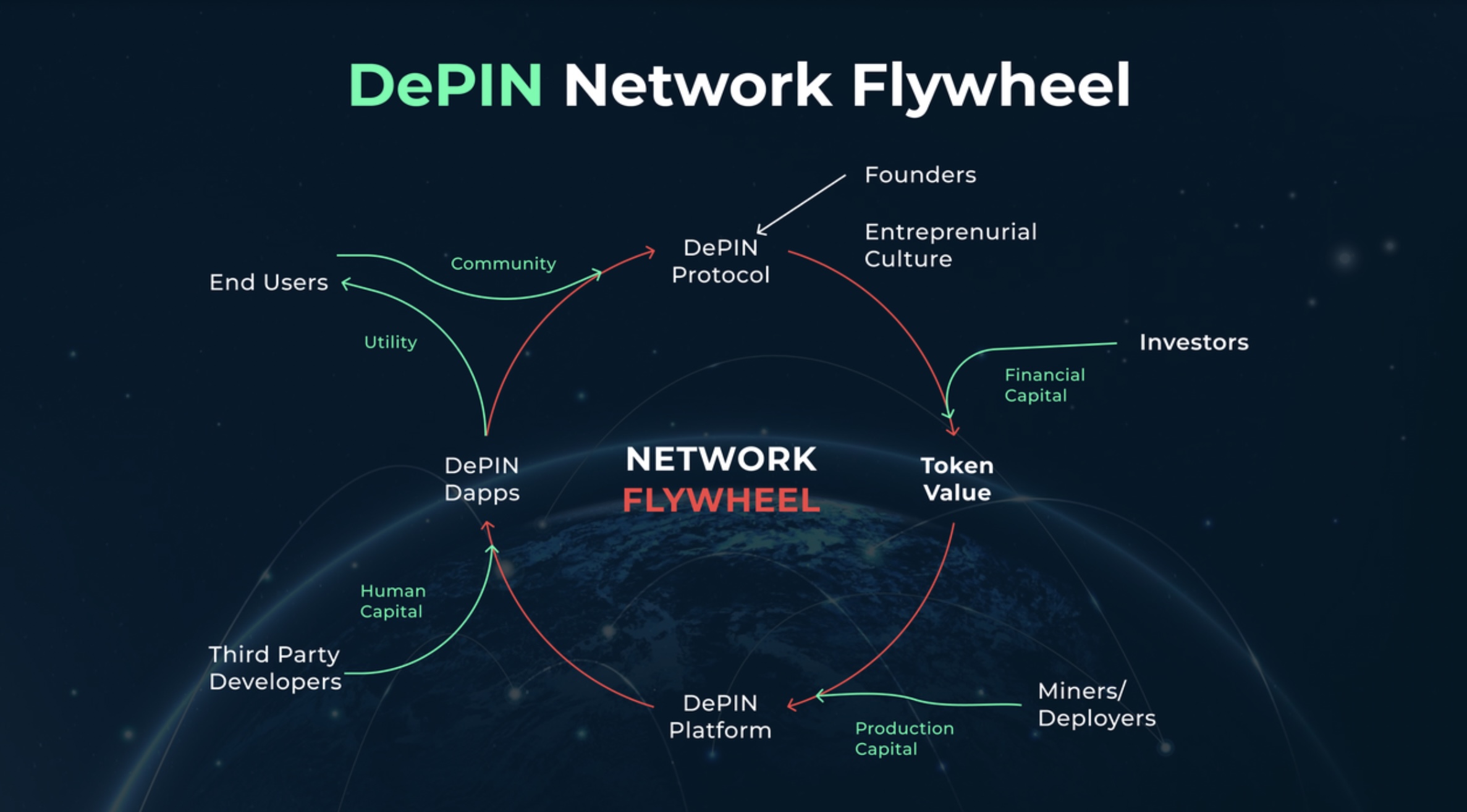
Hivemapper is another example, describing itself as a decentralized map built by people using the world’s first crypto-enabled dashcam. DIMO is a user-owned DePIN platform that allows users to maximize the value of their connected devices, starting with cars.
Additionally, HealthBlocks provides a secure health data sharing and coordination platform by leveraging blockchain and token incentives to create a more efficient, patient-centric healthcare system.
There are also DePIN infrastructure providers, such as IoTeX, which offer centralized infrastructure like W3bstream, developer tools, and go-to-market support to enable decentralized infrastructure network projects.
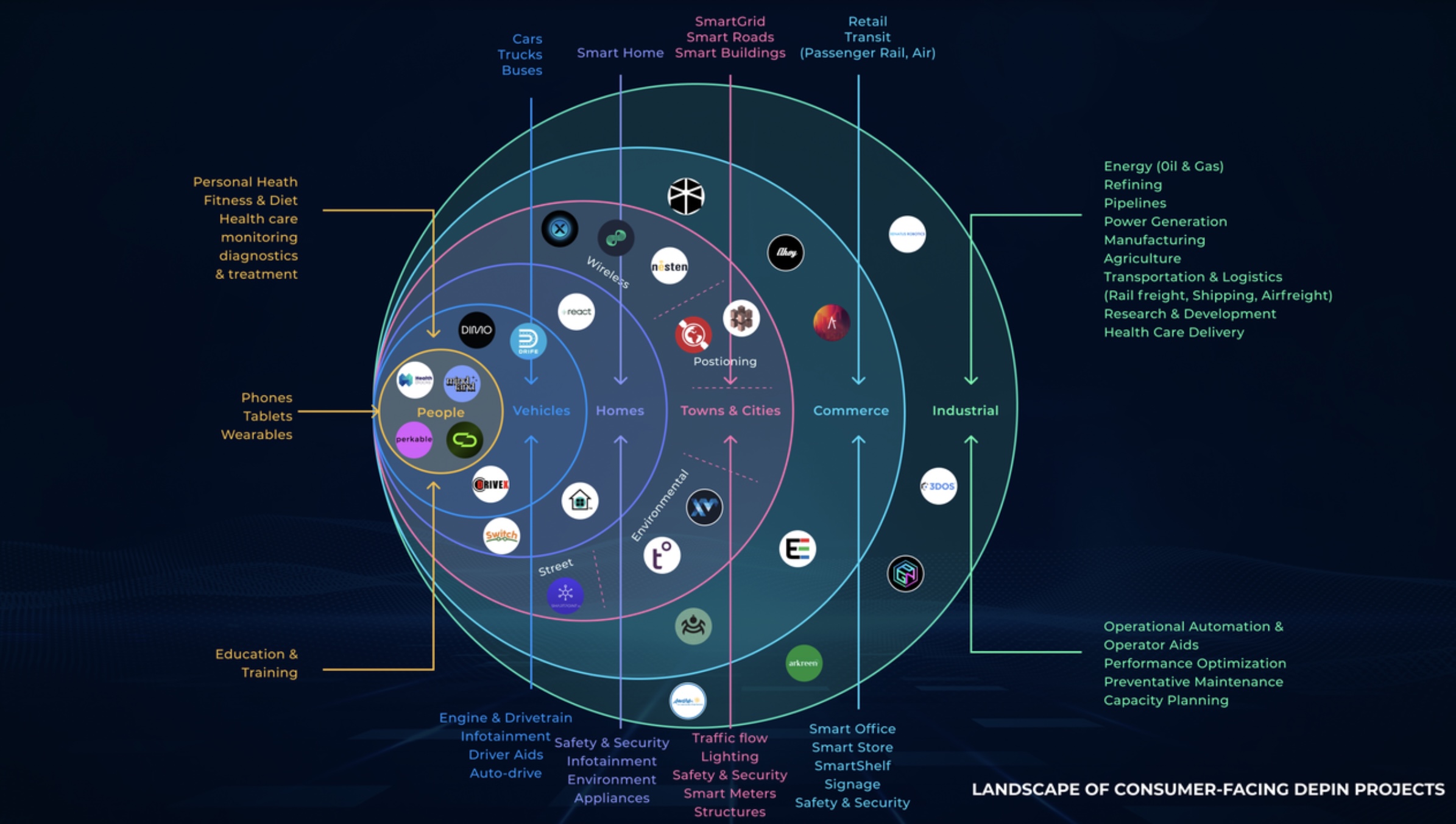
In September 2022, EdgeFi surfaced as a variation of decentralized infrastructure networks focusing on deploying hardware resources closer to end-users at the network’s edge. Essentially, EdgeFi is a decentralized infrastructure network that prioritizes edge computing.
Related Posts
In November 2022, Messari decided it was time to name Web3 physical infrastructure and conducted a Twitter poll where voters chose between PoPW, TIPIN, EdgeFi, and DePIN. MachineFi was omitted. DePIN won with 31.6% of the votes (136).
Web3 physical infrastructure needs a name!
Often referred to as Proof of Physical Work (PoPw), Token Incentivized Physical Networks (TIPIN), EdgeFi, or Decentralized Physical Infrastructure Networks (DePIN), crypto has yet to reach a consensus.
Vote below, or add a suggestion⬇️— Messari (@MessariCrypto) November 5, 2022
In December 2022, Messari mentioned it in research for the first time, stating it would “be one of the most important areas of crypto investment for the next decade.”
How does DePIN work?
DePINs utilize blockchain technology and crypto-economic protocols to enable globally distributed individuals to collectively build, maintain, and operate physical networks in a trustless, permissionless, and programmatic manner. DePINs have four fundamental components:
- Physical infrastructure network: DePIN networks require physical infrastructure to operate. This can include vehicles for mobility networks, solar panels and batteries for energy networks, hotspots and routers for wireless networks, or servers for cloud networks.
- Off-chain compute infrastructure: DePIN relies on middleware connecting the physical and blockchain worlds. User real-world activities are accounted for in their reward calculator and distribution. Additionally, this data can be aggregated for on-chain use cases, such as data proofs for smart contracts and decentralized data marketplaces.
- Blockchain architecture: Each DePIN network interacts with blockchain architecture containing smart contract logic. This blockchain network acts as a ledger, rewarding transactions and other value exchanges between network members, such as purchasing broadband access from someone renting out their router.
- Token Incentives: Supply-side participants are incentivized to join and contribute to the network through token rewards. These tokens act as a subsidy to supply-side participants, allowing them to build out the network before it generates sustainable fees from demand-side usage.
a. Supply-side participants: Anyone can become a supply-side participant in a DePIN network by deploying their physical infrastructure and connecting it to the network. For example, a homeowner could deploy a router and become a wireless network access provider.
b. Demand-side usage: Once the network is established, end users can begin paying to utilize the network’s services or consume crowd-sourced real-world data. This creates a feedback loop that attracts more supply-side participants and investors, driving network growth and adoption.
What is DePIN’s future?
Given that there are already over 40 billion smart devices and machines, along with trillions of sensors deployed worldwide, the future of DePIN is bright. As the demand for decentralized infrastructure continues to grow, more individuals and companies will look to DePIN to build their networks.
Related: CBDCs will lead to absolute government control
By leveraging blockchain technology and token incentives, DePIN offers a more efficient, cost-effective, and collective ownership approach to reimagine how we build physical infrastructure networks in the future.
DePINs represent an exciting new frontier in blockchain technology. They offer a new way of building and operating real-world infrastructure that is more equitable, efficient, and aligned with the interests of network participants. As technology evolves and new use cases emerge, we can expect DePINs to play an increasingly important role in developing our physical world.
A paradigm shift
DePIN represents a paradigm shift in the deployment and operation of physical infrastructure. It enables a more efficient, decentralized, and equitable approach to infrastructure deployment.
With the ability to scale rapidly and disrupt traditional industries, DePIN has the potential to become a significant player in the infrastructure world. As more DePIN projects are developed and deployed, we expect significant disruption and innovation in how we build and maintain physical infrastructure networks.
Raullen Chai is the co-founder and CEO of IoTeX. He previously worked for companies including Google, Uber, and Oracle. He holds a Ph.D. from the University of Waterloo, where his research focused on designing and analyzing lightweight ciphers and IoT authentication protocols. At Google, he led many important security initiatives for its technical infrastructure, including mitigation of SSL attacks, privacy-preserving SSL offloading, and enabling certificate transparency for all Google services. He was also the founding engineer of Google Cloud Load Balancer, which now serves thousands of cloud services, with over 1 million queries per second.Andrew Law is a research scientist at IoTeX, where he conducts in-depth scientific research into the Internet of Things (IoT), blockchain, and Web3 applications. He previously worked as an application engineer for EvapTech in Malaysia and holds a Ph.D. in industrial and systems engineering from Virginia Tech.
W3bstream is IoTeX’s Decentralized Middleware Infra for Connecting Smart Devices to Smart Contracts. Healthblocks and DIMO are IoTeX’s DePIN ecosystem partners. This article is for general information purposes and is not intended to be and should not be taken as legal or investment advice. The views, thoughts, and opinions expressed here are the author’s alone and do not necessarily reflect or represent the views and opinions of Cointelegraph.
