Disclaimer: Information found on CryptoreNews is those of writers quoted. It does not represent the opinions of CryptoreNews on whether to sell, buy or hold any investments. You are advised to conduct your own research before making any investment decisions. Use provided information at your own risk.
CryptoreNews covers fintech, blockchain and Bitcoin bringing you the latest crypto news and analyses on the future of money.


Principles written nearly 500 years ago by Niccolò Machiavelli, the author of the controversial political work The Prince, offer a solution to decentralized governance issues in autonomous organizations, according to a blog post by venture capital firm Andreessen Horowitz (a16z).
The piece is signed by a16z’s general counsel and head of decentralization, Miles Jennings, who believes that “applying Machiavellian principles to decentralized governance in web3 can address current shortcomings.” According to Jennings, Machiavelli’s philosophy offers a pragmatic understanding of social power struggles, which are similar to those experienced by crypto protocols and their decentralized autonomous organizations (DAOs).
Considered the father of modern political theory, Machiavelli was an Italian political philosopher and diplomat. In The Prince, he presents fundamental concepts about social power and argues that the ends—particularly the stability of the state—can justify the means, even if those means are ruthless.
Jennings uses Machiavelli’s work to discuss how to avoid power centralization. The first concept discussed relates to the idea that organizations tend toward autocratic leadership; therefore, DAOs should limit governance by shifting many decisions to the client or third-party layer. According to Jennings:
[Governance minimization] could substantially limit the number of decisions required to pass through the decentralized governance process—significantly lowering the governance burden for the protocol.
Furthermore, the second principle notes that it is critical for DAOs to counterbalance power among leadership classes, leaving emerging leaders exposed to open opposition. He suggests DAOs operate with a bicameral governance layer, similar to the United States Congress, which is divided into the House of Representatives and the Senate.
Using non-token-based voting systems, such as proof-of-personhood, does not help DAOs combat autocracy, Jennings suggests. “While proof of personhood could mitigate a DAO’s vulnerability to attack, it would be unlikely to eliminate autocracy.”
Related Posts
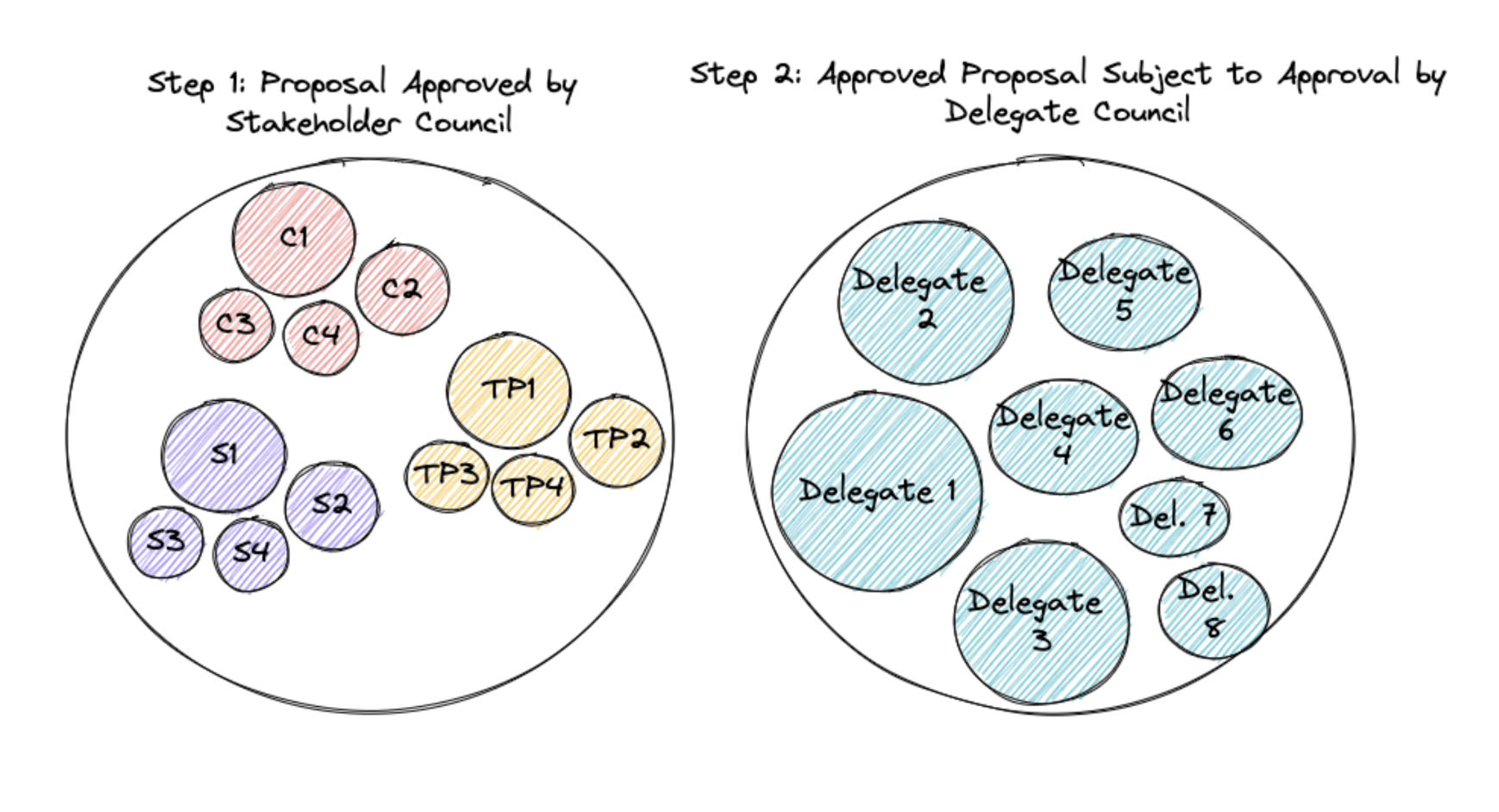
Example of governance system based on delegate council. Source: a16z Crypto
The third principle states that DAOs should not only maintain constant opposition but also allow new leaders to force their way into the leadership class by creating a churn, preventing a static power balance. “According to the Machiavellians, this churn must be forced, as the leadership class will always push against it in order to preserve their position and privilege.”
Jennings further notes that community members are often limited in their ability to acquire power in token-based voting systems due to the financial barriers to obtaining such power.
Finally, in the fourth principle, Jennings suggests DAOs adopt lockup mechanisms for holders participating in stakeholder councils. “If large groups of people are indeed inherently unable to properly hold their leaders accountable (as the Machiavellians predict), DAOs should seek to implement measures that enhance greater accountability throughout their ecosystems,” reads the document. Jennings concludes:
“Web3 should triumph over web2 through decentralization, which reduces censorship and promotes liberty, which in turn enables opposition to power, and therefore drives greater progress. By incentivizing competition, empowering rivals, and utilizing non-token based voting, DAOs can help accelerate this cycle.”
Magazine: Are DAOs overhyped and unworkable? Lessons from the front lines
