Disclaimer: Information found on CryptoreNews is those of writers quoted. It does not represent the opinions of CryptoreNews on whether to sell, buy or hold any investments. You are advised to conduct your own research before making any investment decisions. Use provided information at your own risk.
CryptoreNews covers fintech, blockchain and Bitcoin bringing you the latest crypto news and analyses on the future of money.

Ethereum encounters a pivotal challenge amid increasing demands from scaling, quantum technology, and artificial intelligence.

Although enhancements have boosted efficiency and reduced expenses, the ecosystem grapples with more profound structural issues concerning fragmentation, security, and purpose, all while maintaining a focus on base-layer scaling.
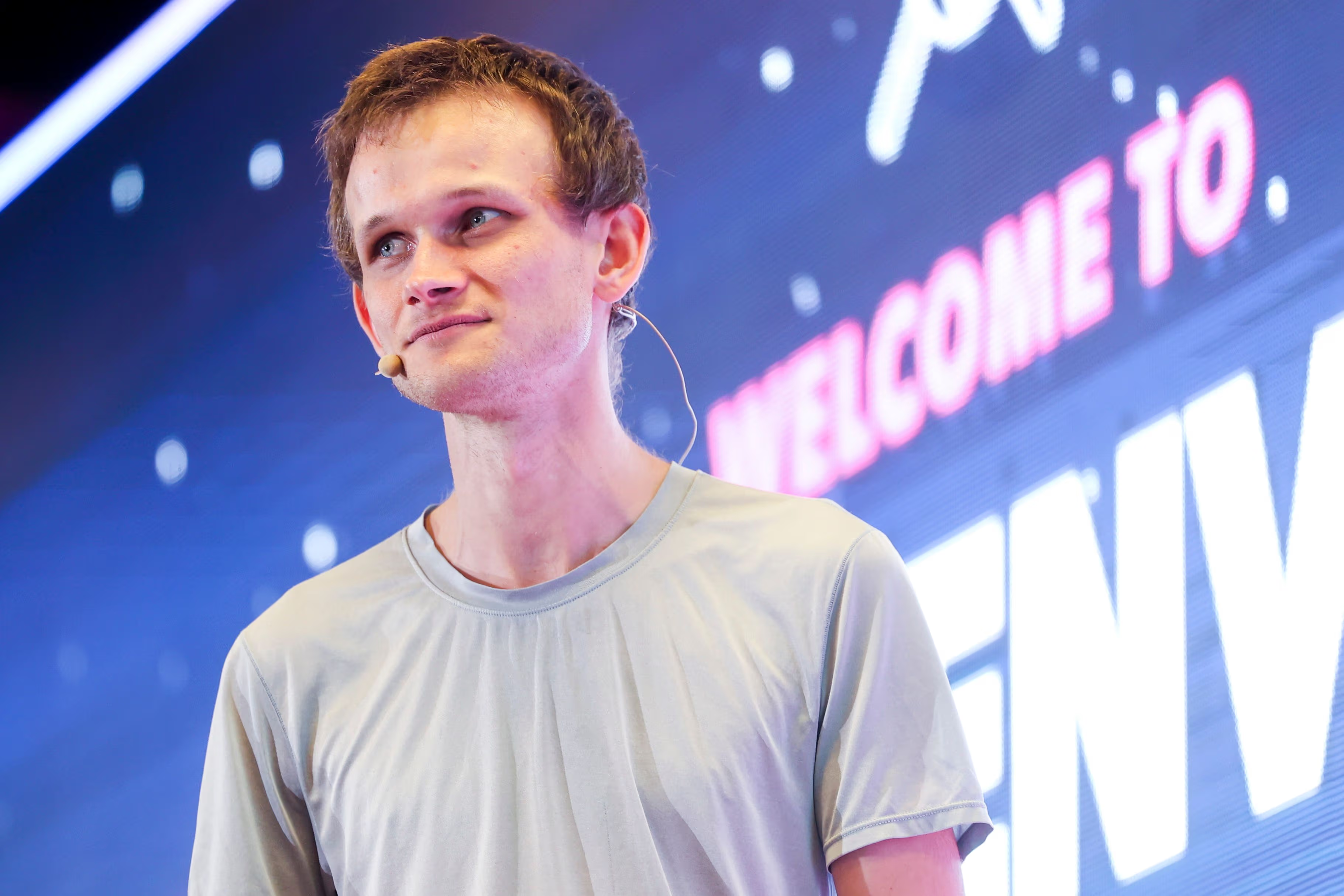 Vitalik Buterin speaking at ETHDenver in February 2022 (Getty Images)
What to know:
- The early months of 2026 have revealed increasing tensions within the Ethereum ecosystem—from Vitalik Buterin’s critique of Layer 2 scaling and heightened concerns about quantum threats, to changes in leadership and a growing drive into AI—prompting a comprehensive reassessment of the network’s trajectory.
- Despite upgrades enhancing efficiency and reducing expenditures, the ecosystem confronts more profound structural inquiries regarding fragmentation, security, and its overarching purpose, even as it maintains its focus on base-layer scaling.
The initial months of 2026 have prompted the Ethereum community to engage in a reflective process—one that transcends price fluctuations, technical upgrades, and delves into the fundamental question of the network’s intended identity.
Even prior to this year, builders and executives sensed that Ethereum was on the brink of a new growth phase—this time fueled not by crypto-native users, but by institutions and technology. Some posited that neobanks could quietly onboard millions by simplifying the complexities of wallets and gas fees. In this perspective, Ethereum would not need to attract users directly; it would operate behind the scenes, powering a new financial stack that appeared distinct from crypto on the surface.
Related Posts
This aligns with a longstanding thesis: that Ethereum’s success would stem from its invisibility.
This vision has been influenced in part by years of prior upgrades designed to enhance user experience and minimize costs. Innovations like “proto-danksharding,” introduced in the Dencun upgrade, significantly reduced fees for layer 2 networks by increasing data downloads for transactions, while ongoing enhancements to the base layer have improved transaction efficiency.
While the price of the network’s ether (ETH) token has been influenced by market dynamics, these upgrades have collectively moved Ethereum closer to a model where users engage with applications without needing to comprehend the underlying infrastructure.
However, that narrative began to shift a few weeks into the year, redirecting focus back to the core roadmap.
The L2 debate
This remark disrupted what had previously been a largely celebratory discussion surrounding rollups. These networks, recognized as layer-2 (L2) networks, handle transactions off Ethereum and then bundle them back onto the main chain to enhance speed and cost-effectiveness. Layer-2 networks have surged in recent years, transaction fees have decreased, and activity has expanded—but the more significant question was whether any of this represented coherent scaling.
Buterin’s argument extended beyond a general critique of advancements. He believes that many current layer 2 designs are straying from Ethereum’s fundamental model: relying on centralized components and isolated environments that do not fully inherit the assurances of the base chain. The concern was not that L2s exist, but that in their present form, they may not be achieving the type of scaling Ethereum was intended to realize.
His critique underscored a growing discomfort.
Fragmentation among L2s, inconsistent security assumptions, and dependence on centralized components were beginning to appear less as temporary compromises and more as structural vulnerabilities. In attempting to scale outward, Ethereum risked forfeiting the very attributes that rendered it valuable in the first place—its robust security, decentralization, and its function as a shared, neutral settlement layer where applications and liquidity can seamlessly interact.
L2 teams, for their part, did not so much push back as they recalibrated. Some acknowledged the critique and leaned into a future where rollups differentiate through specialization: privacy, consumer applications, or unique execution environments, rather than merely functioning as cheaper Ethereum. Others staunchly defended their role, arguing that high-throughput environments remain essential.
Meanwhile, Ethereum’s base layer has made gradual progress on its own. Recent upgrades, such as December’s Fusaka hard fork, enhanced data capacity and efficiency on the main network, allowing for more transactions to be processed while reducing costs. However, the recent spike in transactions has come under scrutiny, with some labeling them as ‘address poisoning’ scams.
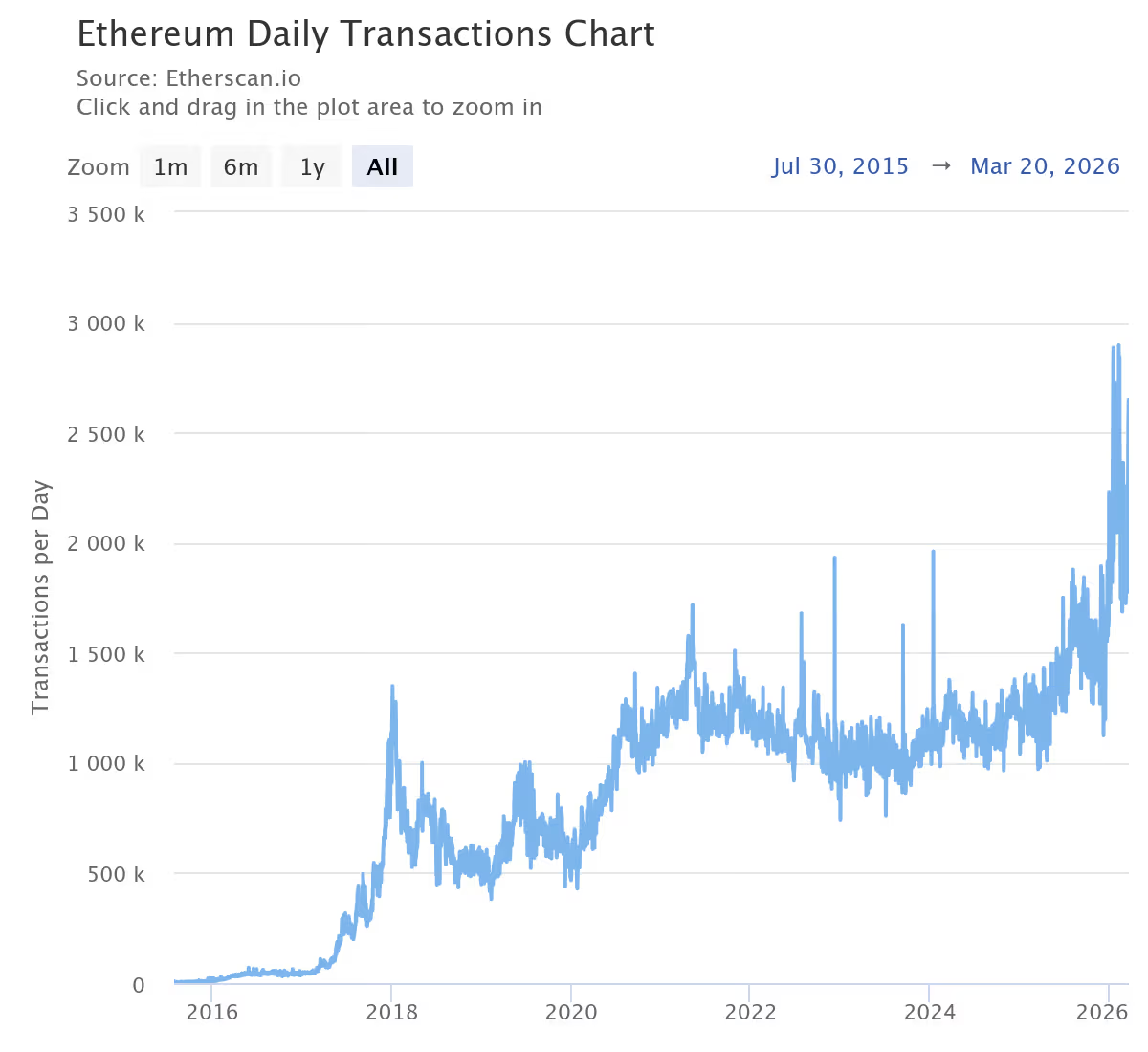 Ethereum’s daily transaction spike (Etherscan.io)
This tense chapter has established for Ethereum that moving forward requires a careful balance between the structural upgrades of the base layer and a new generation of specialized rollups that can expand the ecosystem without compromising its foundational security.
This could also result in consolidation among the layer 2 networks, as noted by 21shares. “The upcoming year is likely to witness Ethereum’s L2 consolidation: a more streamlined, resilient layer supported by ETH-aligned, exchange-backed, and high-performance networks,” the firm stated in a research report.
The quantum threat
Simultaneously, another concern—long discussed but seldom urgent—has suddenly risen in priority: Quantum Computing.
The Ethereum Foundation indicated a shift in approach, elevating initiatives like ‘LeanVM’ and post-quantum signature methodologies. What had previously been regarded as a distant, almost theoretical issue is now being integrated into near-term strategies.
The implications are hard to overlook: the network is no longer merely preparing for the next cycle, but for threats that could fundamentally undermine its cryptographic foundations. The foundation has indicated that it is treating this risk seriously, establishing dedicated research initiatives specifically focused on post-quantum security.
Vitalik Buterin also laid out a plan to safeguard the blockchain from the long-term dangers posed by quantum computers.
The internal shuffle
If scaling revealed vulnerabilities in Ethereum’s current state, quantum risks cast a shadow over its future, and it appeared that the network is taking this threat seriously.
Then came changes from within.
The exit of Tomasz Stańczak as co-executive director of the Ethereum Foundation represented more than just a leadership shake-up. At a time when the network is facing technical, strategic, and philosophical reassessments all at once, even minor shifts at the top can signal a broader recalibration.
This transition also came as a surprise.
The foundation is not typically known for rapid changes, and Stańczak had only recently assumed the role about a year prior, following Aya Miyaguchi’s long-standing tenure. In an ecosystem that prefers continuity, the swift turnover suggests a deeper internal recalibration in progress, as the foundation reevaluates its priorities amid increasing demands for scaling, security, and Ethereum’s potential role in new domains such as artificial intelligence (AI).
‘Trust layer’
AI, a topic that has become impossible to overlook, not just for crypto but for every sector, has begun to shape an independent line of thought for the network.
Buterin outlined how Ethereum could serve a fundamental role in the future of artificial intelligence. This vision transcends payments or DeFi—envisioning a scenario where Ethereum functions as a coordination layer for decentralized AI systems, facilitating verifiable outputs, trust-minimized data sharing, and machine-to-machine economic interactions.
This ambition did not arise overnight.
Early last year, the foundation established a dedicated decentralized AI research unit (dAI) to explore how the network could assist autonomous agents and machine-to-machine economies. What initially seemed experimental has since accelerated into a more intentional effort in 2026, with the foundation increasingly positioning Ethereum as a potential “trust layer” for AI: a system for validating outputs, coordinating agents, and anchoring a rapidly evolving ecosystem that, until now, has been largely dominated by centralized entities.
All of this represents an ambitious expansion of scope, positioning Ethereum at the crossroads of two of today’s most significant technologies.
However, the first quarter of the year indicates that Ethereum can no longer afford to address these questions in isolation; rather, they are converging.
The outcome is a network being pulled in multiple directions, each carrying its own urgency, and maintaining a balance is becoming increasingly challenging. Unlike previous cycles, where narratives could shift as swiftly as prices, the current issues appear more profound, focusing less on momentum and more on structural integrity.
These tensions are unlikely to find resolution soon and will continue to influence Ethereum’s pathway in the coming months.
In the short term, however, the emphasis remains on scaling the base layer, with the upcoming Glamsterdam upgrade, anticipated for this year, expected to advance that initiative. This upgrade will likely serve as a litmus test for the network’s capacity to tackle issues that can effectively transition Ethereum into a robust, quantum-secure “trust layer” capable of supporting the global AI economy.
Read more: Ethereum’s ‘Glamsterdam’ upgrade aims to fix MEV fairness
