Disclaimer: Information found on CryptoreNews is those of writers quoted. It does not represent the opinions of CryptoreNews on whether to sell, buy or hold any investments. You are advised to conduct your own research before making any investment decisions. Use provided information at your own risk.
CryptoreNews covers fintech, blockchain and Bitcoin bringing you the latest crypto news and analyses on the future of money.


Bitcoin’s 12% rise since the onset of the Iran war is not indicative of a risk-on approach. Instead, it represents the market adjusting bitcoin’s status as a neutral settlement layer, according to Bitwise’s CIO.
 Beyond "digital gold," rethinking bitcoin metaphors. (Andrej Sachov/Unsplash)
What to know:
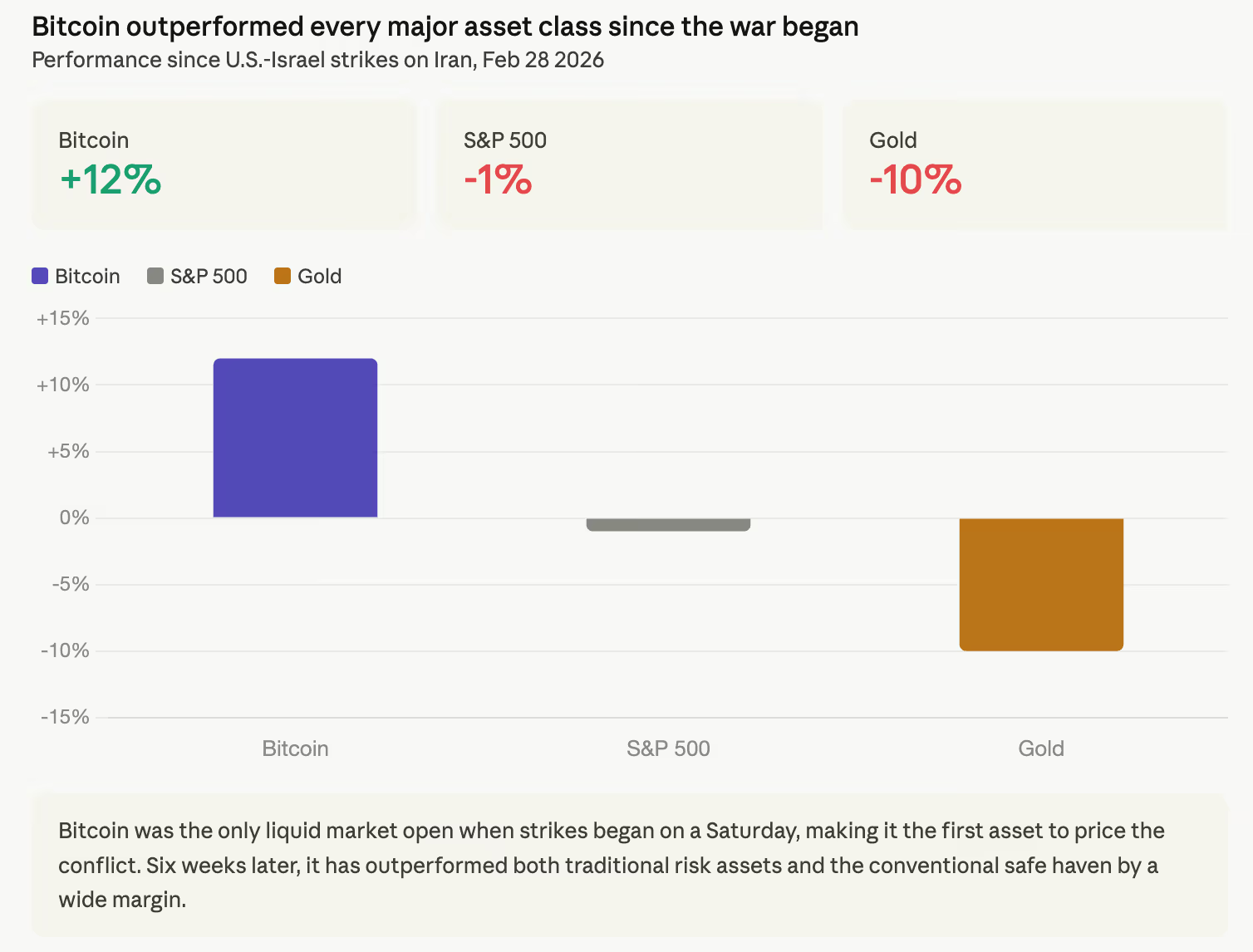
- Bitcoin has increased approximately 12% during the Iran conflict, even as stocks and gold have declined, challenging its image as merely a high-beta tech asset.
- Bitwise CIO Matt Hougan suggests that investors are now evaluating bitcoin as both "digital gold" and a speculative option on its potential future use as a legitimate currency, a transition accelerated by Iran’s choice to impose bitcoin tolls in the Strait of Hormuz.
- While critics argue that Iran’s action highlights sanctions pressure rather than a true preference and that essential payment infrastructure is still in its infancy, markets seem to be revaluing bitcoin differently than in past geopolitical crises.
Bitcoin’s performance during the Iran conflict diverges from typical patterns, and Bitwise CIO Matt Hougan believes he understands the reason.
The leading cryptocurrency has risen 12% since U.S. and Israeli airstrikes commenced on February 28, while the S&P 500 has decreased 1% and gold has dropped 10%. For an asset often regarded as a leveraged tech investment during risk-averse periods, this trend necessitates a reevaluation.
In a post on X, Hougan redefined bitcoin as two concurrent investments. The first is the well-known "digital gold" concept, vying for a share of the $38 trillion store-of-value market.
The second is what he describes as an out-of-the-money call option on bitcoin operating as a genuine currency, a wager he claims most investors have considered largely irrelevant until now.
Related Posts
The conflict involving Iran has altered the dynamics of the second investment. Iran announced it would impose a $1-per-barrel toll in bitcoin from vessels passing through the Strait of Hormuz, amounting to approximately $20 million daily.
This charge represents one of the first tangible instances of a nation utilizing bitcoin as a settlement mechanism for tangible trade, despite the context being less than ideal.
"In a world where countries have weaponized their financial systems, bitcoin is emerging as a non-political alternative," Hougan stated, linking the shift to the U.S. removing Russia from the SWIFT network in 2022, a move that France’s finance minister labeled a financial "nuclear bomb" at the time.
The options framework is what makes this argument notable.
Options gain value when the likelihood of reaching the strike price improves or when the volatility of the underlying asset increases. Hougan contends that the Iran conflict provided both, enhancing the chances of bitcoin’s use as a currency while escalating the volatility of the global financial system.
If his perspective holds true, it suggests that bitcoin could appreciate during future geopolitical tensions, particularly those involving nations situated between the U.S. and Chinese financial frameworks, and that bitcoin’s potential market is significantly larger than that of gold alone.
The counterargument is that Iran’s employment of bitcoin occurs in the context of a sanctioned state acting out of necessity rather than choice. This indicates more about the limitations of dollar-based enforcement than about bitcoin’s capability to serve as a neutral settlement layer. The necessary infrastructure for this, such as stablecoin settlement, cross-border payment systems, and sovereign wallet usage, remains in the early stages of development.
Nonetheless, Hougan’s fundamental observation remains valid. The market is valuing bitcoin differently amid this conflict compared to previous geopolitical events, and the "digital gold" narrative alone does not sufficiently account for this shift.
