Disclaimer: Information found on CryptoreNews is those of writers quoted. It does not represent the opinions of CryptoreNews on whether to sell, buy or hold any investments. You are advised to conduct your own research before making any investment decisions. Use provided information at your own risk.
CryptoreNews covers fintech, blockchain and Bitcoin bringing you the latest crypto news and analyses on the future of money.

Bitcoin recovers as oil prices stabilize, while Trump impeachment probabilities indicate ongoing market uncertainty.

On April 7, Polymarket assigned a 64% probability to the likelihood of President Donald Trump being impeached before the conclusion of his term, approaching the contract’s peak since its launch on March 19.
A similar contract on Kalshi, which is based on Library of Congress records and extends until January 1, 2028, was valued at approximately 67% during the same timeframe.
Influencing the markets, in addition to current events, are the Polymarket probabilities regarding the Democrats securing both the House and the Senate in the upcoming mid-term elections in November. With probabilities exceeding 80% for the House and 55% for the Senate, a legitimate pathway to impeachment and removal from office in 2026 has emerged as a real possibility.
These figures condense a vast geopolitical narrative for Bitcoin traders into a real-time gauge of political stress; however, the market dynamics relevant to BTC shifted following the agreement of a two-week ceasefire among Washington, Tehran, and Israel.
 Related Reading
Traders poured $3 billion into Binance after Bitcoin hit $72,734 on ceasefire headlines – what are they betting on?
The surge in buying was immediate, yet options signals appear to indicate a decline in crash anxiety rather than a confident breakout.
April 8, 2026 · Oluwapelumi Adejumo
Trump’s ultimatum to Iran on April 7 had driven Brent crude prices above $109 and WTI above $114 as markets assessed the risk of an expanded conflict centered around the Strait of Hormuz, which accounts for approximately 20% of global oil and LNG transportation.
This shock began to reverse following the ceasefire announcement. Oil prices dropped significantly as markets recalibrated the immediate risk of a prolonged supply disruption, alleviating the macro pressure that had prevailed in the previous session.
Bitcoin mirrored the broader risk landscape, rebounding as oil prices fell, Treasury yields decreased, and equities rose, underscoring that the transmission mechanism for crypto continues to be influenced by energy prices, inflation expectations, and the Federal Reserve rather than impeachment discussions.
Axios reported renewed calls for the Cabinet to consider the 25th Amendment and a push to impeach Defense Secretary Pete Hegseth, indicating that removal rhetoric can remain heightened even as macro pressures on Bitcoin begin to diminish.
With Republicans holding control of both the House and Senate, elevated probabilities still serve as the market’s quickest indicator of political conflict, but they remain secondary to oil prices, interest rates, and liquidity as direct drivers for BTC.
| Market | Contract wording | Resolution cutoff | Resolution source / trigger | Apr. 8 context | Recent high / context | Volume / liquidity note | Why it matters for BTC |
|---|---|---|---|---|---|---|---|
| Polymarket | Trump impeached before his term ends | Before end of Trump’s term | Contract resolves on impeachment event under market rules | Still elevated after ceasefire | Held near recent highs even as markets shifted into relief mode | Fast-moving public read on political stress | Useful as a live stress gauge, but secondary to oil, yields, and liquidity for BTC direction |
| Kalshi | Comparable impeachment contract | Jan. 1, 2028 | Resolves against Library of Congress records | Also stayed elevated | Confirmed that constitutional-risk pricing did not disappear with the truce | Different rules and cutoff date make it a useful cross-check | Shows political tension remained high even as the macro impulse for BTC turned more supportive |
The chain that actually moves Bitcoin
Bitcoin’s price movements during geopolitical crises follow a specific sequence.
An oil spike driven by conflict revives inflation concerns, pushes rate-cut expectations further into the future, and tightens financial conditions for risk assets. This was the prevailing market logic leading up to Trump’s April 7 deadline.
By April 8, the ceasefire had altered that sequence in the opposite direction. Declining oil prices alleviated immediate inflationary pressures, contributed to lower Treasury yields, and supported a broad recovery in equities and other risk-sensitive assets.
This revision in rate expectations directly impacts Bitcoin’s environment, as risk assets are priced based on liquidity forecasts. When the Fed’s flexibility diminishes and real yields rise alongside oil prices, capital tends to shift away from speculative positions. Conversely, when that pressure subsides, BTC typically stabilizes alongside equities.
As Bitcoin and the wider crypto market rebounded following the ceasefire, the market transitioned from reflecting a live escalation shock to indicating a relief rally with conditions attached.
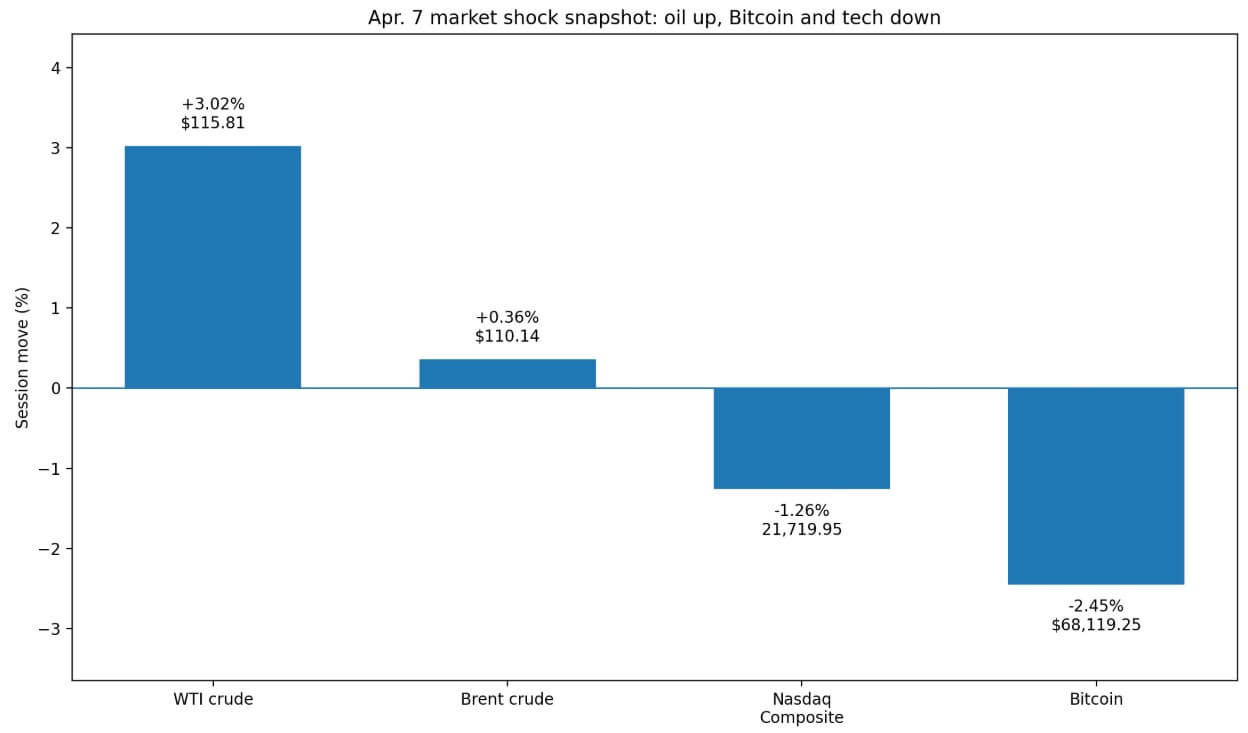 After the ceasefire, oil prices fell sharply while Bitcoin and broader risk assets recovered, indicating a relief move across markets.
Related Posts
A similar pattern was observed in February, when Bitcoin surged above $70,000 after an intraday drop to $60,017, a movement linked to stabilization in tech stocks and other risk assets.
Bitcoin’s correlation with the broader risk landscape in 2026 has been consistent enough to challenge the notion of it being “digital gold in every crisis.”
Goldman Sachs had already increased its US recession probability to 30% prior to the April 7 deadline, and IMF chief Kristalina Georgieva noted that even a swift resolution would still leave risks of slower growth and higher inflation in place following the shock.
The macro backdrop remains delicate even after the relief rally.
Potential pathways
The ceasefire alters the base case, but it does not eliminate the key variables that traders must monitor.
If the two-week truce holds, shipping through the Strait of Hormuz normalizes, and oil prices remain below $100, the headwinds from inflation and interest rates will ease further.
Citi’s Nathan Sheets indicated that recession risks intensify if oil prices exceed $110 to $120. That threshold remains significant, but following the ceasefire, it serves as a downside trigger rather than an immediate market condition.
For Bitcoin, the implications still trend in the same direction, regardless of what drives the headlines: rising oil prices, persistent inflation, delayed easing, and further de-risking from speculative positions.
Earlier this year, options demand clustered around downside strikes of $60,000 to $50,000 during the last period of acute BTC pressure. A retest of the low-$60,000 range remains a plausible downside scenario if oil reclaims the $110 level and the Fed maintains its stance through the summer.
The political discourse continues to overlay a macro configuration already in motion, and the sustained macro penalty would still influence asset reactions if the truce collapses.
The scenario in which impeachment discussions benefit Bitcoin now hinges on de-escalation that proves durable. If the ceasefire holds, oil prices cool, rate-cut expectations resurface, risk appetite improves, and Bitcoin rises alongside equities.
Expectations of de-escalation had already driven over $15 billion in global equity fund inflows for the week ending April 1. The ceasefire reinforced that same trend, with oil prices declining sharply and risk assets rebounding together.
This precedent carries a condition: de-escalation only becomes bullish for BTC when it alleviates the headwinds from oil and interest rates.
| Scenario | Trigger | Oil range / condition | Fed implication | BTC implication | What impeachment odds mean in this case |
|---|---|---|---|---|---|
| De-escalation / relief base case | Two-week ceasefire holds, shipping normalizes, and talks continue | Oil falls back and stays below $100 | Rate-cut expectations return to view in 2026; macro pressure eases | BTC can recover alongside equities if relief pricing holds | Odds remain elevated as a political signal, but they matter less than the lower oil and rates headwind |
| Fragile ceasefire / choppy case | Truce holds formally, but implementation stays uneven and headline risk remains high | Oil stays volatile and elevated versus pre-shock levels, without a decisive new spike | Fed stays cautious and on hold; macro overhang remains unresolved | BTC stays headline-driven and choppy, with upside capped by uncertainty around oil and yields | Odds stay elevated as a stress gauge while crypto traders keep focusing on macro variables |
| Breakdown / bear case | Military exchanges resume, shipping is disrupted, or escalation widens again | Oil reclaims $110 and could push toward or above $120 | Fed flexibility narrows further; easing gets delayed; higher-for-longer risk grows | More de-risking, with a defensible downside retest of the low-$60,000 range; prior acute stress also saw options demand cluster at $60,000 to $50,000 strikes | Odds rise as political confrontation sharpens, but they still reflect stress more than they drive BTC directly |
A diplomatic pause that leaves energy markets unstable does not eliminate the macro overhang, even if it reduces constitutional-risk pricing for a news cycle.
Elevated impeachment odds while oil prices decline would still signify a net positive for Bitcoin. If crude prices remain below $100 and rate-cut expectations for 2026 resurface, BTC could recover toward higher levels even with prediction markets still elevated.
Polymarket and Kalshi’s relevant contracts continue to hold editorial value as rapid public indicators of political stress, but the clearer directional signal for crypto derives from oil prices, yields, and whether broader market relief persists.
Traders seeking a directional setup should now monitor whether Brent and WTI remain below critical levels, whether the Fed’s next communication allows rate-cut expectations to stabilize, and whether the ceasefire endures long enough for markets to perceive the move as more than a temporary repricing.
These factors will dictate BTC’s trajectory long before any House resolution is brought to the floor.
The post Bitcoin rebounds as oil cools but Trump impeachment odds show markets still on edge appeared first on CryptoSlate.
