Disclaimer: Information found on CryptoreNews is those of writers quoted. It does not represent the opinions of CryptoreNews on whether to sell, buy or hold any investments. You are advised to conduct your own research before making any investment decisions. Use provided information at your own risk.
CryptoreNews covers fintech, blockchain and Bitcoin bringing you the latest crypto news and analyses on the future of money.

Bitcoin price holds steady at $70,500 support following the breakdown of US-Iran negotiations and a rise in oil prices above $103.

The price of Bitcoin declined during Asian trading hours following a failed diplomatic effort between Washington and Tehran over the weekend, coupled with a new US maritime directive that raised concerns regarding energy supplies from the Middle East.
This development caused the leading cryptocurrency to drop alongside stock markets, highlighting the market’s sensitivity to oil prices, inflation, and overall risk appetite.
As reported by CryptoSlate, the largest digital currency fell from a weekend peak exceeding $74,000 to a low of $70,540 after Vice President JD Vance announced that negotiations in Islamabad had concluded without a resolution.
At the time of reporting, Bitcoin had slightly rebounded to $70,877, yet it remained significantly below the levels reached following last week’s ceasefire announcement, which had briefly boosted risk assets.
Additionally, this downturn affected other prominent digital currencies, with Ethereum, XRP, and Solana all experiencing declines of over 3% during the reporting period.
This trend mirrored a broader retreat in traditional markets as investors reevaluated the likelihood of a near-term de-escalation in a conflict that has already disrupted shipping routes, crude oil markets, and global growth and inflation expectations.
Consequently, the US stock market, including the S&P 500 and Dow Jones, fell by approximately 1%. Furthermore, the Nasdaq 100 index decreased by 1.3%. This aligns with the asset’s challenges during times of macroeconomic strain.
Simultaneously, oil prices surged as traders reacted to the renewed potential for extended disruptions in one of the world’s most vital energy corridors.
This reversal followed a week in which risk assets had gained on hopes that President Donald Trump’s two-week ceasefire plan could pave the way for a broader resolution.
However, that optimism began to fade over the weekend as negotiators were unable to reconcile their differences after nearly a full day of discussions. Vance indicated that Iranian officials were not willing to accept U.S. terms, while Iran’s state media attributed the failure to what it termed unreasonable American demands.
The ceasefire is set to remain in effect until April 22, but the breakdown of negotiations has left markets facing the possibility that the pause could end without a more sustainable agreement.
A narrower US blockade still rattles markets
U.S. Central Command announced it would begin enforcing new restrictions on maritime traffic entering and exiting Iranian ports at 10 a.m. Eastern on April 13, under a presidential proclamation.
The directive applies to vessels operating in Iranian coastal waters, including port areas along the Arabian Gulf and the Gulf of Oman, irrespective of nationality or ownership.
At the same time, CENTCOM stated that the action would still permit vessels heading to non-Iranian destinations to navigate through the Strait of Hormuz, maintaining passage for broader regional trade.
Commercial crews were advised to monitor maritime advisories, stay in contact with U.S. naval forces, and await further instructions through official mariner notices.
Despite these limitations, traders perceived the move as a new escalation in Washington’s efforts to increase pressure on Tehran.
Data from oilprices.com indicated that Brent crude rose by over 8% to surpass $103 a barrel, climbing back above the $100 mark after dipping below $92 last week when ceasefire optimism returned. US oil prices officially surged 10% at the open, exceeding $105 a barrel.
The rapidity of this increase reflected the fragility of energy markets after weeks of conflict and disruption.
The Strait of Hormuz remains one of the world’s most critical oil and gas chokepoints, responsible for about one-fifth of global supplies. Since the onset of the US-Iran war, traffic through this waterway has significantly decreased.
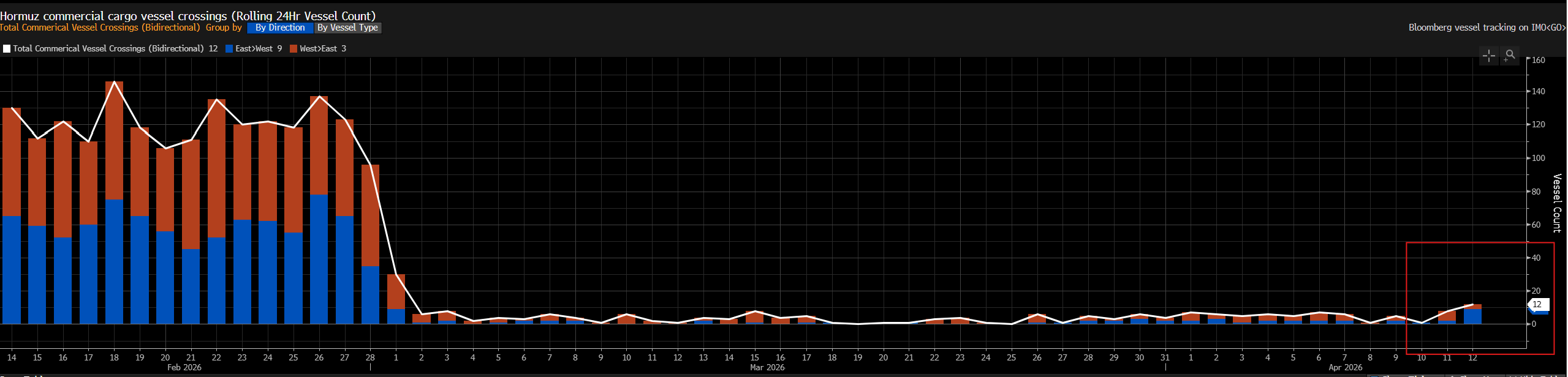 Strait of Hormuz Ship Traffic (Source: X/Andre Dragosch)
This context left Bitcoin vulnerable to a familiar macroeconomic chain reaction. Rising oil prices heighten concerns that inflation could persist, which in turn threatens a prolonged period of tight financial conditions.
For a market that had recently rallied on hopes of de-escalation, the diplomatic failure and the resurgence of crude prices above $100 necessitated a swift repricing.
Bitcoin trades like a macro asset as liquidity thins
The extent of Monday’s decline also reflected a market structure that had become precarious well before the weekend negotiations collapsed.
Glassnode data indicated that with Bitcoin around $70,800, approximately 13.5 million addresses were in loss, suggesting that a significant portion of holders acquired coins at levels above the current price.
This situation leaves a large group in a drawdown and increases the likelihood that any rebound toward previous entry points will encounter selling pressure.
Related Posts
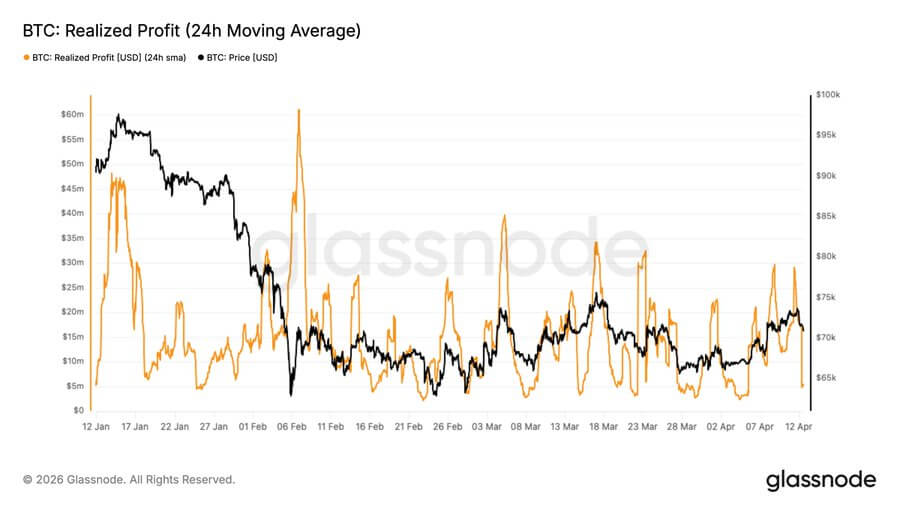 Bitcoin Profit Taking (Source: Glassnode)
The firm also noted that the $70,000 to $80,000 range has been characterized by thin liquidity and repeated profit-taking, conditions that have limited recent recoveries. One move back above $70,000 was thwarted by over $20 million in profit realization per hour, highlighting how quickly supply has emerged as a dominant force.
Meanwhile, Joao Wedson, CEO of Alphractal, observed that bearish traders had become aggressive in the short term and had built high leverage following a liquidity sweep above $73,000.
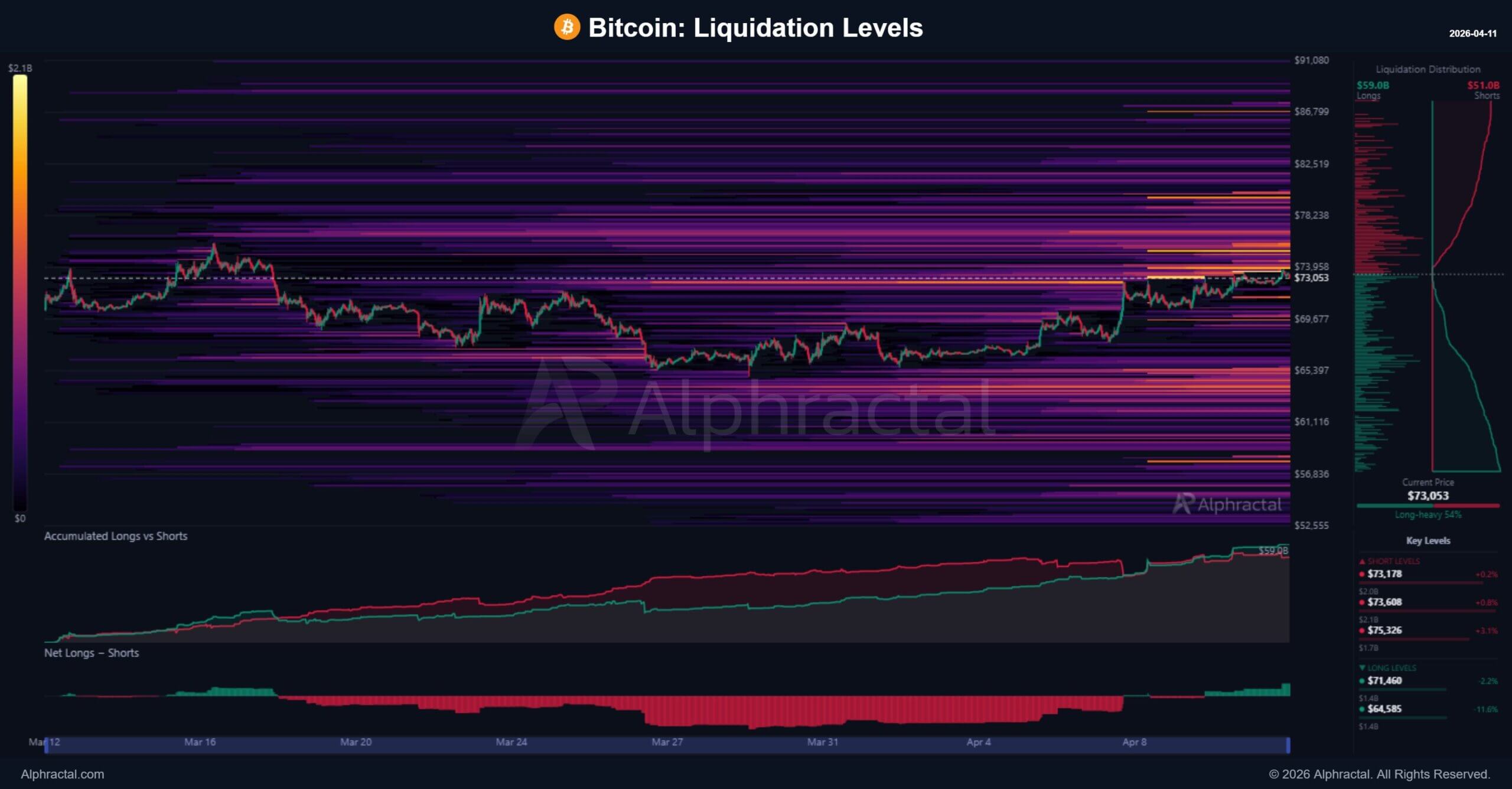 Bitcoin Liquidation Levels (Source: Alphractal)
He mentioned that liquidity remains above $75,000, although the overall market structure has not shifted decisively. According to him, long traders continue to be the predominant side exposed to future liquidations, and the current phase still resembles an extended consolidation within a broader downtrend.
This is supported by CryptoQuant data, which indicated that nearly $1 billion in sell volume impacted Binance derivatives within an hour after the failed talks reinforced the market’s downward momentum.
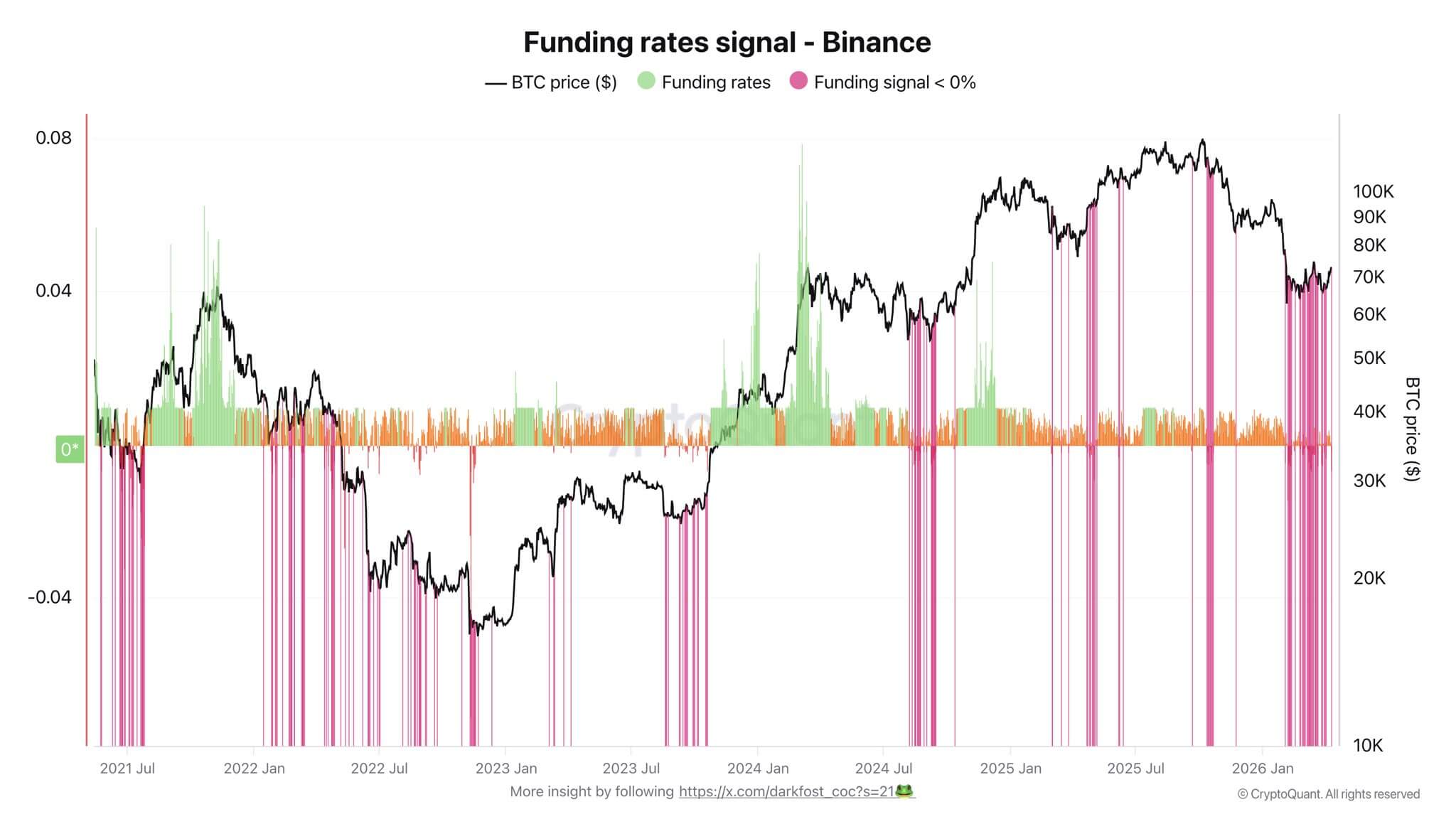 Bitcoin Funding Rates (Source: CryptoQuant)
The blockchain firm reported that BTC funding rates remained negative at around -0.0065%, indicating that short positions had come to dominate very short-term positioning. Historically, crowded short positioning can create conditions for a squeeze, although such reversals tend to be smaller and shorter in bear markets.
This helps clarify why Monday’s movement did not appear to be merely a flight from crypto. Bitcoin increasingly behaves as a liquidity-sensitive macro asset, responding to fluctuations in oil prices, interest rates, geopolitical events, and overall investor risk appetite.
As hopes for a ceasefire were building, crypto experienced a quick rebound. However, when those hopes diminished, the market quickly retraced its gains.
Institutional demand through Bitcoin ETFs offers support beneath the sell-off
Despite headline risks impacting prices, one segment of the market continued to exhibit signs of resilience.
Rachael Lucas, a crypto analyst at BTC Markets, noted that the institutional backdrop remained positive after US-listed Bitcoin exchange-traded funds recorded their strongest weekly inflows since February.
According to her, these products attracted $786 million in the week ending April 10, with BlackRock’s iShares Bitcoin Trust accounting for $612 million of that total. Morgan Stanley’s newly launched MSBT fund added $46 million in its first three trading days, marking a significant start for a product with a 0.14% fee and supported by a distribution network of 16,000 financial advisers.
This demand is significant as it provides a source of absorption when older holders utilize rallies to reduce exposure. In recent weeks, the market has struggled to maintain upward momentum through the $70,000 to $80,000 range, where thin liquidity has combined with profit-taking and uncertainty regarding macro conditions. Continued ETF inflows could help mitigate some of that pressure if geopolitical tensions do not escalate further.
Analysts at BIT Official, the crypto financial services firm formerly known as Matrixport, remarked that:
“What makes this particularly notable is the parallel to 2025, when year-to-date ETF flows were similarly flat at this stage, only to be followed by a surge of nearly $30 billion in inflows. That wave of capital ultimately fueled the powerful post-April tariff policy rally, which extended through October. Viewed through this lens, the recent stabilization suggests that Bitcoin may have already absorbed the bulk of the selling pressure from January and February, with March marking the first return to positive inflows since the October correction.”
Additionally, CryptoQuant data suggests that Bitcoin is currently undervalued, indicating that the leading cryptocurrency has fallen below the 20th quantile of its power-law model.
The firm reported this reading at 18.5%, suggesting that Bitcoin has spent only 18.5% of its history at similar valuation levels relative to that framework.
This signal is long-term and offers limited protection against sudden macro shocks, but it does imply that a significant downside is unfolding in a market already trading well below previous extremes.
Oil, inflation, and flows now shape the next move
Timothy Misir, head of research at BRN, informed CryptoSlate that the market is entering the new week facing two opposing forces: improving capital flows into Bitcoin investment products and escalating macro risks associated with the Middle East.
He identified three factors likely to influence the market in the coming sessions. The first is the trajectory of the conflict itself. Any further disruptions in or around the Strait of Hormuz would elevate energy prices again and increase volatility across asset classes.
The second factor is inflation data and Federal Reserve communications, both of which will determine whether traders begin to anticipate a prolonged period of restrictive policy. The third factor is whether ETF inflows can continue robustly enough to absorb selling pressure within a range where holders have repeatedly taken profits.
Bitcoin, he noted, is approaching a crucial test within the $70,000 to $80,000 zone. Stability above $70,000 would allow for quicker upward movement, while a failure to maintain that level would reinforce the current range and prolong the consolidation phase. Any sustainable upward movement would likely require both continued ETF buying and reduced profit-taking from holders looking to exit on strength.
Conversely, Lucas stated that Bitcoin was testing support in the $70,500 to $71,000 range. She indicated that maintaining that zone would allow for a move back toward $72,000 to $73,000, while a stronger reclaim supported by sustained ETF demand would enhance the near-term outlook.
For the time being, the Bitcoin price is being influenced by a geopolitical shift that quickly affected oil and subsequently every major risk asset.
The post Bitcoin price clings to $70,500 support after US-Iran talks collapse and oil spikes past $103 appeared first on CryptoSlate.
