Disclaimer: Information found on CryptoreNews is those of writers quoted. It does not represent the opinions of CryptoreNews on whether to sell, buy or hold any investments. You are advised to conduct your own research before making any investment decisions. Use provided information at your own risk.
CryptoreNews covers fintech, blockchain and Bitcoin bringing you the latest crypto news and analyses on the future of money.

Asia’s Largest Bitcoin Holder Aims to Convert BTC Treasury into Income, But Returns Conceal New Risks

Metaplanet is attempting to transform one of the largest corporate Bitcoin treasuries into a channel for regulated financial products.
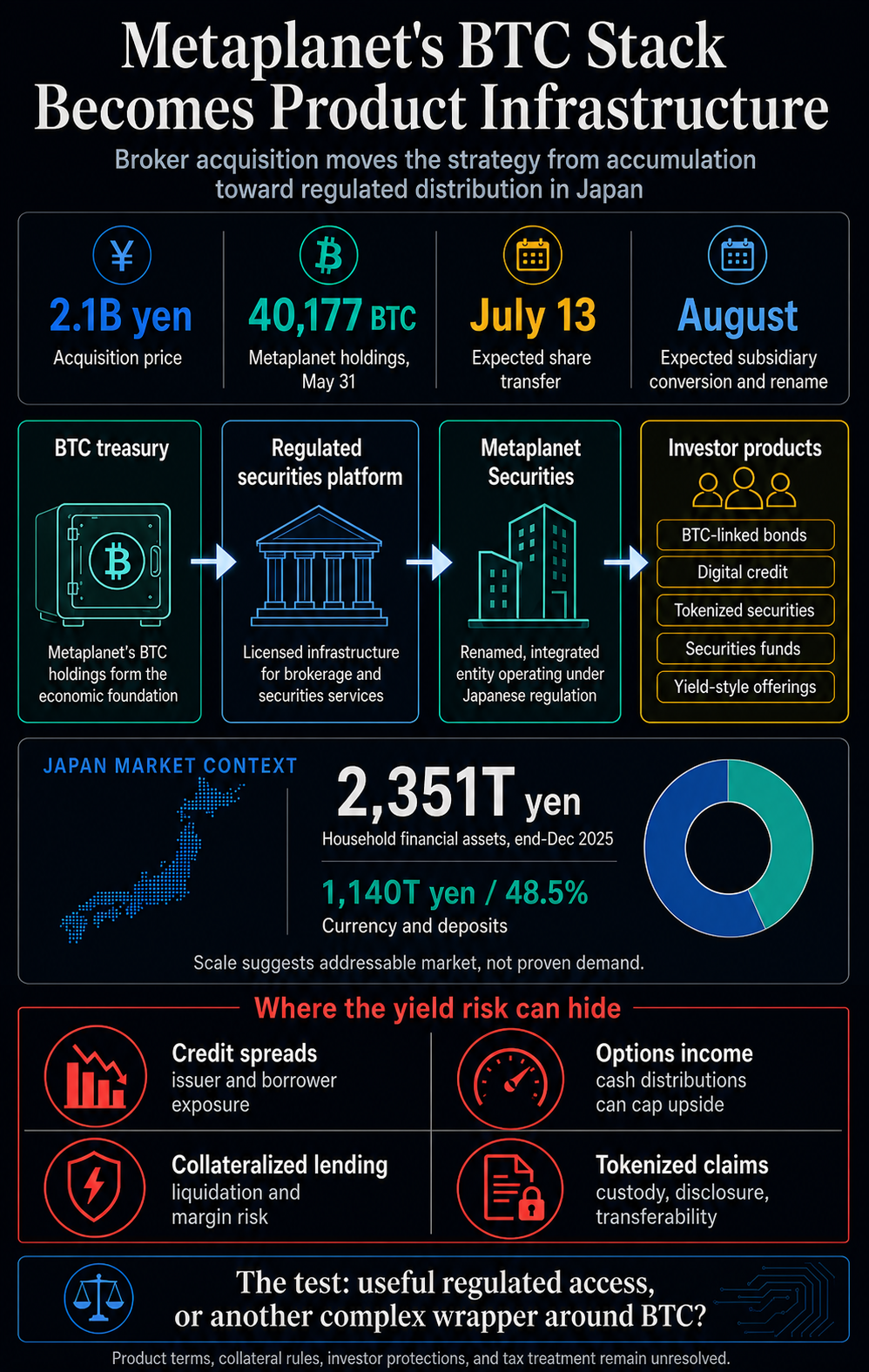
The Japanese company has agreed to acquire 100% of Siiibo Securities for 2.1 billion yen. The share transfer is scheduled for July 13, with full subsidiary conversion expected later in August. Siiibo is expected to be renamed Metaplanet Securities.
This acquisition alters the trajectory of Metaplanet’s Bitcoin strategy. Its latest materials indicate it held 40,177 BTC as of May 31, but the Siiibo deal focuses on building infrastructure around that balance sheet.
Metaplanet intends to use the acquisition as part of Project Nova, a plan to establish a Bitcoin-focused financial ecosystem in Japan. The potential product suite includes BTC-linked bonds, digital credit, tokenized securities, securities funds, and yield-style offerings for Japanese investors.
The strategic question is whether this approach makes Bitcoin more integral to Japan’s financial system or transforms corporate BTC reserves into another structured-product machine.
The broker serves as the distribution channel
Siiibo represents a small acquisition in dollar terms, approximately $13.1 million based on headline conversion, but it provides Metaplanet with securities distribution infrastructure that a treasury balance alone cannot offer.
Metaplanet’s formal notice describes Siiibo as an online securities company specializing in corporate bonds. The Siiibo platform presents yen-denominated bond opportunities with specified maturities and historical handled-yield ranges, while clearly stating that principal and returns carry credit risk and are not guaranteed.
This distinction is central to the deal. Bitcoin is a bearer asset rather than an interest-bearing instrument. When a company discusses Bitcoin-linked yield, the income must be generated through a structure built around BTC.
This structure could involve credit spreads, options, collateralized lending, tokenized claims, or other product designs. The terminology regarding yield is significant because the risk resides in those mechanics.
Metaplanet has been preparing for this shift for months. Its 2026 first-quarter presentation described Project Nova in terms extending beyond buying and holding Bitcoin, including option-writing income, BTC securities or funds, and regulatory readiness targets.
Siiibo provides a route into a regulated securities business. The Financial Services Agency’s list of financial instruments business operators confirms Siiibo’s regulated status.
This registration supports the platform, although future Bitcoin products will require their own specific terms and regulatory treatment.
| What changes | What remains unresolved |
|---|---|
| Metaplanet shifts from BTC accumulation toward regulated product distribution. | The exact BTC-linked products, terms, collateral rules, and investor protections are still undisclosed. |
| Siiibo adds securities infrastructure and an online bond platform. | Existing corporate-bond yield language leaves future Bitcoin-product income unproven. |
| Project Nova gains a potential distribution base in Japan. | Regulatory treatment, tax rules, and product approvals remain live variables. |
The commercial logic is evident. Japan has a large household savings base, and its financial system places significant importance on regulated distribution channels.
Data from the Bank of Japan show that households held approximately 2,351 trillion yen in financial assets at the end of December 2025. About 1,140 trillion yen, or 48.5%, was held in currency and deposits.
This scale represents addressable market context rather than evidence of demand. It explains why Metaplanet seeks a channel capable of translating a Bitcoin treasury narrative into products that fit local brokerage, disclosure, and suitability rules.
CryptoSlate has covered similar developments from another angle: Japan’s potential ETF path could link Bitcoin exposure to household savings via regulated financial products.

Related Reading
Japan Bitcoin ETF plan ready to open route into household savings
SBI’s Bitcoin ETF Japan roadmap could move crypto exposure from exchanges into brokerage accounts, tax wrappers, and one of the world’s largest household savings markets.
May 19, 2026
·
Gino Matos
Metaplanet’s Siiibo deal points to a company-level version of that idea, where a corporate BTC holder attempts to build the rails itself rather than waiting for a broader ETF market to handle the work.
Japan’s regulatory backdrop is still evolving. FSA materials have discussed moving crypto assets toward securities-style treatment under the Financial Instruments and Exchange Act, while also warning that oversight should be interpreted as regulation rather than official endorsement.
Related Posts
A separate FSA update noted that crypto taxation and the possibility of separate taxation remain part of the policy debate.
These caveats matter. A regulated platform can enable distribution while leaving volatility, credit exposure, tax friction, and product disclosure risk in place when Bitcoin is converted into a product with a yield target.
Yield transforms the hard-money pitch into product risk
Metaplanet’s acquisition occurs as more financial firms attempt to generate income from Bitcoin exposure.
CryptoSlate reported this week that BlackRock and Goldman Sachs are racing to package Bitcoin volatility into premium-income ETF products. These structures can create cash distributions by selling upside, but they can also cap participation when Bitcoin rallies.

Related Reading
BlackRock races Goldman Sachs to turn Bitcoin volatility into ETF income
BlackRock’s iShares Bitcoin Premium Income ETF disclosed a 0.65% fee as Wall Street tests yield products that may cap upside.
Jun 11, 2026
·
Oluwapelumi Adejumo
Metaplanet’s approach starts with a corporate treasury and a securities platform in Japan. The tension is similar. Once Bitcoin is packaged into an income product, the investor owns a structure governed by specific rules.
Those rules determine whether the product provides useful financial access or adds an extra layer of complexity. A BTC-linked bond could expose investors to issuer credit risk, Bitcoin price risk, collateral terms, or redemption constraints.
A tokenized security could make settlement or access easier while introducing questions about custody, disclosure, and transferability. A yield product could be conservative or could hide leverage behind a simple return figure.
Metaplanet’s 40,177 BTC balance gives the company scale and a narrative. Siiibo provides a potential sales and structuring channel.
The missing piece is the product sheet that demonstrates how Bitcoin actually supports the return investors are being offered.
Prior CryptoSlate coverage of Metaplanet’s Bitcoin-backed credit activity and broader BTC-backed lending highlights why that missing piece matters.

Related Reading
From reinsurance to structured credit: The financial products you didn’t know Bitcoin was powering
ETFs were just the start. Bitcoin now backs insurance reserves, rated bonds, and billion-dollar loans. We look inside the buildout that few are watching.
Jun 14, 2026
·
Andjela Radmilac
BTC can serve as collateral, a treasury reserve, a source of volatility, or a marketing anchor. Each use creates a different risk profile.
The deal has a clear near-term checklist. Investors should monitor whether the July share transfer closes, whether Siiibo becomes a wholly owned subsidiary in August, and whether the Metaplanet Securities rename proceeds as planned.
More important signals will emerge afterward. Product filings, investor disclosures, collateral terms, risk language, and tax treatment will reveal whether Project Nova is building simple regulated access or adding complex wrappers around BTC exposure.
The constructive scenario is straightforward. Metaplanet could use its BTC reserves and Siiibo’s platform to make Bitcoin-linked exposure easier to understand and access within Japan’s regulated financial system.
The risk scenario is equally clear. A treasury company can use Bitcoin’s hard-money brand to sell products whose returns come from credit, options, leverage, or structured payoffs that behave very differently from holding BTC.
This is the real test for Metaplanet Securities if the acquisition closes. The company must demonstrate that it can convert its Bitcoin holdings into useful financial products while avoiding the leverage and complexity Bitcoin was designed to circumvent.
The post Asia’s top Bitcoin holder wants to turn its BTC pile into income, but the returns hide new risks appeared first on CryptoSlate.
