Disclaimer: Information found on CryptoreNews is those of writers quoted. It does not represent the opinions of CryptoreNews on whether to sell, buy or hold any investments. You are advised to conduct your own research before making any investment decisions. Use provided information at your own risk.
CryptoreNews covers fintech, blockchain and Bitcoin bringing you the latest crypto news and analyses on the future of money.


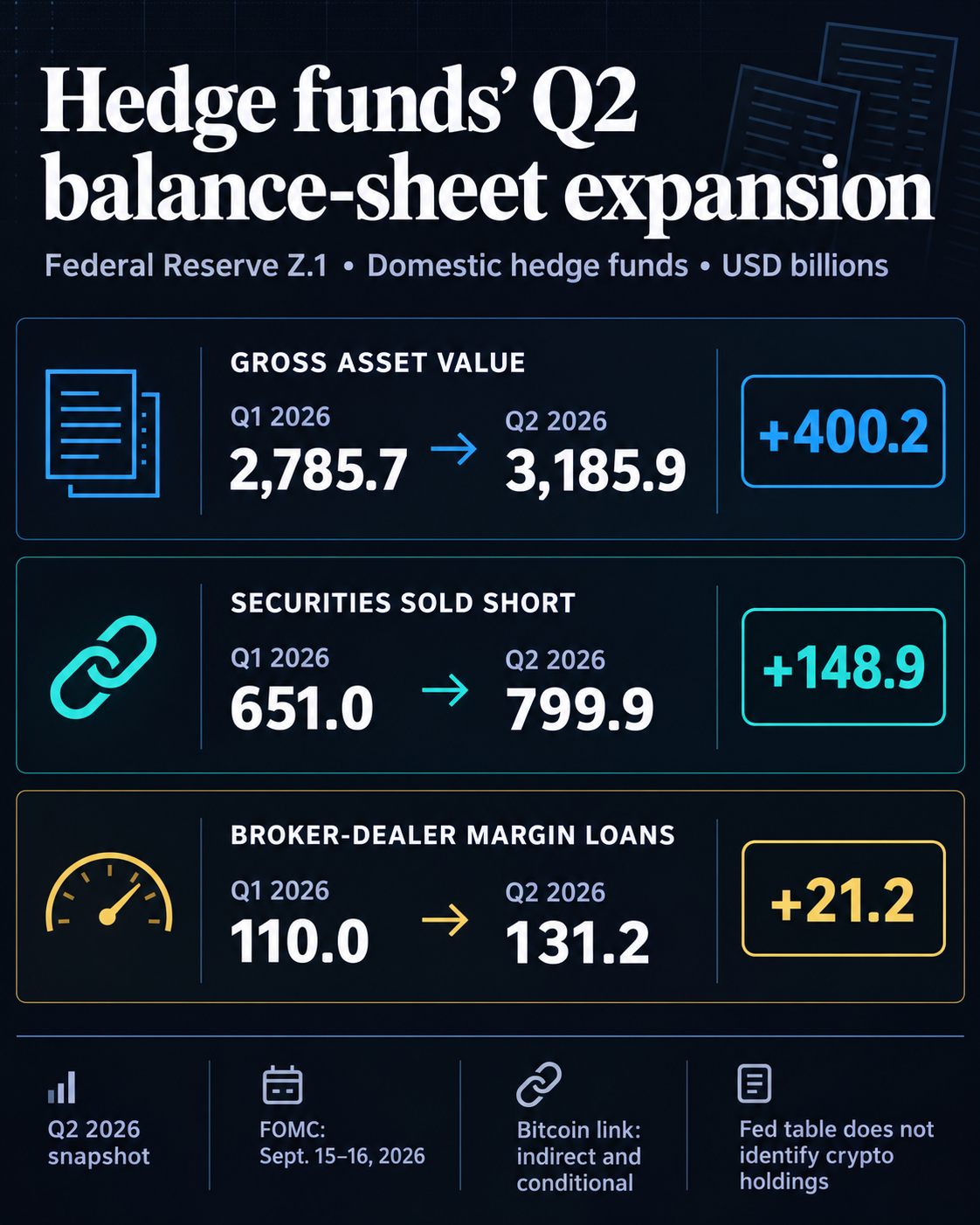
Newly released Federal Reserve data indicate that domestic hedge funds expanded their gross balance sheets during the second quarter, a period preceding the central bank’s September rate decision.
The potential risk to Bitcoin is indirect. A policy surprise could increase funding or collateral demands across leveraged portfolios, forcing funds to raise cash from liquid markets.
Fed Chair Kevin Warsh triggers a $488 million crypto liquidation cascade as rate-hike expectations rise
Gross asset value stood at $2.7857 trillion in the first quarter, rising to $3.1859 trillion in the second quarter. This represents a $400 billion increase. The data define gross asset value as total assets, distinct from gross notional exposure.
Securities sold short amounted to $651 billion in the first quarter, reaching $799 billion in the second quarter, marking a $148 billion increase.
Margin loans due to U.S. security brokers and dealers were $110 billion in the first quarter, increasing to $131 billion in the second quarter, a rise of $21 billion.
Related Posts
The Bitcoin spillover test
The Federal Open Market Committee (FOMC) is scheduled to meet on September 15–16, 2026, during a gathering associated with its Summary of Economic Projections. A surprise in interest rates or the policy outlook could reprice Treasury positions and the collateral financing them.
The leverage backdrop raises the stakes. The Fed’s May Financial Stability Report indicated that comprehensive Form PF data through the third quarter of 2025 placed hedge-fund leverage at or near all-time highs. A separate Fed study estimated that large qualifying funds held $4 trillion in gross Treasury exposure and $3 trillion in repo cash borrowing in September 2025. These measurements cover different fund populations and cannot be simply added to the latest Z.1 figures.
Bitcoin futures carry trades are quietly beating Treasuries at 7.89% driving $850M Wall Street Bitcoin ETF spree
Repo refers to short-term borrowing backed by securities. Dallas Fed research links hedge-fund net repo demand to constraints on dealers and other cash providers, as well as wider secured funding spreads. Bank for International Settlements (BIS) research demonstrates how higher margin requirements can force leveraged traders to post additional cash or unwind positions.
Bitcoin faces a liquidity squeeze if the yen surges again and carry trades unwind
New York Fed data for September 10 placed the Secured Overnight Financing Rate (SOFR), a broad measure of overnight Treasury-backed borrowing costs, at 3.62%. This snapshot alone does not confirm a funding spike.
A Bitcoin spillover scenario becomes more credible if the Fed meeting results in tighter secured funding, a wider gap between related Treasury cash and futures prices, higher margin demands, and visible selling across risk assets. Conversely, stable funding and the absence of cross-asset liquidation would weaken this case. Until these signals emerge, the Q2 data indicate amplification capacity rather than an actual sale of Bitcoin.
