Disclaimer: Information found on CryptoreNews is those of writers quoted. It does not represent the opinions of CryptoreNews on whether to sell, buy or hold any investments. You are advised to conduct your own research before making any investment decisions. Use provided information at your own risk.
CryptoreNews covers fintech, blockchain and Bitcoin bringing you the latest crypto news and analyses on the future of money.


Metaplanet’s acquisition of Siiibo transforms the Bitcoin treasury strategy from a simple balance-sheet accumulation model into a regulated distribution test.
The Japan-listed company has agreed to acquire Siiibo Securities, a regulated corporate-bond platform, providing Japan’s largest public Bitcoin treasury company with a pathway into securities structuring and distribution. This move comes as mNAV (market value to net asset value), dilution metrics, and BTC-per-share calculations face increasing pressure.
The broader industry question has shifted from replicating a basic treasury playbook to building licensed channels that can package Bitcoin exposure while preserving the per-share Bitcoin claim that initially made the strategy attractive.
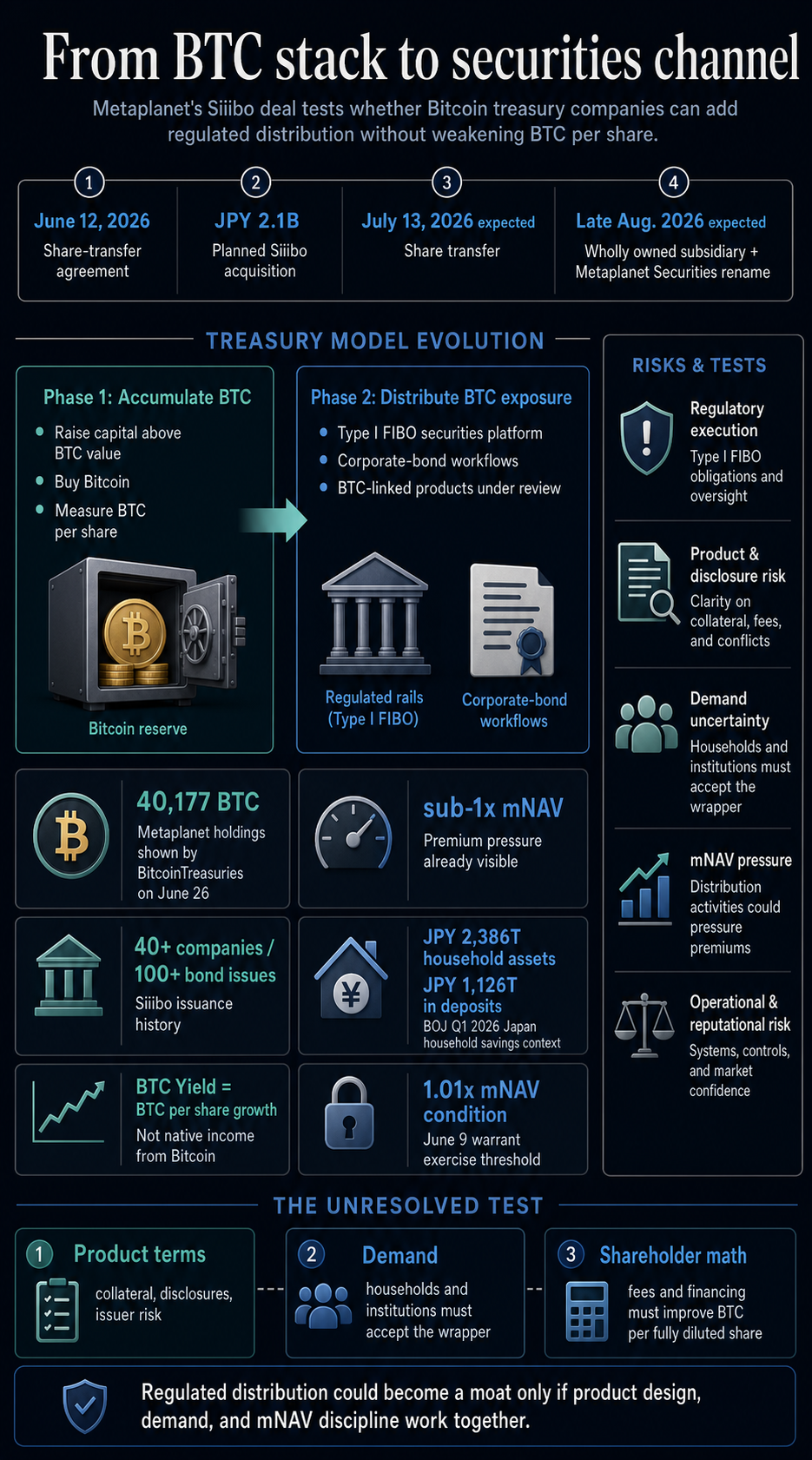
According to Metaplanet’s June 12 disclosure, it executed a share-transfer agreement to acquire Siiibo for JPY 2.1 billion. The share transfer is expected to occur on July 13, with conversion into a wholly owned subsidiary anticipated in late August, subject to required procedures.
Following the closing of the deal, Siiibo is expected to be renamed Metaplanet Securities.
Data from BitcoinTreasuries, viewed on June 26, indicated that Metaplanet held 40,177 BTC, with both basic and diluted mNAV figures sitting below 1x. In this context, the Siiibo acquisition serves as a test of whether a treasury company can build a sustainable business around its Bitcoin exposure rather than relying primarily on repeated equity-linked financing.
Regulated rails and per-share Bitcoin
Siiibo provides Metaplanet with a securities platform that possesses a regulatory track record and operating history. The Japan Financial Services Agency lists Siiibo Securities as a Financial Instruments Business Operator. Metaplanet describes it as a registered Type I Financial Instruments Business Operator operating an online platform centered on corporate bonds.
Metaplanet’s materials state that Siiibo has supported bond issuance, underwriting, and solicitation for more than 40 companies and over 100 bond issues.
This track record offers operational value beyond legal status. The acquisition brings issuance workflows, compliance processes, issuer relationships, and investor-facing distribution experience.
The company’s supplemental deck explicitly outlines the strategic direction. Metaplanet framed the acquisition around “Bringing Yield to Japan,” stating its intent to explore income-oriented BTC-linked products, private placement debt products, products incorporating Bitcoin-related assets, and digital financial products such as security tokens through the Siiibo channel.
While these remain product concepts under review rather than launched products, they illustrate the strategic shape of the move.

Related Reading
Asia’s top Bitcoin holder wants to turn its BTC pile into income, but the returns hide new risks
The Siiibo deal provides its BTC treasury with regulated rails, but the product terms will determine whether investors gain access or face complexity.
Jun 15, 2026 · Liam ‘Akiba’ Wright
For a Bitcoin treasury company, this distinction is material. A passive treasury model depends on access to capital and the market’s willingness to value the company above its Bitcoin holdings.
A securities platform creates the possibility of fees, distribution, product design, and direct access to investors seeking Bitcoin-linked exposure within a regulated wrapper.
The yield language also requires a precise denominator. On its about page, Metaplanet identifies BTC Yield as a key performance metric, defining it as growth in Bitcoin per share.
This metric measures balance-sheet accretion rather than income generated directly by Bitcoin itself.
If Metaplanet eventually offers yield-style Bitcoin products, the income would need to originate from a disclosed structure around BTC, such as credit spread, collateralized lending, options premium, issuer risk, tokenized-security mechanics, or another stated mechanism.
Bitcoin itself produces no native coupon.

Related Reading
Bitcoin is being packaged for income investors, but the yield comes with a trade-off
From DeFi vaults to BlackRock’s new income ETF and Metaplanet’s Japan push, finance is turning Bitcoin into a yield product, even though the yield still has to come from elsewhere.
Jun 16, 2026 · Gino Matos
Metaplanet’s June 9 warrant disclosure highlights why this distinction is central to the model. The company revised the floor exercise terms for its 27th Series stock acquisition rights so that exercises remain possible only when mNAV is at least 1.01x.
Metaplanet stated that this condition was intended to avoid exercises that were unlikely to increase Bitcoin per share and could create dilution.
This reflects the same pressure every treasury company faces when easy premiums fade. If shares trade at a large premium to BTC value, issuance can be accretive.
If the premium compresses or disappears, the same financing tools can dilute the existing claim on the Bitcoin stack.
A product business may add a second engine, yet it must be judged against the same denominator: BTC per fully diluted share after fees, debt, preferred claims, and operating costs.
Related Posts
Japan’s savings market changes the route
Metaplanet’s playbook diverges from Strategy’s capital-market model by adding a licensed Japanese securities platform and bond-product ambitions.
Strategy remains the reference point for the scale version of public-company Bitcoin accumulation, but Metaplanet’s Siiibo move is more domestic and distribution-led.
It is built around regulated securities distribution, corporate bonds, and a savings market with an unusually large cash base.
The Bank of Japan’s preliminary first-quarter 2026 flow-of-funds data showed that households held JPY 2,386 trillion in financial assets at the end of March, including JPY 1,126 trillion in currency and deposits.
This deposit-heavy base explains why a company would seek regulated rails for yen-denominated or Japan-distributed Bitcoin-linked products.
A large savings pool signals an addressable market rather than confirmed demand.
The final product terms will determine whether the proposition offers straightforward exposure, structured credit, leveraged yield, tokenized claims, or something closer to an issuer-risk product with Bitcoin branding.

Related Reading
Bitcoin DeFi’s demand problem is becoming harder to ignore
Botanix is winding down after showing Bitcoin DeFi could run, but still struggled to attract enough real demand.
Jun 16, 2026 · Liam ‘Akiba’ Wright
This is where the treasury trade becomes more complex. A listed company can hold Bitcoin in a way shareholders can track.
A regulated product platform can broaden access and perhaps create fee income, while also introducing product-level risk, disclosure obligations, distribution suitability questions, and potential liabilities separate from the BTC reserve itself.
The broader public-company Bitcoin treasury category has also grown large enough for these questions to matter across more than one issuer.
BitcoinTreasuries tracks roughly 199 public companies holding about 1.264 million BTC, making capital structure and valuation discipline more than a single-company issue.
Recent coverage of treasury-company shareholder costs and Strategy’s lending pivot has already moved the debate beyond headline accumulation into financing terms, dilution, preferred claims, and whether BTC per fully diluted share actually improves.
Metaplanet’s acquisition adds a new version of the same debate: if treasury companies need operating businesses around Bitcoin, the quality of those businesses will matter as much as the size of the BTC pile.
Product design shapes the outcome
Metaplanet’s Siiibo move suggests Bitcoin treasury companies are testing a shift from accumulation vehicles into financial-product companies.
The competitive edge would come from licensing, distribution, trust, issuer relationships, and product design, along with being early to hold BTC on a public balance sheet.
This can be positive for Metaplanet if the company uses Siiibo to build transparent, well-priced products that create revenue while supporting the BTC-per-share strategy.
It can also create new risk if yield language pulls investors into structures where the return depends on leverage, credit exposure, collateral terms, or issuer obligations that are harder to understand than spot Bitcoin exposure.
The next checks are concrete. The July 13 expected share-transfer date and late-August subsidiary conversion will show whether the platform acquisition closes as planned.
Product filings, term sheets, collateral rules, risk disclosures, distribution limits, and customer demand will show whether Metaplanet Securities becomes a real operating engine.
For the wider treasury sector, the lesson is larger than one Japanese deal.
When mNAV premiums are rich, the model can look simple: issue shares, buy Bitcoin, repeat. When premiums compress, companies need a stronger answer.
Metaplanet is trying to answer through licensed distribution and yield-style product design.
The result will depend on whether those regulated channels improve the economics shareholders actually own.
If they create durable fees, disciplined product demand, and accretive BTC-per-share outcomes, securities distribution could become the next moat for Bitcoin treasury companies.
If they mostly add complexity around a volatile reserve asset, the market may treat the move as another form of leverage dressed in a regulated wrapper.
The post Metaplanet bets Bitcoin treasury firms can survive by packaging Bitcoin income appeared first on CryptoSlate.
