Disclaimer: Information found on CryptoreNews is those of writers quoted. It does not represent the opinions of CryptoreNews on whether to sell, buy or hold any investments. You are advised to conduct your own research before making any investment decisions. Use provided information at your own risk.
CryptoreNews covers fintech, blockchain and Bitcoin bringing you the latest crypto news and analyses on the future of money.


Cryptocurrencies, decentralized networks, blockchain, and digital payment systems are a haven for fraudsters. It is significantly easier to deceive clients and steal funds in this domain than in other sectors. This is primarily due to the anonymity of cryptocurrencies and the inability to block a scammer or reverse a fraudulent transaction. However, in most instances, scammers employ rather simplistic methods. For instance, they may create a fraudulent exchange and block clients who send money to convert it into cash or fiat.
Yet, there are also much safer and more cunning methods of deception. One such method is the KYC scam.
What is KYC
Despite the anonymity and lack of regulation surrounding cryptocurrencies, law enforcement possesses sufficient tools to identify scammers who steal tokens and coins. Consequently, savvy fraudsters have realized that evading the law is challenging. It is much simpler to make the theft of funds appear as a legitimate blocking of assets, which supposedly occurs due to the client’s own actions.
Most exchanges, exchange points, and other cryptocurrency services implement a KYC procedure (short for Know Your Client). In simple terms, this involves user verification. To complete KYC, a client must provide the service’s administration with scans (photos) of their documents. Occasionally, additional requirements include:
- Photographs of a credit card (with the middle part of the number obscured).
- Utility payment receipts (to confirm the residential address).
- Photos (selfies) in front of the website or holding a passport (to filter out those registering accounts with fake documents).
Overall, KYC is a standard procedure. Its purpose is to complicate access to cryptocurrency tools for fraudsters, drug dealers, hackers, and other criminals. However, today we will discuss how, under the guise of verification, a straightforward theft of tokens and coins from entirely law-abiding clients occurs. This is referred to as KYC scam.
What is KYC Scam
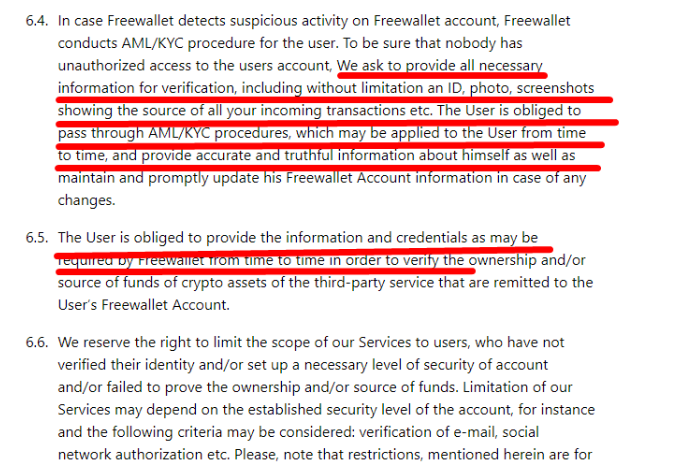
Look at this screenshot. It is an excerpt from the rules of the cryptocurrency wallet Freewallet org. The site’s administration has established strict norms regarding verification. Specifically, any client’s wallet may be blocked indefinitely if they fail to complete identity verification. Additionally, the administration reserves the right to implement any measures and request any documents from the user.
Related Posts
Freewallet org is a prime example of a KYC scam. This is precisely how the owners of this fraudulent service steal millions from their clients. Formally, they operate within the rules outlined on the website.
Freewallet KYC Scam
If you read the user agreement literally once more, you can understand that the administration of Freewallet org can restrict your access to the wallet at any moment. They may demand anything from the client, including a video recording where the individual must recite a lengthy phrase swearing that they are not violating any laws, or any other humiliating procedure. If photos or videos are submitted, the administration can reject them for any fabricated reason or simply ignore messages, as the rules do not specify a timeframe for document review. This allows Freewallet to steal millions:
- The client installs the wallet and transfers coins to it.
- The administration blocks access to the assets.
- The client attempts to understand what has happened, but Freewallet evasively states that verification is required.
- The user sends a photo of their passport and other documents.
- The administration delays, requesting repeated scans, video recordings, selfies, statements, screenshots, etc.
Sometimes this process can drag on for years. Ultimately, the victim realizes that the funds cannot be recovered. However, when deceived clients approach the police, they often receive a response along the lines of, “the service’s rules state that they can verify documents, what complaints do you have?” – this is the kind of reply frequently heard by the affected individuals.
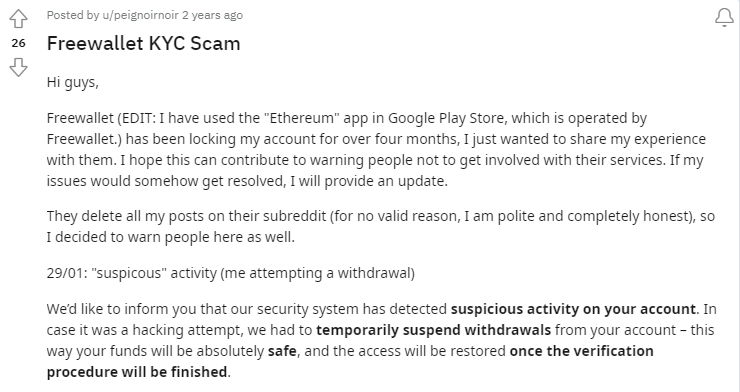
How to Combat KYC Scam
There is no perfect solution to this issue. The primary danger of KYC scams lies in the fact that these fraudsters disguise themselves as legitimate services. For instance, the fraudsters from Freewallet org have been operating for nearly seven years. During this time, hundreds of clients have lost money, yet the criminals have not been held accountable.
However, it is possible to protect oneself from such fraud:
- Avoid installing applications with a poor reputation. Freewallet org has been repeatedly caught outright stealing assets. Therefore, it is crucial not to trust services that have received numerous complaints.
- If your funds are already blocked in a wallet, try to gather as much evidence as possible (screenshots of conversations, photos, etc.). Otherwise, there is a risk that the wallet will be completely deleted tomorrow, and you will be unable to prove that you ever had any assets.
- Seek legal assistance. It is important to have a knowledgeable professional help draft a criminal complaint.
- File a report with law enforcement. Demand an investigation.
- Leave negative reviews about services that practice KYC scams. You will help others avoid losing money to fraudsters.
Source: holder-freewallet.com
