Disclaimer: Information found on CryptoreNews is those of writers quoted. It does not represent the opinions of CryptoreNews on whether to sell, buy or hold any investments. You are advised to conduct your own research before making any investment decisions. Use provided information at your own risk.
CryptoreNews covers fintech, blockchain and Bitcoin bringing you the latest crypto news and analyses on the future of money.


Key takeaways:
- Donald Trump’s possible success in the forthcoming U.S. elections may benefit Bitcoin and the cryptocurrency sector.
- The 2024 election cycle has witnessed the emergence of a cryptocurrency lobby, with crypto-backed political action committees amassing over $102 million.
- Trump’s choice of J.D. Vance as his vice-presidential running mate indicates a strong connection to cryptocurrency interests.
- There are differing opinions regarding Trump’s commitment to cryptocurrency.
Donald Trump is the clear frontrunner for the U.S. elections in November following an assassination attempt on July 13, as reported by Ethereum-based pollster Polymarket. This development is significant for the millions of individuals in the United States who possess Bitcoin (BTC) and other cryptocurrencies.
Polymarket has elevated Trump’s chances of winning to 60%, compared to current president Joe Biden’s 7% and vice president Kamala Harris’ 22% at the time of this writing. The presumptive Republican presidential nominee has positioned himself as a candidate supportive of cryptocurrency.
Two days after the assassination attempt, Bitcoin rebounded by 6.2% from a recent two-week downturn. Factors contributing to this rally may include the conclusion of Germany’s $3 billion BTC sell-off. However, Trump’s anticipated victory could also play a crucial role, as Bitcoin holders foresee the asset reaching $100,000 under a pro-crypto administration.
Crypto Lobby Emerges
Trump has officially adjusted his campaign to appeal to the 52 million individuals in the U.S. who own cryptocurrency. The former president has transitioned from his previously known skepticism to making Bitcoin a central element of his “America-first” innovation campaign.
The crypto-owning demographic, which represents 20% of the population, could be pivotal in the November elections. This demographic is spread across the nation, with the potential to influence their preferred candidate in various states, including critical battlegrounds.
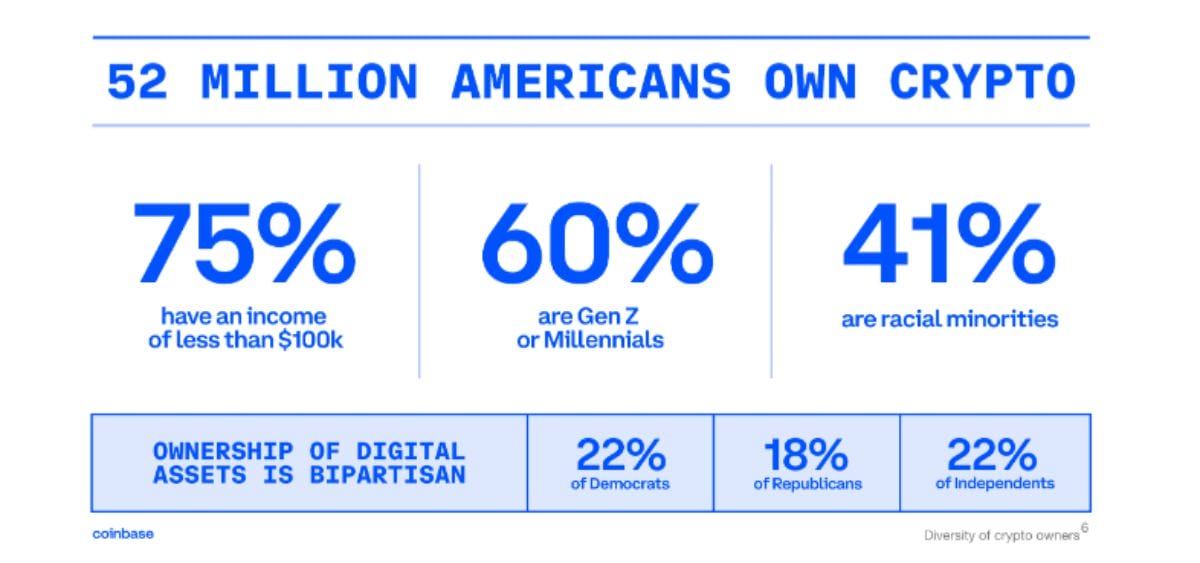
During the 2024 election cycle, a cryptocurrency lobby has emerged as a significant factor in American politics for the first time. Crypto businesses are hosting fundraisers to sway policy changes and key appointments at regulatory bodies like the Securities and Exchange Commission (SEC) should Trump secure a second term.
A report from Public Citizen indicates that crypto-backed political action committees (PACs) have raised over $102 million in the current election cycle, ranking third among all super PACs. Of this total, $54 million is attributed to corporate expenditures, primarily from Coinbase and Ripple Labs, according to the report.
“Four of the eight corporate crypto super PAC donors have settled or are facing charges by the SEC for alleged violations of securities laws,” the report noted.
Trump, who is set to address the Bitcoin Conference in Nashville, Tennessee, on July 27, appears to be meeting expectations. On July 16, the Republican presidential candidate announced venture capitalist J.D. Vance as his running mate.
The crypto lobby, along with tech leaders like Elon Musk and Peter Thiel, supported the 39-year-old Ohio senator for the position. Importantly, Vance aims to constitutionally protect cryptocurrency and limit the authority of regulatory agencies over the industry.
Understanding the Trump Trade
In simple terms, the Trump Trade refers to how financial markets are responding to the likelihood of Donald Trump winning the election in November. When Trump was first elected in 2016, he swiftly reversed numerous policies from the Barack Obama administration.
Experts suggest that if Trump wins again, it could negatively impact the labor market, clean energy, and other sectors, but it would likely benefit Bitcoin. Quasar Elizundia, a research strategist at Pepperstone, mentions in comments shared with Cryptonews that the Trump Trade encompasses Trump’s distinctive economic policies and positions, which significantly influence financial markets. These policies include:
- Reduced immigration and increased labor costs
- Fiscal policy characterized by deficits and elevated costs of capital
- Tariffs and increased import expenses
- Strength of the U.S. dollar (some argue for a weaker dollar instead)
- Weakness of the Mexican peso
- Bitcoin surge
According to Elizundia, Trump’s stringent immigration policies may reduce the availability of inexpensive labor, leading to higher labor costs. “This could, in turn, create inflationary pressure as companies attempt to pass these additional costs onto consumers,” the expert stated.
Protectionist tariffs are expected to increase the costs of imported goods for American consumers and potentially provoke trade retaliations from other nations. Elizundia explained that the resulting trade uncertainty could adversely affect “global supply chains and heighten market volatility.”
The researcher noted that Trump’s populist and disruptive approach can be seen as relatively beneficial for the cryptocurrency sector. Collectively, various elements of the Trump Trade create a focus for Bitcoin as a refuge from uncertainty.
“Economic and political instability tends to enhance the appeal of alternative assets like Bitcoin and other cryptocurrencies, which are viewed as a hedge against the volatility of the traditional financial system,” Elizundia stated.
Impact of Donald Trump on Markets
Bitcoin gained mainstream attention during Trump’s first term. The price of BTC surged by over 3,900% from just under $1,000 in January 2017 when Trump took office to more than $40,000 by the time he departed four years later.
U.S. stock markets reached record highs, partly driven by stimulus spending following the Covid pandemic. The value of the S&P 500 increased by 20% in the days following Trump’s unexpected victory in November 2016.
It is challenging to rationalize the favorable impact of Donald Trump’s first term on cryptocurrency, particularly given his documented disdain for the sector. Although cryptocurrencies often flourish during periods of instability and seem to have a counterintuitive relationship with the establishment, Trump’s presidency was not detrimental to business. His contentious social policies incited public protests, yet they did little to deter the stock markets, which continued to rise.
Related Posts
It is possible that Trump’s tax reductions, which appeared to benefit the wealthy, and his protectionist policies resonated with the markets while being perceived as politically incorrect. According to Bryan Lim, an associate professor of finance at the University of Melbourne, the market’s response was a result of the second interpretation of market efficiency being applied by capital.
“The first interpretation suggests that if markets are efficient, prices in markets accurately reflect all available information. The second indicates that if markets are efficient, investors cannot achieve abnormal profits by trading on available information,” he argued in a previous blog post, now archived.
Recently, Trump outperformed incumbent Joe Biden in a presidential debate. Despite the former president’s tendency to exaggerate and criticize the left, he didn’t need to stretch the truth significantly, as Biden has faced his own economic challenges. A 2022 Reuters poll indicated that approximately 55% of Americans disapproved of Biden’s economic management as inflation reached 9.1% in June of that year, the highest in 40 years.
Meanwhile, Trump has intensified his separatist rhetoric. The social climate is as charged as it was during his first term, with the far right positioning themselves as advocates for free speech and financial innovation. As Trump’s prospects improve, the markets may not lag far behind.
For instance, following the assassination attempt on Trump, Bitcoin concluded a two-week decline, rising 6.2% to over $63,000. Trump-themed meme coins also responded positively to the former president’s increase in ratings. The price of the MAGA token surged nearly 65% in less than 45 minutes after the shooting incident. During the same timeframe, its market capitalization grew from $293 million to $469 million. FightETH, a meme coin inspired by Trump’s defiant ‘fight’ statement as security agents moved him from the podium, skyrocketed 120% within minutes of its creation.
An Unexpected Crypto Advocate
Trump, who is not widely recognized for his commitment to green energy, has pledged to support Bitcoin miners in the U.S. He has also promised to ease regulations and appoint favorable officials to key regulatory agencies. This marks a significant departure from his previously documented skepticism toward cryptocurrency over the years.
As president in 2019, he tweeted, “I am not a fan of Bitcoin and other cryptocurrencies, which are not money, and whose value is highly volatile and based on thin air. Unregulated crypto assets can facilitate unlawful behavior, including drug trade and other illegal activity.” In 2021, the former president compared crypto to a scam designed to undermine the U.S. dollar.
However, in May of this year, Trump rebranded himself as a staunch advocate for Bitcoin and vowed to support American leadership in the sector. “Crooked Joe Biden, on the other hand, the worst president in the history of our country, wants it to die a slow and painful death,” he posted on his social network Truth Social.
The Trump campaign is making significant efforts to attract crypto supporters. The Republican party has begun accepting cryptocurrency donations. Additionally, its platform prioritizes digital currencies over artificial intelligence as a key focus for fostering innovation.
Not everyone is convinced. Crypto commentator and former BitMEX CEO Arthur Hayes believes that Trump has not genuinely embraced cryptocurrency but is instead posturing for political advantage. He encourages the crypto community to advocate for legislation that would protect the ownership of cryptocurrencies under “free speech.”
The Supreme Court has previously upheld the notion that contributing to election campaigns is a form of free speech. Given Trump’s shifting stance on various policy issues during his first term, constitutional protections may be a more reliable option.
Billionaire investor Mark Cuban believes that the potential for tax cuts under Donald Trump will have an inflationary impact on the dollar and elevate the value of Bitcoin. “What will drive the price of BTC is lower tax rates and tariffs, which if history is any guide (and it’s not always), will be inflationary,” he posted on X.
Part 1
Here is a contrary opinion on the emergence of Silicon Valley support for former President Trump. Which like all my opinions on here, probably won’t be popular.It’s a bitcoin play.
Not because the former President is a far stronger proponent of crypto. That’s nice.…
— Mark Cuban (@mcuban) July 17, 2024
According to Cuban, Trump’s image as a geopolitical wildcard could adversely affect the dollar, benefiting BTC. “Combine that (tax cuts) with global uncertainty regarding the geopolitical role of the USA, and the impact on the US Dollar as a reserve currency, and you can’t align the stars any better for a BTC price acceleration.”
Counting on Vance
Trump’s newly appointed vice presidential candidate, J.D. Vance, serves on the U.S. Senate’s banking committee and has demonstrated initiative in the legislative process. The 39-year-old advocates for clear regulations over regulatory oversight in sectors including technology and cryptocurrencies.
The author of “Hillbilly Elegy,” who owns Bitcoin, has previously co-sponsored legislation allowing banks unregulated access to crypto markets. He has actively promoted cryptocurrency within the Trump campaign, earning him support from fundraisers for the vice presidency.
The Ohio Senator could pose challenges for the tech sector, having suggested the breakup of major companies like Google and Meta, which he perceives as overly “progressive.” Meanwhile, attendees at the Tennessee Bitcoin Conference, organized by Vance, will need to pay a substantial $800,000 per seat. A previous event organized by Vance charged $300,000 per seat.
Such an honor to join President Trump and VP @JDVance1 last night at the RNC. Let us come together and Make America Great Again!
pic.twitter.com/Qnj9uA9O9v
— Cory Mills (@CoryMillsFL) July 17, 2024
 pic.twitter.com/Qnj9uA9O9v
Democrats Remain in the Mix
Trump’s pro-crypto positioning does not guarantee him all the votes from the sector. A survey of 1,000 registered voters conducted by crypto venture capital firm Paradigm found that 48% of respondents intend to vote for Trump, while 39% prefer Biden. It is crucial to note that crypto holders are not single-issue voters; they may support Trump’s cryptocurrency policies but disagree with him on other significant matters.
Biden’s administration has not been entirely antagonistic toward cryptocurrencies either. This year, the SEC approved rule changes to permit the listing of spot Bitcoin and spot Ethereum exchange-traded funds (ETFs) in a first for the sector.
However, these concessions were hard-won after a series of costly legal battles. As far as crypto lobbyists are concerned, a favorable policy environment will serve them better than litigation. This includes companies like Coinbase and Ripple, which have reported substantial losses in legal disputes with the SEC.
In terms of legislation, the Financial Innovation and Technology bill has received bipartisan support in Congress. Democrats have also begun accepting donations in cryptocurrency.
The post How Does the Trump Trade Affect Bitcoin Markets? appeared first on Cryptonews.
