Disclaimer: Information found on CryptoreNews is those of writers quoted. It does not represent the opinions of CryptoreNews on whether to sell, buy or hold any investments. You are advised to conduct your own research before making any investment decisions. Use provided information at your own risk.
CryptoreNews covers fintech, blockchain and Bitcoin bringing you the latest crypto news and analyses on the future of money.


The U.K. has announced the dismantling of extensive money laundering operations worth billions that heavily utilized cryptocurrencies to hide assets and facilitate international transfers.
“Operation Destabilise” was initiated by the National Crime Agency and revealed individuals engaged in “supporting serious and organized crime globally.”
Two specific Russian networks, identified as Smart and TGR, were crucial in assisting traffickers and affluent oligarchs in evading restrictions.
Investigators outlined a scheme in which fiat currency obtained by drug trafficking organizations was converted into digital assets that had been illicitly acquired by cybercriminals through ransomware attacks and hacks.
This ultimately rendered illicit funds significantly more challenging for law enforcement agencies to trace, while simultaneously diminishing the movement of money across international borders.
The NCA indicated that the use of cryptocurrency created a detrimental cycle, enabling gangs to purchase larger quantities of drugs and weapons without detection.
Highlighting the importance of this operation, Rob Jones, the NCA’s director general of operations, stated:
“For the first time, we have been able to map out a link between Russian elites, crypto-rich cyber criminals, and drug gangs on the streets of the UK.”
He noted that the investigation has significantly disrupted this criminal enterprise, resulting in over 80 arrests and the seizure of cryptocurrencies valued in the millions.
In related news, the U.S. has imposed sanctions on six individuals associated with the operation of Smart and TGR, which means any assets they possess within the United States are frozen.
 Ekaterina Zhdanova. Image: NCA
Bradley Smith, the acting undersecretary for terrorism and financial intelligence at OFAC, remarked:
“Through the TGR Group, Russian elites sought to exploit digital assets — particularly U.S. dollar-backed stablecoins — to evade U.S. and international sanctions, further enriching themselves and the Kremlin.”
OFAC reported that Tether was frequently utilized to circumvent these sanctions and launder money, with the network spanning over 30 countries.
Both networks assisted Russian ransomware groups in laundering illicit proceeds, with official estimates indicating that £27m ($34m) was extorted from 149 victims in the U.K. alone.
One of these groups, Ryuk, encrypted data on compromised systems and demanded cryptocurrency for its release.
Related Posts
This operation targeted organizations rather than individuals, affecting hospitals worldwide. Some medical facilities were left incapacitated and unable to deliver essential care to patients.
Schools and businesses were also impacted, with investigators cautioning that assessing Ryuk’s complete influence and reach is challenging.
While some operations result in minimal consequences for the exposed networks, the NCA asserts that its actions have caused substantial harm, stating:
“This activity has also been extremely costly to the networks, who are assessed to operate on very low profit margins – often charging as little as 3% commission for the amount laundered. Based on this figure, they would need to launder around £700m for free to pay back the £20m seized by the NCA and partners.”
There were also troubling allegations against the Russian crypto exchange Garantex, with both money-laundering networks involved in Operation Destabilise reportedly having “regular exposure” to this platform.
This raises broader concerns that recent modifications to the country’s crypto regulations could serve as a means for evading sanctions, with stricter measures initially implemented following Vladimir Putin’s invasion of Ukraine.
 The Garantex exchange
Dan Jarvis, a British security minister, characterized the NCA’s operation as “a significant step against economic crime,” adding:
“Op Destabilise has exposed Russian kleptocrats, drug gangs and cyber criminals — all of whom relied on the flow of dirty money.”
Nevertheless, keeping pace with the shadowy realm of organized crime can often resemble an endless game of Whac-A-Mole. When money laundering networks, darknet markets, and ransomware variants are dismantled, new ones frequently emerge in their place, with wrongdoers particularly emboldened during bullish market conditions.
Critics may quickly assert that this recent operation serves as further evidence that cryptocurrency represents a “Wild West” environment that permits malicious actors to operate in secrecy without repercussions.
However, this perspective overlooks how on-chain investigations conducted by entities such as Chainalysis illuminate the flow of illicit crypto funds, providing a level of transparency that cash cannot achieve.
The company has generated detailed graphs illustrating the connections between service providers, intermediary wallets, and the addresses utilized by key figures in this operation.
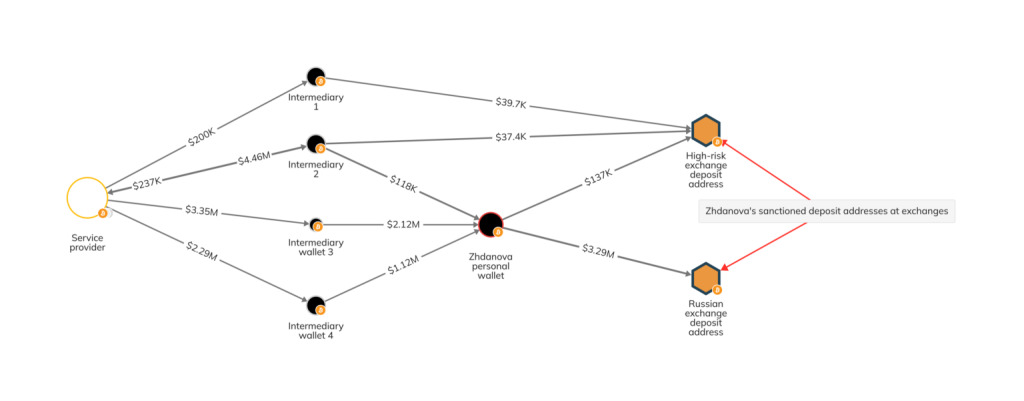 Tracking Zhdanova’s on-chain activity. Image: Chainalysis
And considering its official estimates indicate that merely 0.34% of total on-chain transaction volumes in 2023 were associated with crypto crime, it is essential to contextualize all of this information.
Operation Destabilise demonstrates that digital assets continue to attract money launderers, drug lords, and gangs hiding substantial wealth. We have not yet reached a stage where transacting in Bitcoin is prohibitively challenging for those operating outside the law.
The post How Much Did Operation Destabilise Damage Crypto Criminals? appeared first on Cryptonews.
